A 10 HP continuous-duty centrifugal pump running 12 hours a day will consume approximately ₹10.7 Lakhs in electricity over a five-year lifecycle. I have sat across the table from hundreds of procurement managers across industrial estates in Gujarat and Maharashtra who aggressively negotiate to shave ₹15,000 off the initial SS pump price India, completely blind to the fact that a mere 5% drop in hydraulic efficiency will cost them ₹53,000 in wasted power over that same period.
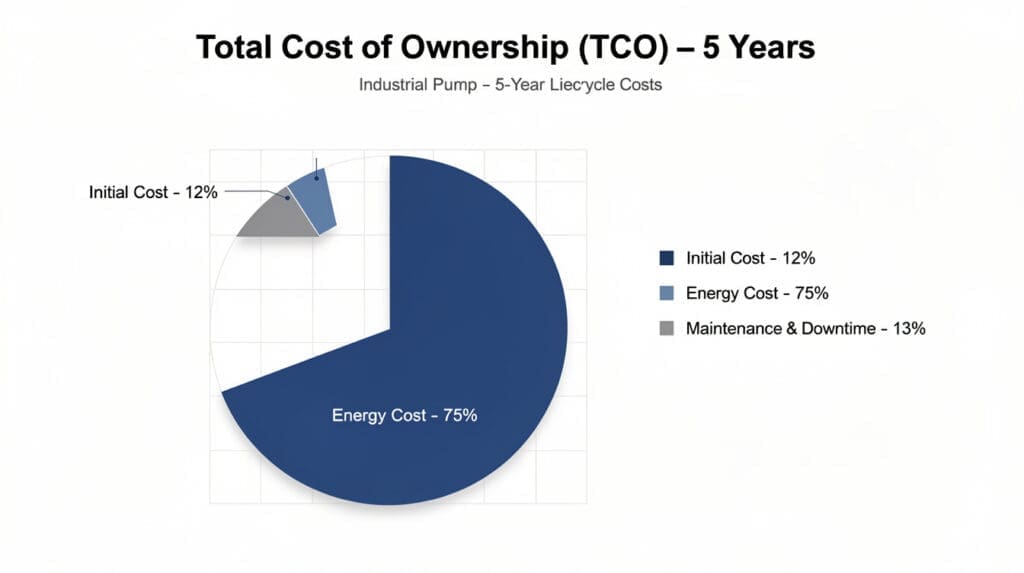
After 22 years of sizing, installing, and troubleshooting fluid handling systems at Chintan Engineers, I can tell you that treating a process pump as a one-time capital expense is the most expensive mistake a plant manager can make. When you evaluate industrial pump TCO (Total Cost of Ownership), the purchase order value represents barely 10% to 15% of the financial reality. The rest is consumed by energy draw, mechanical seal replacements, and production downtime.
Below, I will map out exactly where your money goes over a 60-month operating cycle, relying on strict engineering data, IS 5120 standards for rotodynamic pumps, and our own field performance metrics.
85% of Lifetime Cost€” The percentage of a centrifugal pump's total lifecycle cost dedicated entirely to electricity consumption and routine maintenance, dwarfing the initial purchase price.
The Three Pillars of Industrial Pump TCO
To accurately calculate the stainless steel centrifugal pump cost over its lifespan, we must break the operation into three distinct silos: Capital Expenditure (CAPEX), Operational Expenditure (OPEX – Energy), and Maintenance Expenditure (Downtime & Spares). Because frankly, a pump is just a hunk of metal until you power it up and maintain it.
1. Capital Expenditure (The Tip of the Iceberg)
The initial cost includes the bare pump, the motor, the baseplate, coupling, and the installation labor. A standard Chintan Engineers CE Series SS-304 monoblock pump is built from rolled stainless steel. Why does that matter? Rolled SS offers a pore-free, non-pitting surface compared to cast materials.
I see this mistake weekly: procurement teams compare our pumps with cheaper cast-iron or cast-SS alternatives. However, cast volutes have inherently higher surface roughness. Under ISO 9906 hydraulic performance acceptance testing, that surface friction directly translates to lower pumping efficiency. You might save ₹12,000 on day one, but you are buying a permanent parasitic energy drain on your plant's electrical grid.
2. Operational Expenditure (The Silent Drain)
Let's run the actual math on energy consumption. Our CE Series pumps are rated for capacities up to 120 M³/hr and heads up to 60 meters.
If you operate a 10 HP (7.46 kW) pump on a 380-415V three-phase supply, running 12 hours a day, 300 days a year, for 5 years, the pump runs for 18,000 hours.
- Total Energy = 7.46 kW × 18,000 hours = 134,280 kWh.
- At an industrial tariff of ₹8.00 per kWh, your 5-year OPEX is ₹1,074,240.
If your cheaper pump operates at just 60% efficiency compared to an optimal 65%, the motor must draw proportionately more amperage to hit your required duty point. That 5% variance translates directly into tens of thousands of wasted rupees.
I always advise clients sizing pumps for viscous fluids (like dairy or syrups) to recalculate their pump curves. Our CE series handles up to 1500 centipoise, but failing to account for viscosity derating will push your motor out of its Best Efficiency Point (BEP), skyrocketing your energy TCO.
5-Year Maintenance Cycles: Seals and Shafts
When you sit down to calculate SS pump maintenance cost, mechanical seals and bearings will completely dominate your spreadsheet. In the dusty environments of GIDC industrial estates, coupled with severe monsoon humidity, seal integrity is everything.
Our CE Series pumps operate at speeds up to 2880 RPM. At these velocities, shaft deflection must be practically zero. We utilize a flexible shaft sealing arrangement with gland packing as a standard, but for critical chemical and dairy applications, mechanical seals are non-negotiable.
(I've pulled apart enough failed cast-iron pumps in pharmaceutical setups to tell you that using inferior metals around corrosive fluids doesn't just eat the impeller; it destroys the seal faces through excessive vibration caused by uneven impeller wear).
The Back Pull-Out Advantage
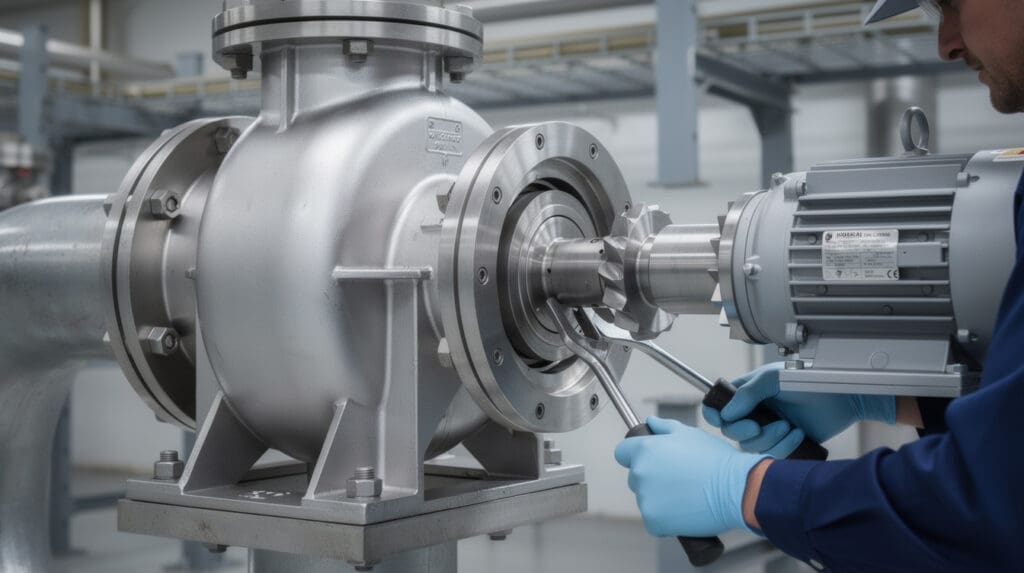
Maintenance labor costs and production downtime are closely linked. We engineer our CE and BPO (Back Pull Out) series specifically to isolate the rotating assembly. When you need to inspect the impeller or change a seal, the back pull-out design allows your maintenance team to withdraw the rotating elements without disturbing the suction and delivery piping.
In a continuous processing plant, cutting pump maintenance time from 4 hours down to 45 minutes saves massive amounts of lost production revenue.
Tired of frequent mechanical seal failures stopping your production?
Our CE Series Stainless Steel pumps feature precision-machined oversized shafts to eliminate deflection and extend seal life.
Real-World Data: 5-Year TCO Comparison Table
Let's put real numbers to this with a 5-year cost comparison between a budget-grade centrifugal pump and a Chintan Engineers CE Series SS-316 pump, both sized for a 10 HP, 60m head application in a chemical processing plant.
| Cost Component (5 Years) | Budget Cast-SS Pump | Chintan CE Series SS Pump |
| :— | :— | :— |
| Initial Purchase Price (CAPEX) | ₹ 55,000 | ₹ 75,000 |
| Energy Cost (OPEX) (₹8/kWh, 18k hrs) | ₹ 1,180,000 (lower efficiency) | ₹ 1,074,000 (optimized BEP) |
| Mechanical Seal Replacements | ₹ 45,000 (4 replacements) | ₹ 22,500 (2 replacements) |
| Bearing Replacements & Labor | ₹ 18,000 | ₹ 8,000 |
| Estimated Downtime Impact | ₹ 80,000 (System offline longer) | ₹ 25,000 (Back pull-out advantage) |
| Total Cost of Ownership (TCO) | ₹ 1,378,000 | ₹ 1,204,500 |
The Reality: The procurement manager who "saved" ₹20,000 on the initial purchase actually cost their company ₹1,73,500 in operational losses over five years.
Industrial Context: Where SS Pumps Are Mandatory
In my tenure, I've integrated thousands of pumps into complex fluid handling systems. You simply cannot decouple the pump from the process.
Dairy and Pharmaceutical (Hygienic Applications)
If you are pumping milk, RO water, or pharmaceutical intermediates, you cannot have microscopic pits where bacteria can breed (which is why FDA inspectors are so strict about surface finishes). The rolled stainless steel construction of our SS-304/SS-316 pumps provides the hygienic surface required by BIS and FDA guidelines. For detailed guidance on sizing these specific systems, I strongly recommend reviewing our engineering guidelines on SS Pumps for Dairy: Sizing & Engineering Guide.
Automated Batching Systems
When we design liquid dispensing loops, the pump must work in tandem with precision flow meters and solenoid valves. If your pump's flow rate degrades due to internal recirculation (caused by excessive wear ring clearances), your batching accuracy suffers. An optimized pump ensures constant line pressure, which is critical for accurate flow measurement. If you are upgrading your automation, see our Liquid Batching System Specs: Engineer's Guide to understand how pump selection impacts dosing accuracy.
A Quick Note on Viscosity: Centrifugal pumps are generally best for fluids under 500 centipoise, but our CE series impellers are engineered to handle viscosities up to 1500 centipoise with appropriate motor upsizing. Beyond this, you must transition to positive displacement pumps.
Installation & Maintenance Guidelines for Minimum TCO
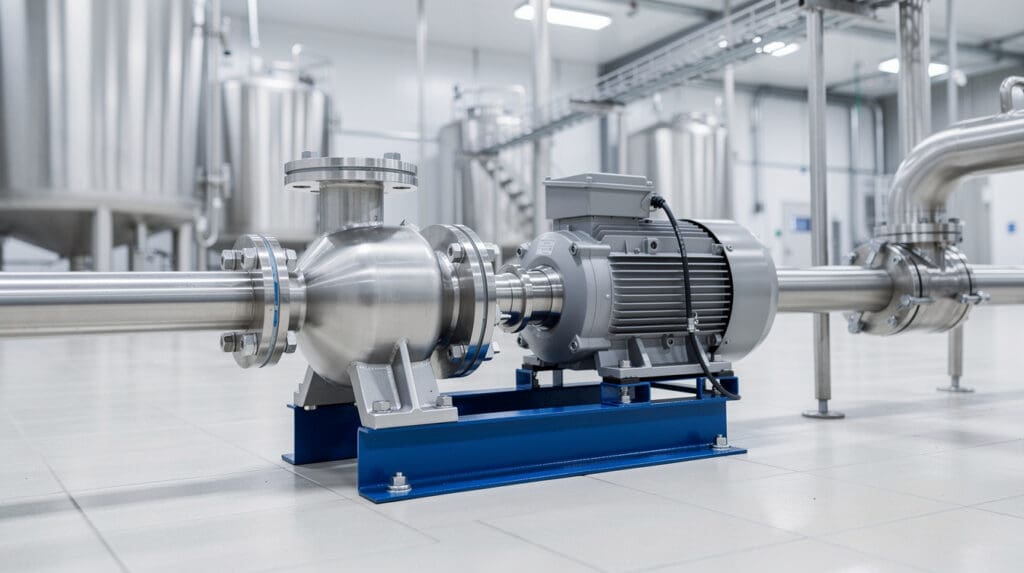
I'll be blunt: to achieve the TCO numbers in the table above, your installation must be flawless. I have seen perfectly engineered pumps destroyed in six months due to poor foundation work.
- Baseplate Rigidity: Mount the pump on a solid concrete foundation that weighs at least three times the mass of the pump and motor combined. This absorbs vibrational energy.
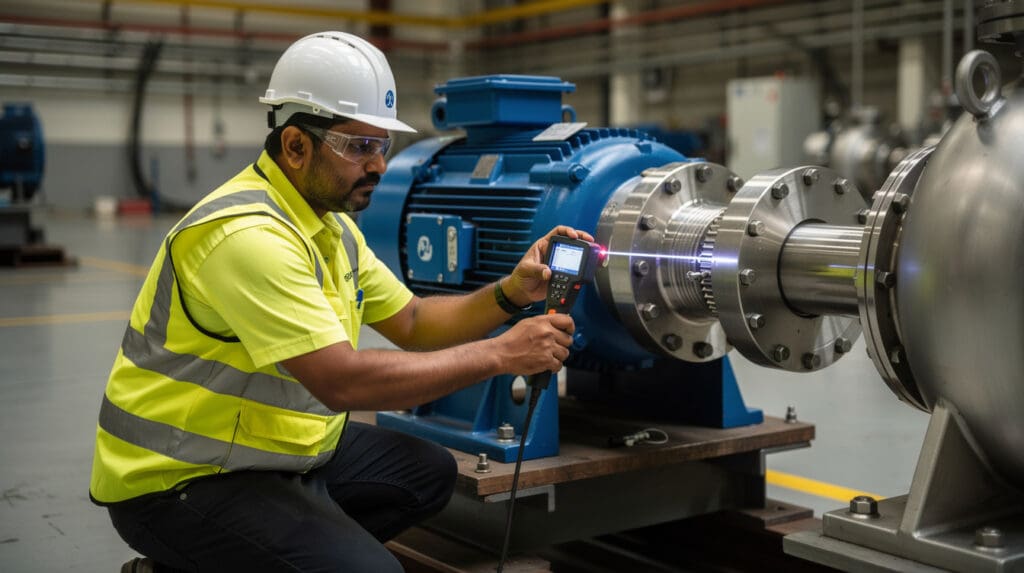
- Laser Alignment: For bare shaft coupled pumps, do not rely on a straight edge. Use laser alignment to ensure the motor and pump shafts are perfectly coaxial. Misalignment is the number one cause of premature mechanical seal failure.
- Suction Piping: Ensure the suction pipe is at least one size larger than the pump's discharge nozzle (e.g., if discharge is 50mm, suction should ideally be 65mm). Keep the suction line as straight and short as possible to prevent cavitation, which will literally pit the stainless steel impeller and destroy hydraulic efficiency.
- Voltage Stability: Indian industrial grids frequently fluctuate. While our motors are rated for 380 V to 415 V three-phase, running a motor continuously at 380V under full load will increase the current draw, elevating winding temperatures and degrading insulation life.
Never throttle the suction valve. If you need to control flow, throttle the discharge valve or use a Variable Frequency Drive (VFD). Throttling the suction drops the Net Positive Suction Head Available (NPSHa), leading immediately to cavitation.
Frequently Asked Questions
What are the main factors in industrial pump TCO?
The main factors are energy consumption (usually 70-85% of total cost), initial purchase price (CAPEX), routine maintenance (mechanical seals, bearings, lubrication), installation costs, and the financial impact of unplanned downtime.
How does rolled stainless steel differ from cast stainless steel in pump efficiency?
Rolled stainless steel (used in our CE Series) has a naturally pore-free, highly smooth surface finish. Cast materials have microscopic roughness. The smooth surface of rolled SS significantly reduces fluid friction inside the volute, leading to higher hydraulic efficiency and lower power consumption over the pump's life.
Why is my SS pump maintenance cost so high for mechanical seals?
Premature mechanical seal failure is rarely a fault of the seal itself. It is usually caused by shaft deflection (due to operating too far from the Best Efficiency Point), severe pipe strain pulling on the pump casing, cavitation, or dry running. Ensuring oversized, rigid shafts and proper alignment drastically reduces this cost.
Can a centrifugal pump handle high viscosity fluids like syrups?
Standard centrifugal pumps lose rapid efficiency as viscosity increases. However, our CE Series is engineered to handle fluids up to 1500 centipoise. Beyond this viscosity threshold, the friction losses become too great, and you must switch to a positive displacement pump (like a gear or lobe pump).
What does "back pull-out" design mean?
A back pull-out design allows the maintenance crew to unbolt the bearing bracket and motor, pulling the entire rotating assembly (impeller, shaft, seal) out from the back of the pump. The volute casing remains bolted to the suction and discharge piping, saving hours of labor and preventing pipeline misalignment.
Stop letting inefficient pumps drain your operational budget.
Whether you need high-efficiency SS pumps for a cooling tower, dairy plant, or chemical transfer, Chintan Engineers provides solutions engineered for lowest lifetime TCO.