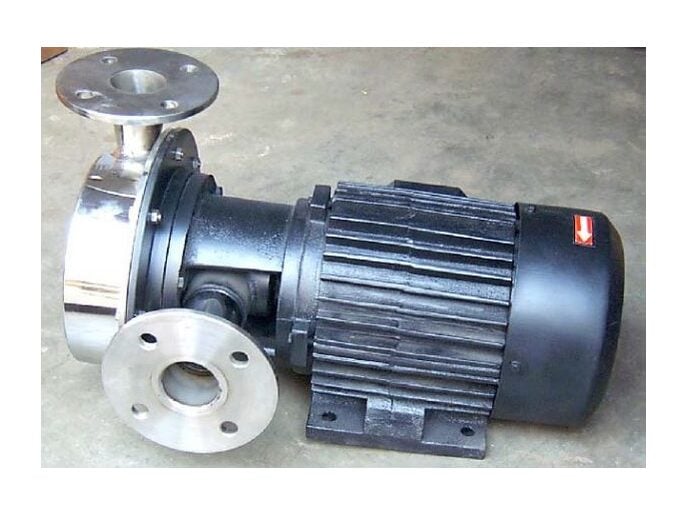
A microscopic 0.1mm pitting flaw in a standard cast-iron or low-grade steel pump volute handling 50,000 liters of raw milk daily can incubate enough bacterial load to spoil an entire batch. That single contamination event costs a dairy processing plant upwards of ₹24 Lakhs in rejected product and emergency Clean-In-Place (CIP) chemical cycling in a single afternoon.
Over the last 22 years at Chintan Engineers, I've designed and calibrated fluid transfer and measurement systems across India—from the heavy crude lines at ONGC to the receiving bays of massive cooperative dairies in Saurashtra. I have seen exactly what happens when procurement teams try to save a few thousand rupees by treating a milk transfer pump like a standard water pump.
Milk is a live, biological fluid. It is highly susceptible to shear forces, temperature fluctuations, and bacterial growth. If your centrifugal pump isn't explicitly engineered with pore-free surfaces and sanitary mechanical seals, you are not transferring milk—you are degrading it.
Instead of generic advice, I'm going to walk you through exactly how to specify a sanitary centrifugal pump for Indian dairy operations, focusing on what actually matters: hygienic design, metallurgy, and CIP mechanics.
₹24 Lakhs€” The average financial impact of a 50,000L batch rejection due to bacterial contamination from improper pump surface finishes and dead-legs.
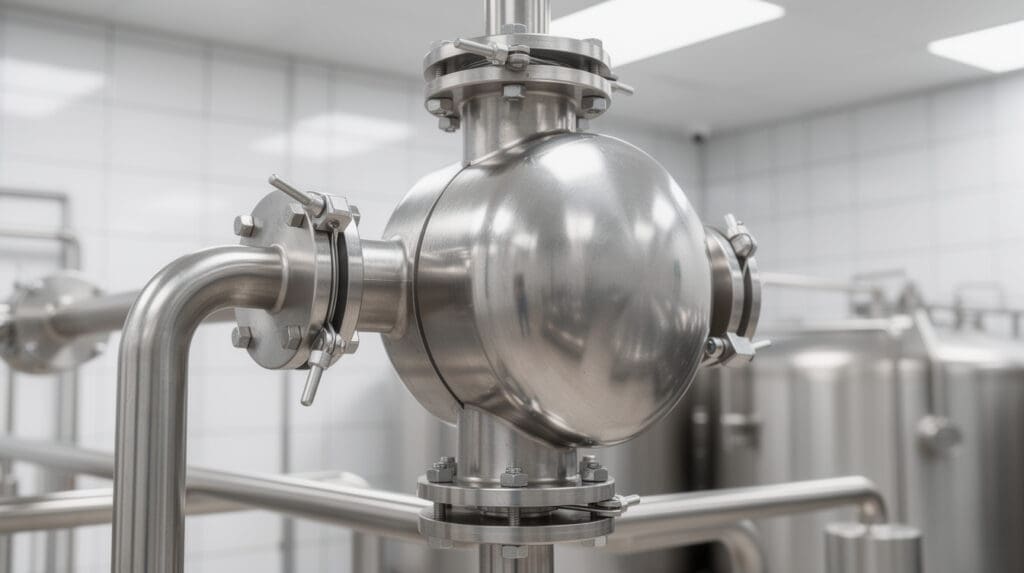
The Physics of Milk Transfer: Shear Stress and Churning
Before looking at metallurgy, we have to respect the fluid itself. Raw milk is an emulsion of butterfat globules suspended in a water-based fluid containing dissolved carbohydrates and protein assemblies. When you pump milk, particularly at high velocities, you introduce mechanical shear.
Excessive shear forces strip the protective membrane from fat globules, causing them to clump together—a process essentially identical to churning butter. If a centrifugal pump impeller is incorrectly sized, or if the pump runs off its Best Efficiency Point (BEP), internal recirculation occurs. This recirculation generates friction, heat, and extreme localized shear.
To prevent this, a proper milk transfer pump must operate with a closed or semi-open dynamically balanced impeller designed for smooth fluid acceleration rather than abrupt pressure spikes. Our SS Pumps (CE Series) are specifically engineered to handle viscosities up to 1500 centipoise. You'd be surprised how many engineers ignore viscosity ratings, but this ensures that even chilled cream transfers smoothly without structural degradation.
Always size your dairy pump to operate within 10% of its Best Efficiency Point (BEP). Running a sanitary centrifugal pump too far to the left of the curve causes internal recirculation, which physically damages milk fat globules and artificially raises fluid temperature.
Rolled vs. Cast Stainless Steel: The Hygiene Imperative
Once the hydraulics are sorted out, the material itself dictates your contamination risk. Many manufacturers market "stainless steel" pumps that are manufactured using standard sand-casting methods. I cannot stress this enough: cast stainless steel has no place in the sanitary product contact zones of a dairy plant.
Castings inevitably contain microscopic pores, inclusions, and surface irregularities. You can machine them until they shine, but you cannot eliminate the structural porosity inherent to the casting process. Under a microscope, a cast surface looks like a sponge. When you pump milk through it, organic proteins and calcium phosphate (milk stone) embed themselves deep within these pores. Standard CIP velocities (typically 1.5 to 2.0 m/s) cannot generate enough boundary-layer turbulence to scour these pores clean.
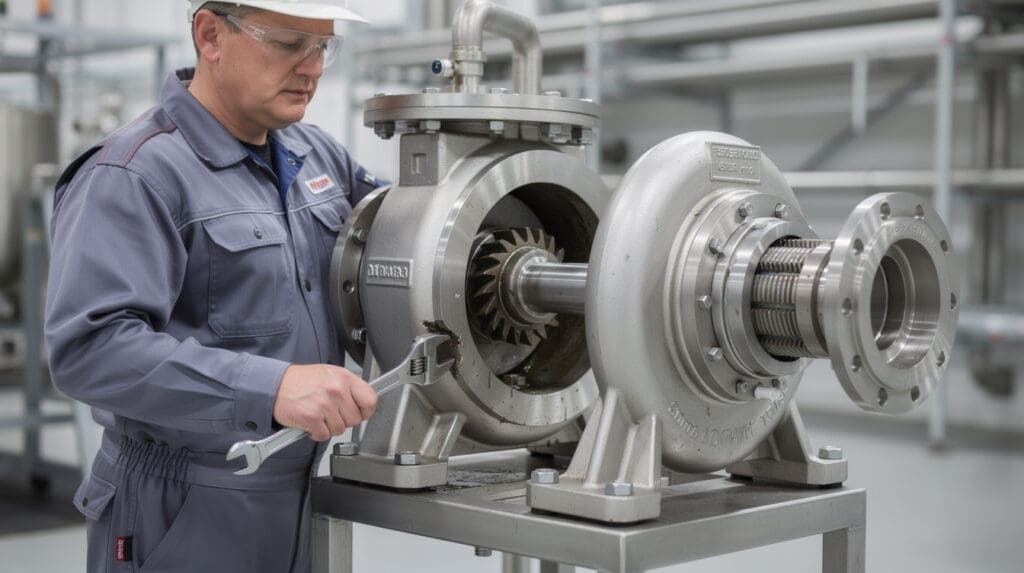
This is why our CE Series pumps utilize rolled stainless steel construction. Rolled SS-304 and SS-316 sheets are cold-worked, resulting in a grain structure that is highly compressed and completely pore-free.
Material Comparison: Cast vs. Rolled SS in Dairy Applications
| Feature | Cast Stainless Steel (Standard Industrial) | Rolled Stainless Steel (Sanitary/CE Series) |
| :— | :— | :— |
| Surface Topography | Porous, prone to micro-pitting | Pore-free, non-pitting surface |
| CIP Effectiveness | Poor; bio-films survive chemical washes | Excellent; full sterile boundary layer sweep |
| Friction Factor | Higher internal friction | Low friction, highly energy efficient |
| Corrosion Resistance | Moderate (chlorides in CIP can cause pit corrosion) | High (uniform passive oxide layer) |
| Bacterial Harboring | High risk after 12+ months of use | Zero risk when CIP protocols are followed |
Experiencing high bacterial counts after routine CIP?
Your current cast pumps might be harboring bio-films. Upgrade to our CE Series rolled stainless steel pumps for a truly sterile, pore-free fluid path.
Shaft Sealing and CIP Mechanics
The shaft seal is the Achilles' heel of any sanitary pump. If I walk into a plant and see standard gland packing on a food-grade line, I immediately know their QA team is constantly fighting fires. Gland packing leaks by design and creates massive dead-legs where bacteria thrive; it is entirely unacceptable for dairy.
For a sanitary centrifugal pump india operations require, you must specify precision mechanical seals. In dairy applications, we utilize single or double mechanical seals with faces constructed from Silicon Carbide (SiC) against Carbon, or SiC against SiC for abrasive applications like liquid sugar or high-concentration whey.
More importantly, the seal housing must be self-venting and self-draining. When the plant enters its CIP cycle—flushing caustic soda (NaOH) at 80°C followed by a nitric acid (HNO3) rinse—the fluid dynamics within the pump casing must guarantee that 100% of the internal surface area, including the back of the impeller and the seal chamber, experiences turbulent flow.
If your CIP return line shows a temperature drop of more than 5°C from the supply, or if velocity drops below 1.5 m/s, your mechanical seals are likely not getting properly sterilized. Dead-legs in pump housings are the #1 cause of sudden coliform spikes in pasteurized milk silos.
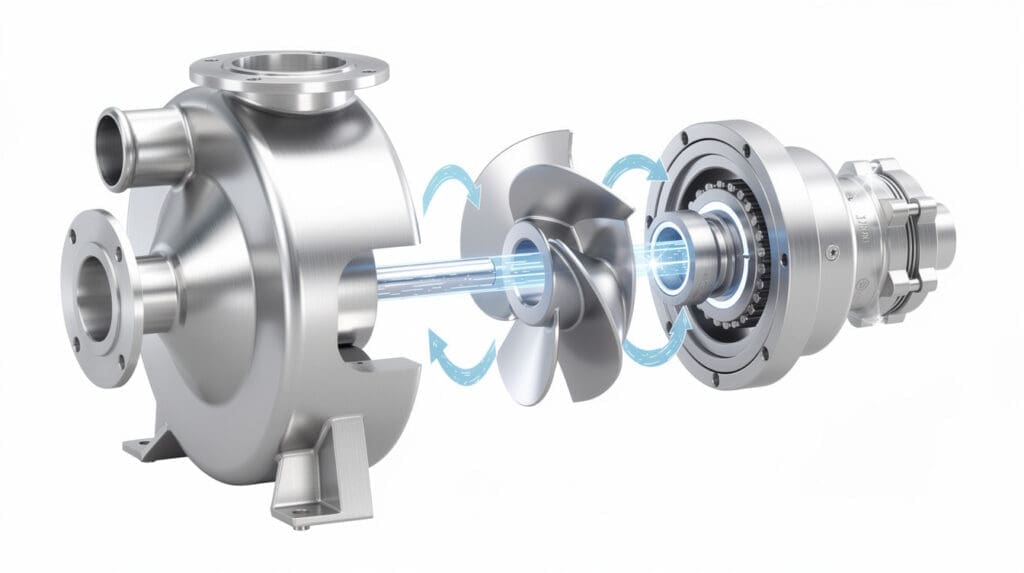
Plant-Wide Utilities: Flow Measurement and Boiler Feed Integration
A pump doesn't operate in a vacuum; it feeds downstream systems that demand stability. If your milk transfer pump suffers from cavitation due to poor Net Positive Suction Head available (NPSHa), the resulting two-phase flow (liquid + air bubbles) will cause significant errors in your downstream Coriolis or magnetic flow meters.
Just as precise diesel measurement requires robust, pulsation-free delivery—a topic I covered extensively in our guide on Legal Metrology Standards for Diesel Flow Meters—milk flow measurement requires a completely flooded, stable hydraulic profile. A perfectly calibrated OIML R117 compliant flow system is effectively blind if the pump feeding it is entraining air.
Furthermore, dairy plants are massive consumers of steam and backup power. The same engineering rigor we apply to milk transfer applies to utility fuels. Many dairies upgrade their boiler feed loops using our CE Backpullout (BPO) Series pumps, and transition their DG sets from unreliable gravity feeds to precision pumped systems. You can read my comparative analysis on this in our Industrial Fuel Dispenser vs Gravity-Feed Setup breakdown.
A 2% volumetric error caused by pump cavitation during milk tanker offloading of 20,000 liters translates to 400 liters of untracked product per truck. At ₹40/liter, that is ₹16,000 lost per offload, simply because a pump was improperly sized for the suction lift.
Operating Data and Sizing Guide for Milk Transfer
Let's talk numbers. When sizing a stainless steel pump for dairy, you cannot rely on "rule of thumb" estimates. I have witnessed countless maintenance engineers replace a failed 5 HP pump with a 7.5 HP pump under the false assumption that "bigger is better." Don't just round up to the next motor size—that's lazy engineering. In fluid dynamics, oversized centrifugal pumps run far off their BEP, leading to shaft deflection, premature bearing failure, and extreme seal wear.
Here are the actual operating capabilities of our SS Monoblock (CE Series) and BPO Series pumps, built to handle the rigors of Indian dairy processing:
Chintan Engineers SS Pump (CE Series) Specifications:
- Capacity: Up to 120 M³/hr
- Head: Up to 60 Meters
- Discharge Size: 25 mm to 100 mm
- Power Rating: 1.0 HP to 20 HP (Three Phase, 380V-415V)
- Operating Speed: Up to 2880 RPM
- M.O.C (Material of Construction): Rolled SS-304, SS-316
- Viscosity Handling: Up to 1500 centipoise (suitable for thick creams and condensed milk)
For utility applications such as cooling tower circulation, RO water systems, or fire fighting within the plant, our CE Backpullout Pump BPO Series offers heavy-duty cast iron construction with a 3mm corrosion allowance, delivering capacities up to 990 m³/hr and handling up to 16 bar working pressures.
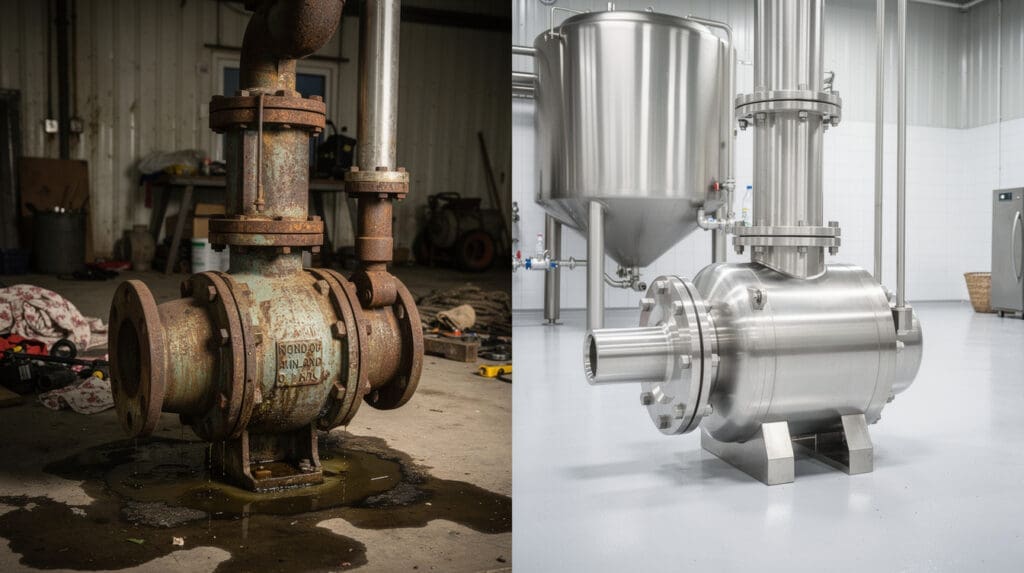
Indian Industrial Context: Power Quality and Ambient Conditions
Operating a dairy plant in India presents unique environmental and electrical challenges. We do not have the luxury of pristine, uninterrupted power grids. In industrial zones like the GIDC estates in Gujarat, voltage fluctuations are a daily reality. A sudden voltage dip increases amperage, which drastically raises motor winding temperatures.
Our SS Monoblock pumps are designed with robust Indian electrical realities in mind:
- Voltage Tolerance: Our three-phase motors (380V to 415V) are wound to withstand the transient voltage drops common during peak summer load shedding.
- Monsoon Humidity: The high humidity during Indian monsoons causes severe exterior condensation on chilled milk pumps. Our CE series features modular construction with highly resistant exterior finishes to prevent surface oxidation.
- Maintenance Accessibility: In a 24/7 milk processing environment, downtime is lethal. Our Backpullout (BPO) design enables maintenance teams to withdraw the rotating assembly for seal replacement without disturbing the suction and delivery piping. This reduces MTTR (Mean Time To Repair) from 4 hours down to under 45 minutes.
Total Cost of Ownership (TCO) Calculation
Let’s address the elephant in the room: the ss dairy pump price. A standard commercial cast-iron pump with rudimentary SS plating might cost ₹35,000. Our precision-engineered, rolled SS-316 CE Series pump will require a higher initial capital outlay. However, procurement managers must look at a 3-year TCO rather than just the initial invoice.
Scenario: 10 HP Milk Transfer Pump running 14 hours/day
| Cost Component | Standard Cast Pump | Chintan CE Series (Rolled SS) |
| :— | :— | :— |
| Initial Purchase Price | ₹35,000 | Premium Outlay |
| Energy Cost (3 Years) | ₹14,50,000 (Low efficiency) | ₹12,10,000 (High hydraulic efficiency) |
| Seal & Bearing Replacements | ₹45,000 (Vibration & shaft deflection) | ₹12,000 (Stable, dynamically balanced) |
| Product Rejection Risk | High (Porosity & Biofilms) | Zero (Pore-free surface) |
| Estimated 3-Year TCO | ₹15,30,000+ | ₹12,22,000 + Initial Cost |
The superior hydraulic efficiency of a properly designed closed impeller alone pays for the pump within the first 14 months of operation through electrical savings.
Stop wasting electricity and risking product integrity with low-grade pumps.
Upgrade your plant with our energy-efficient, hygienic CE Series Stainless Steel Pumps.
Frequently Asked Questions
What makes a stainless steel pump for dairy different from an industrial water pump?
A dairy pump utilizes non-porous rolled stainless steel (SS-304/316) to prevent bacterial growth. It features sanitary mechanical seals rather than gland packing, and its internal geometry is designed to be self-draining and 100% cleanable via CIP (Clean-In-Place) procedures without leaving dead-legs.
Why is my milk transfer pump cavitating during tanker offloading?
Cavitation occurs when the Net Positive Suction Head available (NPSHa) drops below the pump's required NPSH (NPSHr). This often happens in dairy plants if suction lines are too long, filters are clogged, or the raw milk temperature is unusually high. Cavitation physically damages butterfat globules and destroys pump impellers.
What is the typical ss dairy pump price in India?
Prices vary significantly based on capacity, head, and metallurgy. While cheap cast-iron pumps retrofitted for food use are inexpensive upfront, a true sanitary rolled SS-316 monoblock pump is a premium engineered asset. The slightly higher initial price is offset by massive energy savings and the elimination of bacterial contamination risks. Contact our engineering team for precise sizing and pricing.
Can a sanitary centrifugal pump india operations use handle viscous products like condensed milk?
Yes, provided it is properly specified. Standard water pumps fail at high viscosities. Our CE Series Stainless Steel pumps are engineered to handle fluids up to 1500 centipoise, making them highly effective for cream, condensed milk, and liquid sugars.
How often should mechanical seals on a milk transfer pump be replaced?
In a properly aligned pump operating under ideal conditions without dry-running, a high-quality Silicon Carbide seal should last 12 to 18 months. However, if the plant frequently runs the pump dry during CIP chemical changes, thermal shock can crack the seal faces within days.
The Engineering Reality
In my 22 years of calibrating flow systems and specifying pumps, I have learned that fluid dynamics is unforgiving. You cannot cheat the physics of shear stress, and you cannot sanitize a porous metal surface.
For dairy plant operations heads and maintenance engineers, the mandate is clear: specifying the correct pump is not a place for aggressive cost-cutting. The financial risk of spoiled product, CIP inefficiencies, and electrical waste far outweighs the capital savings of a sub-standard pump.
Based on field data across Indian dairies, I strongly recommend upgrading all raw milk, pasteurized milk, and CIP return loops to rolled stainless steel, dynamically balanced centrifugal pumps like our CE Series.
Protect your product integrity, lower your power consumption, and eliminate contamination dead-legs.
Ready to optimize your dairy's fluid transfer?
Provide us with your head, capacity, and fluid viscosity requirements, and our engineers will size the perfect SS pump for your operation.