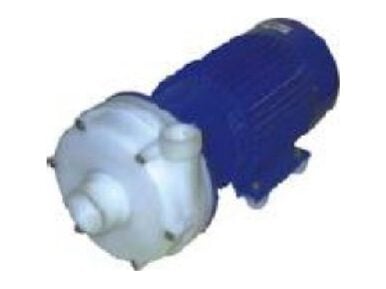
₹6.8 Lakhs€” The hidden 5-year cost of operating a cheap ₹25,000 PP pump on a 30% Hydrochloric Acid line due to mechanical seal failures, motor rewinding, and wasted energy.
I’ve spent 22 years at Chintan Engineers diagnosing fluid transfer systems across India’s harshest industrial belts—from the humid, salt-heavy air of Dahej to the erratic voltage grids of rural Gujarat GIDCs. If there is one conversation I have every single week with procurement managers, it is the fundamental misunderstanding of chemical pump economics.
You are approving a purchase order based on the initial PP pump price. But that capital expenditure represents barely 10% to 15% of the total cash that pump will extract from your operational budget over the next 60 months. A poorly specified, non-standard plastic pump handling corrosive effluents or concentrated acids will bleed your maintenance budget dry before the monsoon season ends.
I'll strip away the marketing claims and show you the brutal mathematics of chemical fluid transfer. We're breaking down the 5-year Total Cost of Ownership (TCO) for a polypropylene centrifugal pump, factoring in the realities of Indian chemical plant operations, and showing you exactly how to stop hemorrhaging money on premature mechanical seal failures and excessive power consumption.
The Procurement Trap: Why "PP Pump Price" is the Wrong Metric
When handling corrosive liquids like H2SO4, NaOH, or effluent slurries, the standard practice is to deploy a polypropylene centrifugal pump. Because PP is a widely available polymer, the market is flooded with cheap, poorly molded variants that lack structural integrity under thermal or mechanical stress.
Look, here is the reality on the plant floor: A pump’s purchase price is a one-time event. Power consumption is a daily operational tax. Maintenance is a recurring penalty for poor initial specification.
If you buy a pump for ₹25,000 instead of a properly engineered DIN 24256 compliant pump for ₹45,000, you saved ₹20,000 on day one. But what happens when that cheaper pump's inefficient volute casing demands a 7.5 kW motor instead of a 5.5 kW motor just to achieve the same head and flow? You will burn an extra ₹85,000 in electricity annually (assuming ₹8/kWh, 12 hours/day, 300 days). Your ₹20,000 upfront "savings" just cost you ₹4.25 Lakhs over 5 years in power alone.
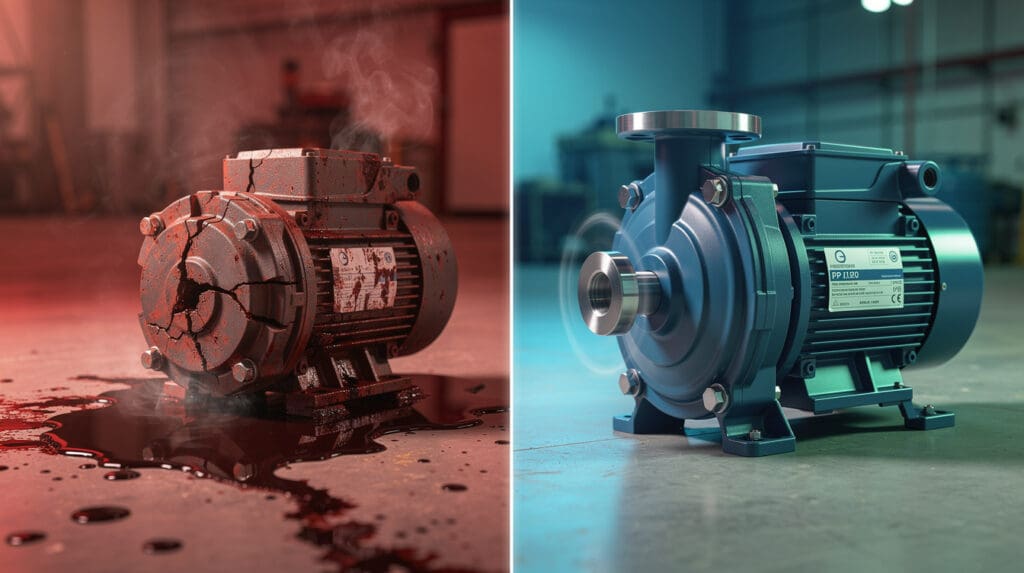
Beware of non-standard casing designs. Cheap PP pumps often lack an external metal ring for expansion stability. When pumping liquids approaching 90°C to 120°C, the polymer expands, warping the casing. This misaligns the shaft, instantly destroying the mechanical seal.
Breaking Down the 5-Year TCO for a Polypropylene Centrifugal Pump
If we want to accurately project your chemical pump maintenance cost, we must analyze four pillars: Acquisition, Energy, Maintenance, and Downtime.
1. Capital Acquisition Cost (10-15% of TCO)
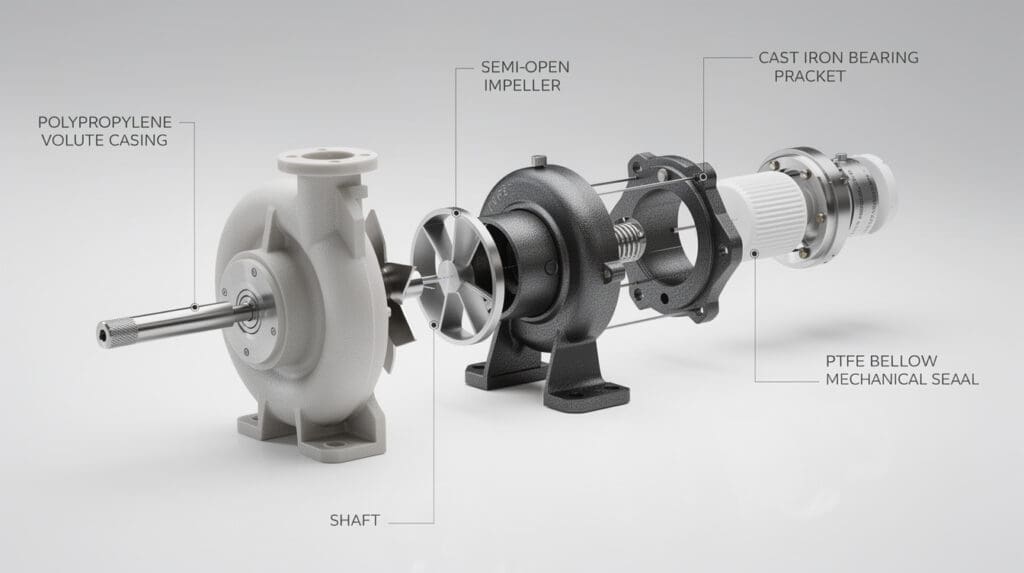
This includes the bare pump, motor, base plate, coupling, and initial installation. Engineered pumps following ISO 5199 / DIN 24256 standards cost more upfront because they feature dynamically and hydraulically balanced impellers with streamlined profile vanes. They also utilize high-grade shaft sleeves (GRP, Ceramic, Alloy-20, or Hastelloy B/C) instead of standard EN9 or SS304.
2. Energy Consumption (40-50% of TCO)
These pumps are typically in continuous service for Water Treatment Plants (WTP) or pickling lines, meaning hydraulic efficiency is paramount. A single-piece, self-venting volute casing reduces internal turbulence. In my field visits, I consistently see plants running oversized pumps and throttling the discharge valve. (I see this same destructive throttling behavior when auditing dosing setups—which is why I strongly advise engineers to read my Liquid Batching System Selection Guide & Specs to properly match pump curves with flow meter requirements).
3. Maintenance & Seal Replacement (20-30% of TCO)
In corrosive duties, mechanical seals are the primary failure point. A standard pump might chew through a basic Teflon bellow seal every 4 months due to shaft deflection or crystallization of the pumped chemical. High-end pumps use heavy-duty Cast Iron (GRFG-26) bearing brackets with double ball bearings to eliminate shaft play. I've seen plants extend seal life to 18-24 months and cut maintenance man-hours by 70% just by upgrading the bracket.
4. Unplanned Downtime (10-20% of TCO)
When a pump fails on a steel rolling mill's continuous pickling line, the cost isn't just the spare parts—it's the halted production. In batching processes, a failed pump means aborted batches. Try explaining a ₹5 Lakh batch loss to management because procurement saved ₹20,000 on a generic pump.
Losing money to constant seal replacements?
Stop replacing cheap pumps. Upgrade to our heavy-duty, DIN 24256 standard PP pumps designed for harsh Indian chemical environments.
Real-World TCO Calculation: 30% Hydrochloric Acid Transfer
Let’s look at the actual math from a recent audit I conducted in Vapi. Here is a 5-year TCO comparison for transferring 30% HCl at 20 m³/hr with a 30m head, running 12 hours a day, 300 days a year.
| Cost Component | Generic Local PP Pump | Engineered Chintan PP Pump (DIN 24256) |
| :— | :— | :— |
| Initial Purchase Price | ₹28,000 | ₹52,000 |
| Motor Required (Efficiency) | 7.5 kW (Lower hydraulic eff.) | 5.5 kW (Optimized profile vanes) |
| 5-Year Power Cost (at ₹8/kWh) | ₹10,80,000 | ₹7,92,000 |
| Seal Replacements (5 Yrs) | 12 replacements (₹60,000) | 3 replacements (₹24,000) |
| Shaft/Sleeve Wear Replacements | 4 replacements (₹20,000) | 1 replacement (₹8,000) |
| Estimated Labor & Downtime | ₹1,20,000 | ₹25,000 |
| Total 5-Year Cost | ₹13,08,000 | ₹9,01,000 |
The Verdict: The "expensive" engineered pump saves your operation over ₹4 Lakhs per unit over 5 years. If your ETP plant runs 5 of these pumps, that is ₹20 Lakhs added directly to your company's bottom line.
Maximizing PP Pump Lifespan in Indian Conditions
When discussing PP pump lifespan in India, we have to address environmental realities. European operational manuals assume climate-controlled plants. We operate in industrial estates where ambient temperatures hit 48°C in May, and monsoon humidity corrodes standard metal brackets in weeks.
Here are my non-negotiable specifications for extending lifespan in these environments:
1. External Metal Ring Stabilization: Polypropylene has a high coefficient of thermal expansion. If you are pumping liquids above 70°C, the casing will deform without an external structural ring. Deformation leads to impeller rubbing, which destroys the pump in days. I outright refuse to commission a high-temp line without these external metal rings.
2. Bearing Bracket Material: The bearing bracket must be Cast Iron GRFG-26. I have seen vendors use lighter materials to cut costs. The moment an unbalanced load hits the impeller, a weak bracket allows micro-vibrations. These vibrations are amplified down the shaft, shattering the ceramic mechanical seal faces.
3. Correct Shaft Sleeve Metallurgy: Polypropylene pumps use a metal shaft (usually EN9 or SS) that must be protected from the pumped fluid. The sleeve material is critical.
- For highly abrasive slurries: Ceramic.
- For Sulfuric Acid (H2SO4): Alloy-20.
- For severe pitting acids (HCl, HF): Hastelloy B/C or PVDF.
Using a standard SS316 sleeve for Hydrochloric acid is an amateur mistake that guarantees a catastrophic leak within weeks.
Always verify specific gravity. Chemical engineers often size a pump for water (Specific Gravity = 1.0). If you pump 98% Sulfuric Acid (S.G. = 1.84), your motor will trip on overload immediately. Always multiply your required water horsepower by the specific gravity of the chemical to properly size your motor.
Eliminating TCO Entirely: The PP Magnetic Pump Alternative
Want to completely eliminate seal-related maintenance costs? Remove the mechanical seal entirely.
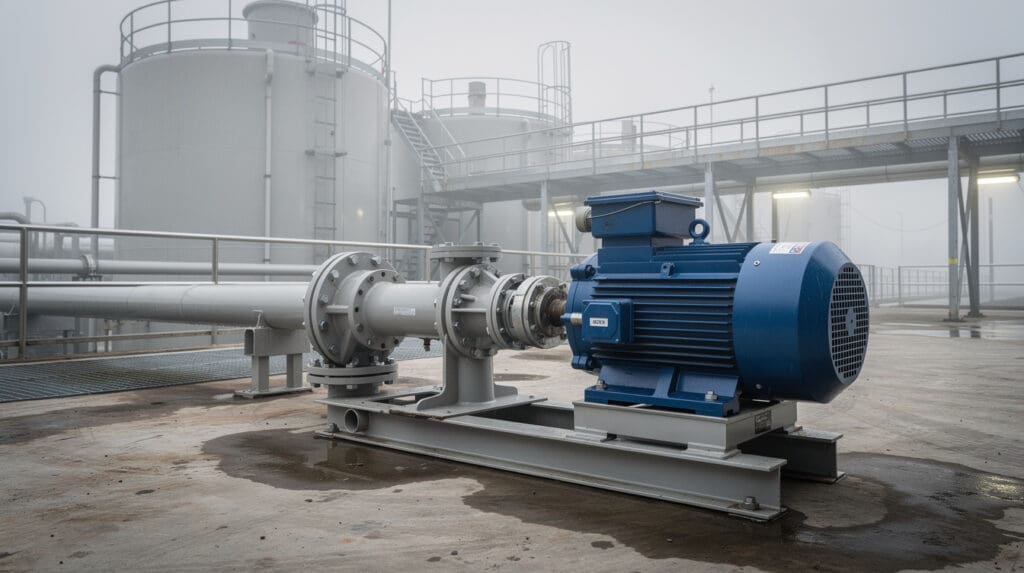
For extremely hazardous liquids—where a leak could mean severe regulatory fines or operator injury—I recommend stepping up to a PP Magnetic Pump. In this design, the motor drives an outer magnet, which magnetically turns an inner magnet connected to the impeller inside a hermetically sealed polymer casing.
No mechanical seal means zero leakage, no seal replacement costs, and no barrier fluid monitoring. While the initial capital cost is higher, the 5-year TCO drops significantly on maintenance-heavy applications like electroplating chemical circulation.
Pumping highly hazardous or expensive chemicals?
Eliminate mechanical seal leaks completely. Explore our PP Magnetic Pumps for zero-leakage, zero-maintenance fluid transfer.
Applications Where Engineered PP Pumps Are Mandatory
Based on decades of installations, these are the critical applications where cutting corners on pump quality will severely punish your operational budget:
- Scrubber Systems (Cl2, SO2, NH3): Scrubbers operate continuously. A pump failure here leads to immediate atmospheric venting of toxic gases. High-capacity transfer pumps with dynamically balanced impellers are mandatory.
- Pickling Lines in Steel Plants: Handling boiling acids with high suspended solids requires a semi-open impeller design to prevent clogging.
- Filter Press Feeding: Dosing dyes and chemicals requires handling high-pressure backpressure as the press fills. A standard PP pump's casing will split under these pressures. (If you are controlling volumetric flow into these presses, you must understand your instrumentation. Read my guide on Decoding Oil Flow Meter Specs to grasp how pressure drops affect both pumps and meters).
- Electroplating & Metal Finishing: Perfect circulation is required to maintain bath chemistry. Even minor seal leaks contaminate the external environment and degrade the plating quality.
Installation & Maintenance Rules from the Field
I’ve commissioned thousands of fluid systems across Gujarat and Maharashtra. I'll let you in on a secret: 90% of "pump failures" are actually installation errors. Follow these rules:
- Suction Piping: The suction pipe should always be at least one size larger than the pump’s suction flange. Never install an elbow directly at the suction flange; allow at least 5 to 10 pipe diameters of straight run. Turbulence at the suction eye causes cavitation, which will pit a PP impeller in a matter of weeks.
- Baseplate Grouting: Do not just bolt the baseplate to a concrete floor. It must be properly leveled and grouted with non-shrink epoxy grout to absorb operational vibrations.
- Dry Running: A standard mechanical seal relies on the pumped liquid for lubrication and cooling. Running a PP pump dry for even 30 seconds will melt the PTFE bellows and shatter the seal faces. Always install dry-run protection relays on the motor control panel.
The IS 5120 Context: While European DIN 24256 dictates casing dimensions and performance curves, Indian Standard IS 5120 dictates the technical requirements for rotodynamic special purpose pumps. Ensuring your pump aligns with these tolerances ensures reliable performance under fluctuating Indian power grid conditions.
Frequently Asked Questions
What is the typical lifespan of a PP pump in chemical applications?
A standard, poorly specified PP pump often lasts 1-2 years before catastrophic casing failure. An engineered PP pump (DIN 24256) with a heavy-duty bracket and correct shaft sleeve, when properly maintained, will reliably operate for 8-12 years.
Why does my PP pump mechanical seal keep failing?
Seal failure is usually a symptom, not the root cause. It is typically caused by shaft deflection (due to weak bearings or cavitation), thermal expansion warping the casing, or using a seal material incompatible with the pumped chemical's corrosiveness or suspended solids.
Can a polypropylene centrifugal pump handle slurries?
Yes, but it must be equipped with a semi-open impeller to prevent clogging, and the mechanical seal must be externally mounted or utilize Silicon Carbide/Tungsten Carbide faces to withstand the abrasive nature of the slurry.
Is it better to buy a bare pump or a monoblock version?
Monoblock pumps have a smaller footprint and are easier to install for light duties. However, for industrial chemical transfer, bare shaft pumps coupled to standard IEC motors on a baseplate are far superior. They isolate motor heat from the pump casing and allow for easy motor replacement without disturbing the pump's hydraulic end.
Can I use a PP pump for solvents?
Generally, no. Polypropylene has excellent resistance to acids and alkalis (HCl, H2SO4, NaOH), but it is susceptible to swelling and degradation when exposed to aromatic hydrocarbons, chlorinated solvents, or highly concentrated nitric acid. For volatile solvents, metallic pumps (SS316 or specialized alloys) are required.
Vikram’s Final Recommendation
The math is irrefutable. Chasing the lowest "PP pump price" is a false economy that will cost your plant lakhs of rupees in wasted energy and maintenance downtime.
Based on my 22 years of field experience in Indian industrial environments, here is my recommendation for your chemical plant:
Do not buy any polymer pump that does not conform to DIN 24256 / ISO 5199 standards. Ensure the pump features a heavy-duty Cast Iron GRFG-26 bearing bracket with double ball bearings. If you are handling severe pitting acids like Hydrochloric Acid or highly abrasive effluent, insist on Hastelloy B/C or Ceramic shaft sleeves with externally mounted PTFE bellow mechanical seals.
If you want a fluid transfer system that operates silently for years rather than requiring a maintenance crew every quarter, spec it right the first time.
Ready to specify a pump that actually lasts?
Our team at Chintan Engineers custom-builds Polypropylene Pumps to exact chemical, temperature, and specific gravity requirements. Stop gambling with your plant's reliability.