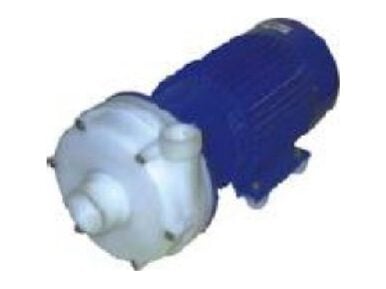
₹6.4 Lakhs€” The average true cost of a single catastrophic acid pump failure in a continuous process plant, factoring downtime, hazmat cleanup, and hardware replacement.
A catastrophic mechanical seal failure on a 30m³/hr Hydrochloric acid transfer line doesn't just cost you the base price of a replacement unit. Factor in four hours of plant downtime at typical Indian chemical manufacturing rates, environmental compliance reporting, and compromised batch integrity, and that "cheap" non-standard polymer pump just blew a massive hole in your quarterly maintenance budget.
I'm Vikram Desai. Over the last 22 years at Chintan Engineers in Ahmedabad, I've designed, specified, and troubleshot thousands of fluid handling systems—from ONGC refineries to independent effluent treatment plants (ETPs) across the GIDC estates of Gujarat. I've seen enough warped volute casings and shattered impellers to know exactly what happens when procurement prioritizes a low initial quote over rigorous engineering standards.
(I've replaced enough melted polypropylene impellers to know that pushing a standard polymer pump past 90°C without a reinforced external metal ring is just asking for a mid-shift blowout—and I'll explain why in this breakdown.)
If you're a plant engineer tasked with handling highly corrosive fluids—HCL, Sulphuric Acid, Caustic Liquids, or scrubbing gases like NH3 and SO2—you can't afford guesswork. In this breakdown, I'll walk you through the reality of DIN 24256 and ISO 5199 compliance, and how to match metallurgy and seal configurations to your precise fluid dynamics.
The Engineering Reality of ISO 5199 and DIN 24256 Standards
You'll frequently see DIN 24256 and ISO 5199 on pump datasheets. To be blunt, these aren't just suggestions to pad out a brochure—they are the architectural blueprints for your plant's reliability.
DIN 24256 (historically tied to EN 22858 / ISO 2858) strictly dictates the dimensional interchangeability of centrifugal pumps. It guarantees that a pump with a 50mm discharge, 80mm suction, and a 200mm nominal impeller diameter will fit exactly into the existing piping footprint of your plant, regardless of the manufacturer. This allows for drop-in replacements without requiring your pipefitters to cut and weld new flanges.
But fitting perfectly doesn't mean it will last. That is where ISO 5199 comes in.
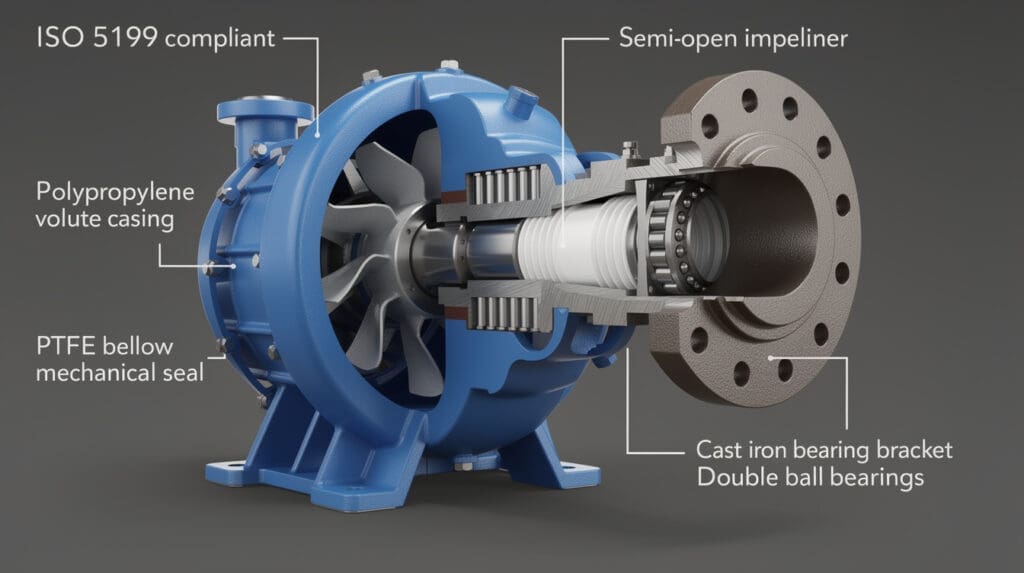
ISO 5199 is the technical specification for heavy-duty centrifugal pumps. For a chemical pump built for Indian conditions, adhering to ISO 5199 requires specific design mandates:
- Heavy-Duty Shaft Deflection Limits: The shaft (typically SS or EN9 under a protective sleeve) must be rigid enough to limit deflection at the mechanical seal faces to less than 0.05 mm under maximum load. This is critical for preventing premature mechanical seal failure.
- Bearing Life Minimums: The bearing bracket must support double ball bearings designed for a minimum L10 life of 17,500 hours.
- Vibration Limits: Dynamic balancing of the rotating assembly to limit vibrations, reducing wear on the motor and coupling.
For a solid polypropylene pump, achieving ISO 5199 compliance is significantly harder than for a Cast Iron or Stainless Steel pump because polymers lack the inherent tensile strength of metal. (Let's be honest, getting a polymer to behave like metal takes serious engineering.) To bridge this gap, our PP Pumps utilize a heavily ribbed, one-piece self-venting volute casing. More importantly, the pump casing is furnished with an external metal ring to provide expansion stability. Polypropylene expands at roughly 5 to 6 times the rate of steel under heat; without this metal ring, piping stress combined with fluid temperature would crack the volute.
Always verify that your piping system is independently supported. A PP pump casing is not a pipe anchor. I have seen countless chemical pumps fail because pipefitters bolted a misaligned 4-inch discharge line directly to the pump flange, allowing piping strain to distort the polymer casing.
Semi-Open Impeller Hydraulics: Why Closed Impellers Fail in ETPs
Fluid dynamics in Indian chemical plants rarely involve perfectly clean liquids. Whether you are pumping from a steel pickling line, circulating scrubber fluids, or feeding a filter press for dyes, you are dealing with suspended solids, crystalline precipitates, and fluctuating viscosities.
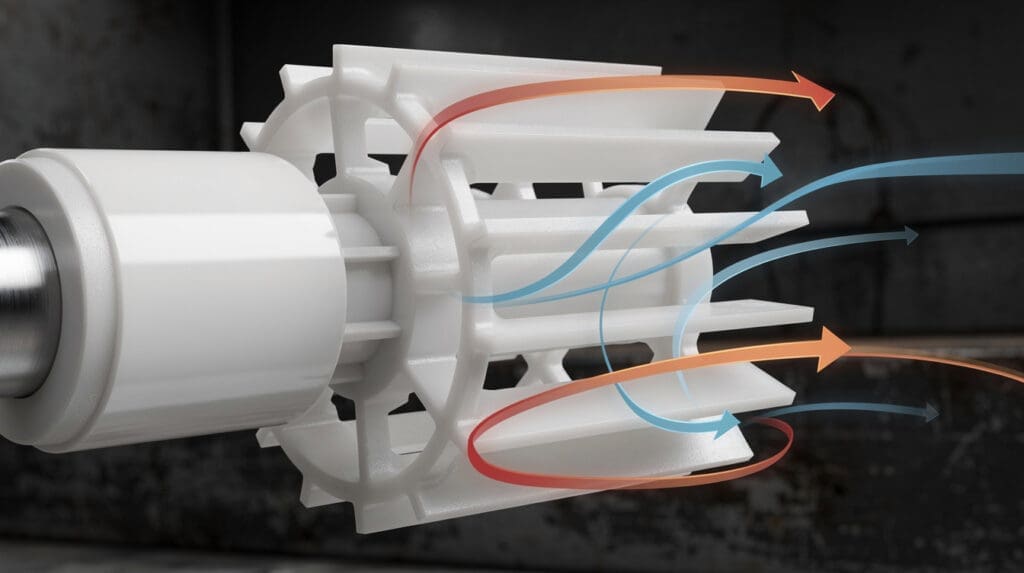
That's exactly why we standardise our PP pumps on a single-suction, semi-open impeller featuring dynamically balanced, streamlined profile vanes.
Closed impellers—which have a front and back shroud—are highly efficient for clean water. But introduce them to an Effluent Treatment Plant (ETP) handling a mix of alkali waste and suspended particulates, and they'll bridge and clog before your weekend shift is over. A semi-open impeller leaves the front of the vanes exposed, utilizing the pump casing as the stationary front shroud.
This design provides three critical advantages:
- Solids Handling: It readily passes suspended solids and sludges without catastrophic jamming.
- Hydraulic Balancing: Our impellers are dynamically and hydraulically balanced. Back pump-out vanes reduce axial thrust on the double ball bearings and lower the pressure in the seal chamber, extending mechanical seal life.
- Clearance Adjustability: As the impeller vanes wear from abrasive slurries, the axial clearance between the impeller and the casing can be adjusted at the bearing bracket to restore pumping efficiency, extending the lifecycle of the wet end components.
Material Selection Matrix: Beyond Basic Polypropylene
The wetted parts of a chemical pump—the casing, impeller, and back plate—dictate its chemical compatibility and temperature limits. Standard PP is great for general corrosives, but for specialized industrial applications, you often need to upgrade the polymer matrix.
Here is how I typically spec materials based on fluid requirements:
- Standard PP (Polypropylene): Excellent for HCL, Alkali, and Caustic Liquids. Rated for temperatures up to 80°C.
- GRP (Glass Reinforced Polymer): Enhances tensile strength and pushes the temperature threshold slightly higher while maintaining excellent chemical inertness.
- PVDF (Polyvinylidene Fluoride): The absolute gold standard for highly aggressive chemicals like Bromine (Br2), Fluorine (F2), and high-concentration Sulphuric acid. PVDF allows the pump to operate in temperatures up to 120°C without structural deformation.
- UHMWPE (Ultra-High-Molecular-Weight Polyethylene): Deployed when the fluid is both highly corrosive and highly abrasive (e.g., lime slurries in ETPs or carbon slurries). Its abrasion resistance outperforms even hardened steel.
The Critical Link: Shaft Sleeves
The drive shaft itself is typically high-tensile SS or EN9 steel to handle the torque. However, the steel must never touch the process fluid. It is protected by a shaft sleeve that passes through the seal chamber. I see more failures originating from the wrong shaft sleeve than almost any other component.
- Ceramic: Extremely hard, highly chemical resistant, but brittle. Great for general acids, terrible if the system suffers from dry-running or severe thermal shock.
- Alloy-20: Excellent for sulphuric acid applications where polymers might fail.
- Hastelloy B/C: The ultimate choice for boiling hydrochloric acid or reducing chemical environments.
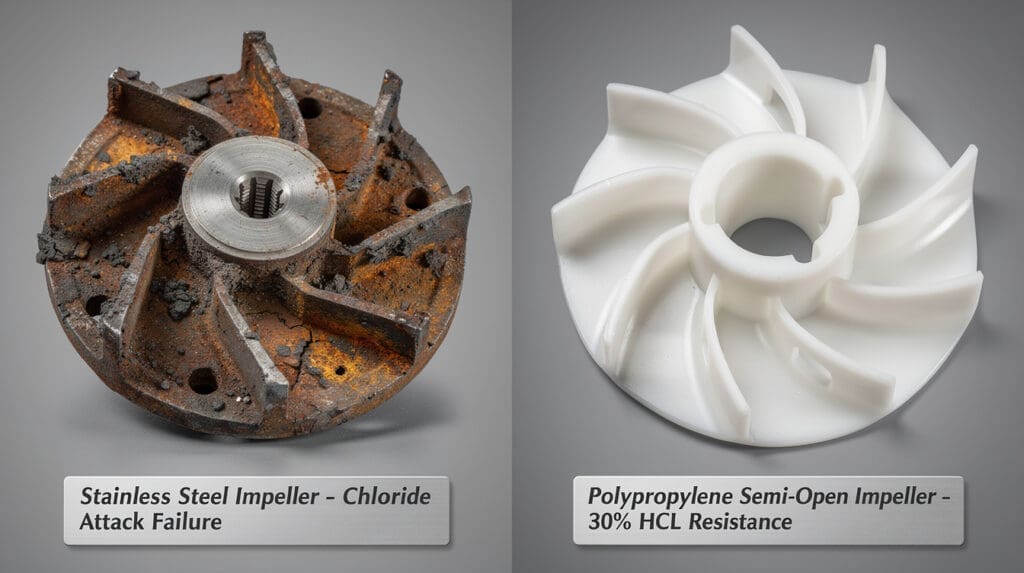
Never specify a ceramic shaft sleeve for an application prone to sudden temperature spikes or dry running. The rapid thermal expansion differential will shatter the ceramic, instantly exposing your EN9 steel shaft to 30% HCL, destroying the shaft in less than 48 hours.
Handling highly corrosive acids or volatile scrubber gases?
Do not risk your process line on generic polymers. Our PP Pumps are engineered with tailored shaft sleeves (Alloy-20, Hastelloy) and external metal reinforcement rings to handle up to 120°C.
Similar to the debate around Fuel Flow Meter vs Weighbridge for Bulk Diesel, process engineers often argue about metallic pumps with corrosion allowances versus solid polymer units for bulk acid transfer.
Here is a realistic Total Cost of Ownership (TCO) comparison I recently ran for a client transferring 30% Hydrochloric Acid at 40°C over a 5-year cycle.
| Evaluation Metric | C.I. Pump with Internal Coating | Stainless Steel 316 Pump | Solid PP Chemical Pump (ISO 5199) |
| :— | :— | :— | :— |
| Initial Capital Cost | Lowest | Very High | Moderate |
| Chemical Resistance to HCL | Poor (relies entirely on coating integrity) | Poor (pitting corrosion occurs rapidly) | Excellent (chemically inert to HCL) |
| Risk of Catastrophic Failure | High (if coating chips, acid eats the C.I. in days) | Moderate (chlorides attack the steel) | Very Low (solid polymer throughout) |
| Maintenance Frequency | High | High | Low |
| 5-Year Estimated TCO | ₹4,50,000 (Requires multiple replacements) | ₹6,00,000+ (High initial cost + repairs) | ₹2,10,000 (Predictable seal/bearing maintenance) |
For severely corrosive but non-abrasive fluids like HCL or Caustic, solid Polypropylene outperforms exotic metals at a fraction of the cost. You aren't paying for a "corrosion allowance" (like the 3mm allowance we design into our Cast Iron BPO Series for milder applications); you are utilizing a material that fundamentally does not react with the fluid.
Sealing Configurations for Corrosive Services
If the pump is the muscle, the mechanical seal is the Achilles heel. Because these pumps handle toxic or corrosive liquids (often used in demanding setups like Agrochemical Batching Systems), zero-leakage operation is mandatory under the Legal Metrology Act and environmental regulations.
Depending on the process fluid, I usually narrow it down to four configurations:
- Externally Mounted Mechanical Seal: The preferred choice for severe corrosives. The metallic spring components of the seal are located outside the pump casing, meaning they never contact the process fluid. Only the static PTFE bellow and the rotating/stationary faces (usually Silicon Carbide or Carbon/Ceramic) touch the acid.
- PTFE Bellow Mechanical Seal: An internally mounted seal where the spring is encased in a thick PTFE bellow, protecting it from chemical attack. Excellent for high-pressure applications where external seals might pop open.
- Inside Mechanical Seal: Used for non-corrosive, clean chemical applications where cooling and lubrication from the pumped fluid are sufficient.
- Gland Packing: An older technology, but occasionally requested for highly viscous or sludgy applications where a mechanical seal would face premature abrasion failure. (We generally recommend transitioning away from gland packing for hazardous chemicals due to the inherent drip-rate required for lubrication).
For perfectly zero-leakage, seal-less applications (handling extremely hazardous or volatile liquids where even vapor emissions are unacceptable), we specify our PP Magnetic Pumps. These utilize a magnetic drive to spin the impeller, completely eliminating the mechanical seal and the physical shaft penetration through the pump casing.
Indian Industrial Realities: Installation and Commissioning Directives
Operating chemical pumps in European laboratories is one thing; operating them in an open-air electroplating plant in Vapi during the monsoon is entirely different.
If you're installing these in an Indian industrial context, keep these realities in mind:
1. Voltage Fluctuations:
Our pumps are designed to operate at standard 2900 RPM or 1450 RPM at 50 Hz. However, grid voltage in rural GIDC estates can fluctuate violently. A drop in voltage increases motor amperage, causing the motor shaft to heat up. This thermal energy transfers down the shaft into the polymer impeller. If the pump is near its 120°C thermal limit (using PVDF) or 80°C limit (using PP), motor heat can soften the polymer. Always install highly sensitive thermal overload relays and ensure the motor cooling fan is free of industrial dust.
2. Baseplate Grouting Is Non-Negotiable:
Polymer pumps are lightweight. If you mount a PP pump on an un-grouted, flimsy fabricated base channel, the 2900 RPM operational frequency will induce resonant vibrations. This vibration will destroy the C.I. GRFG-26 bearing bracket within months. Always use a heavily ribbed, cast iron or heavy-gauge steel baseplate, and grout it solidly into a concrete foundation using epoxy grout.
3. Suction Conditions and NPSHr:
Chemicals like Sulphuric Acid have a higher specific gravity than water. If your pump is drawing from a subterranean ETP tank, calculate your Net Positive Suction Head available (NPSHa) meticulously. Cavitation in a polymer pump doesn't just pit the impeller like it does in steel; the localized implosion of vapor bubbles generates extreme heat, rapidly melting the plastic vanes.
Struggling with pump cavitation or rapid seal failures in your process line?
Let us engineer a fluid handling solution designed specifically for your specific gravity, viscosity, and temperature requirements.
Frequently Asked Questions
What is the maximum temperature limit for a standard PP chemical pump?
A standard Polypropylene (PP) pump is safe up to 80°C. For temperatures between 80°C and 120°C, the material of construction must be upgraded to PVDF (Polyvinylidene Fluoride) or GRP, and the casing must feature an external metal ring for thermal expansion stability.
Why use a semi-open impeller instead of a closed impeller for chemical process pumps?
Chemical processes, especially in electroplating, pickling, and effluent treatment, often involve suspended solids, crystalline formations, or slurries. A closed impeller will rapidly clog under these conditions. A dynamically balanced semi-open impeller easily passes solids and allows for clearance adjustments as the vanes wear over time.
How does DIN 24256 differ from standard water pump dimensions?
DIN 24256 provides specific dimensional standards (flange-to-flange length, centerline height, suction/discharge diameters) primarily for chemical process pumps. This ensures that any DIN-compliant pump can be installed in the same piping footprint without requiring expensive modifications to plant infrastructure.
Can a PP pump handle high-concentration Sulphuric Acid?
Yes, but material selection is critical. While standard PP can handle diluted acids, high concentrations of Sulphuric Acid (especially at elevated temperatures) require PVDF wetted parts, an externally mounted PTFE bellow mechanical seal, and typically an Alloy-20 shaft sleeve to prevent chemical degradation.
What is the advantage of the external metal ring on a PP pump casing?
Polymers have a high coefficient of thermal expansion. When pumping hot chemicals, the pump casing expands. If subjected to piping stress, a pure polymer casing can warp or crack. The external metal ring acts as a rigid exoskeleton, maintaining the structural integrity of the one-piece volute casing under thermal load.
Should I choose a 2900 RPM or 1450 RPM motor for my PP pump?
This depends entirely on your required head and fluid viscosity. 2900 RPM generates higher head and flow in a smaller footprint, ideal for low-viscosity transfer like water or light solvents. For viscous chemicals, abrasive slurries, or continuous 24/7 duty cycles, 1450 RPM is vastly superior as it dramatically reduces wear on the impeller, bearings, and mechanical seal.
Final Engineering Recommendation
Based on two decades of tracking pump installations across Gujarat and beyond, here is my bottom line:
Stop using cast iron pumps with internal polymer linings for highly corrosive continuous processes. The moment a suspended solid scratches that lining, the acid will eat the casing from the inside out within hours.
Instead, specify a Solid Polypropylene Centrifugal Pump engineered to ISO 5199 robustness. Ensure it utilizes a C.I. GRFG-26 bearing bracket, an external metal reinforcement ring on the casing, and a shaft sleeve precisely matched to your fluid's metallurgy (Alloy-20, Hastelloy, or Ceramic).
For toxic applications, opt for the externally mounted PTFE bellow mechanical seal, and for completely hazardous or volatile scrubbing liquids, move directly to our seal-less PP Magnetic Pump configuration.
When properly specified, correctly grouted, and meticulously aligned, a solid polymer pump will give you years of zero-leakage transfer.
Ready to upgrade your chemical fluid transfer reliability?
View our complete range of highly functional, corrosion-resistant PP Pumps with impeller diameter options tailored exactly to your process execution requirements.