
















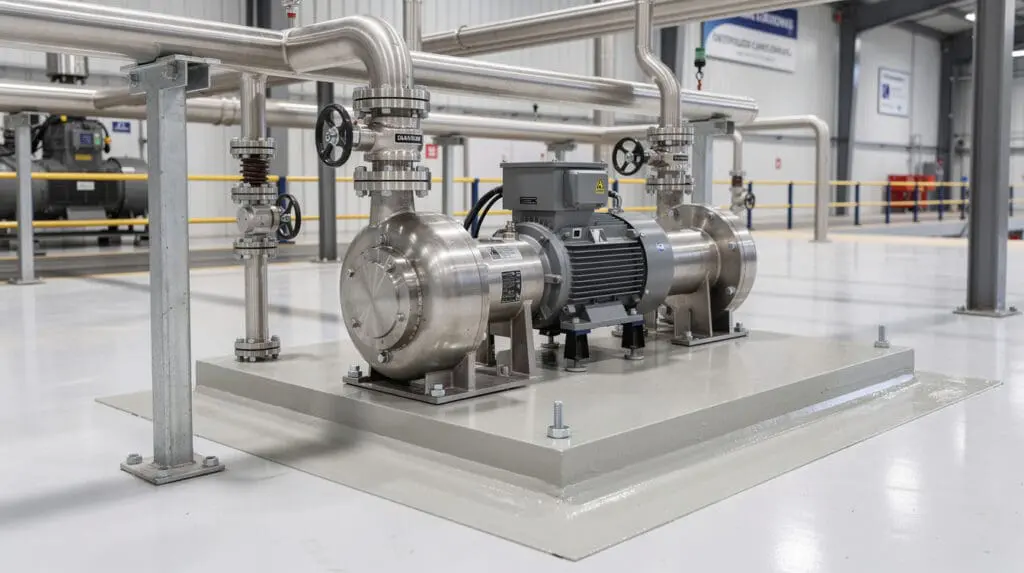
Over the past 22 years, my team at Chintan Engineers has calibrated and commissioned over 5,000 flow measurement and fluid transfer systems across India. I have walked into hundreds of GIDC industrial estates, from Vapi to Ankleshwar, and witnessed a recurring, expensive tragedy: premium stainless steel centrifugal pumps bolted directly onto uneven, raw concrete floors, with rigid piping bearing down heavily on the pump casing.
An industrial pump is not a pipe hanger. A stainless steel centrifugal pump, specifically our CE Series manufactured from rolled SS-304 or SS-316, is a precision-engineered piece of rotating equipment. It is designed to transfer aggressive chemicals, pharmaceutical-grade RO water, and high-viscosity dairy liquids (up to 1500 centipoise) with pore-free, non-pitting hygiene. But when you subject that precision equipment to severe pipe strain, Indian monsoon humidity, voltage fluctuations, and thermal expansion, you are actively engineering your own downtime.
Downstream flow meters don't stand a chance if your fluid delivery is pulsating. If your pump is cavitating due to improper suction piping, or vibrating out of specification due to baseplate distortion, no Coriolis or turbine meter downstream will give you OIML R117 compliant readings.
Forget the standard manufacturer manuals. Here is exactly how you must handle foundation grouting, pipe stress mitigation, mechanical seal commissioning, and shaft alignment to guarantee a 10+ year operational lifespan in harsh Indian industrial plants.
In This Article
- The Mathematics of Foundation and Grouting
- Pump Pipe Stress Mitigation: The Golden Rules
- Suction Piping Geometry and NPSH Optimization
- Mechanical Seal Commissioning and Protection
- Industrial Pump Alignment Checklist
- Core Specifications: Chintan SS Centrifugal Pumps
- Integrating SS Pumps with Liquid Batching Systems
- 5-Year TCO: The Cost of Getting It Right
- Frequently Asked Questions
The Mathematics of Foundation and Grouting
Your foundation dictates your vibration dampening. I see it all the time in Dahej and Vatva: plant engineers attempt to save time by using standard concrete to mount baseplates directly, skipping the critical epoxy grouting phase entirely. This is an expensive mistake.
For a centrifugal pump handling high-velocity fluids, the mass of the concrete foundation must be at least three to five times the total mass of the pump and motor assembly. This mass ratio is non-negotiable if you expect to absorb the dynamic forces generated at 2880 RPM.
Foundation Preparation
- Curing: The concrete foundation pad must cure for a minimum of 28 days. In high-humidity environments like coastal Gujarat or during monsoons, curing times may require adjustment. Never mount a baseplate on green concrete.
- Chipping: The top surface of the foundation must be chipped to expose the aggregate. This provides the necessary mechanical key for the grout to bond. A smooth troweled finish will result in grout delamination—I've seen it happen in less than six months of operation.
- Leveling: Utilize leveling wedges or jacking bolts to level the baseplate to a strict tolerance of 0.25 mm per meter.
Epoxy vs. Cementitious Grout
I refuse to sign off on standard cementitious grout for industrial SS pump installations. Non-shrink, high-strength epoxy grout is mandatory. Epoxy grout offers a compressive strength of up to 100+ MPa, resists chemical spills (crucial when pumping aggressive solvents or CIP chemicals), and effectively dampens high-frequency vibrations.
Pro Tip: Eliminate the "Soft Foot" before grouting. Check all four motor feet with a dial indicator. If loosening a hold-down bolt causes the foot to rise by more than 0.05 mm, you have a soft foot. Shim it properly before pouring your grout, or you will lock permanent stress into the baseplate.
Pump Pipe Stress Mitigation: The Golden Rules
Thermal expansion is a severe issue. Ambient summer temperatures in Rajasthan or Gujarat frequently exceed 45°C—and metal remembers. If you are pumping process fluids at 80°C to 120°C through rigid stainless steel piping, that pipe is going to expand. If the piping is not independently supported, those massive thermal growth forces transfer directly to the pump nozzles.
Excessive nozzle loading distorts the pump casing. Even a microscopic casing distortion will rub the closed or semi-open impeller against the volute, destroying the mechanical seal and shattering the bearings.
Executing Pipe Stress Mitigation
- Independent Piping Supports: The absolute rule of pump pipe stress mitigation is this: If you unbolt the suction and discharge flanges from the pump, the piping should not move a single millimeter. The piping must be fully supported by independent hangers, anchors, and guides.
- Expansion Joints: Use proper elastomeric or corrugated stainless steel expansion joints to isolate the pump from thermal piping growth and system vibrations. But please, ensure expansion joints are properly tie-rodded. An untied expansion joint under 16 bar of working pressure acts like a hydraulic ram against the pump casing.
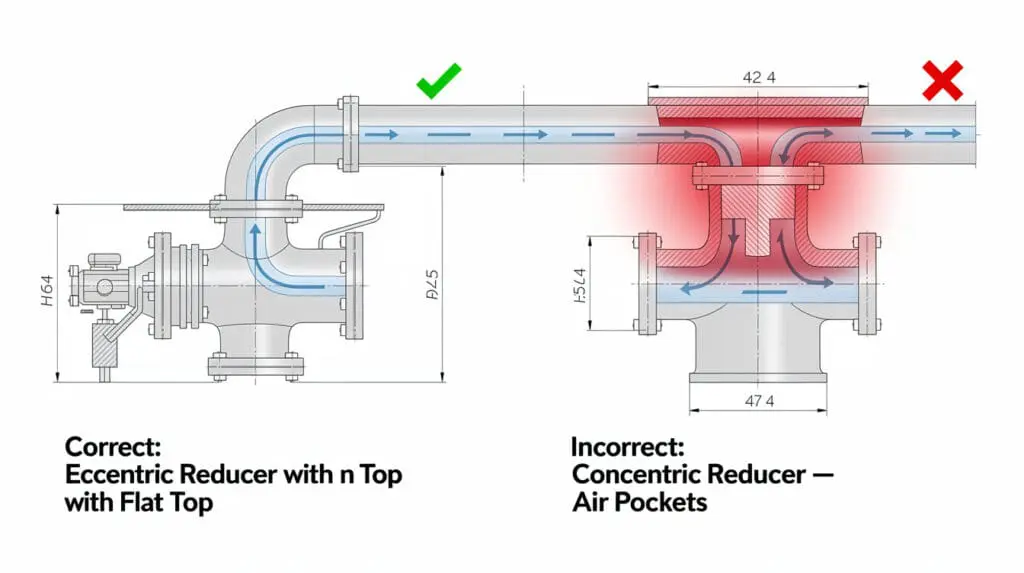
- Concentric vs. Eccentric Reducers: On the horizontal suction line, always use an eccentric reducer with the flat side up (top flat). Using a concentric reducer traps a pocket of air at the top of the pipe, which will eventually be swept into the pump, causing air locking and cavitation.
Warning: Do not force flanges to mate. If I catch a fitter using a chain block or crowbar to pull a misaligned pipe flange onto a pump nozzle, bolting it down under immense tension, I halt the installation. This guarantees premature failure. Flanges must align naturally with a tolerance of less than 1.5 mm and be perfectly parallel before inserting bolts.
Suction Piping Geometry and NPSH Optimization
Net Positive Suction Head Available (NPSHa) must always be greater than the Net Positive Suction Head Required (NPSHr) by the pump, ideally with a margin of at least 1.0 to 1.5 meters. It sounds like textbook theory, but in Indian summers, as ambient heat warms outdoor storage tanks, the vapor pressure of the liquid rises, drastically reducing your NPSHa.
To maximize NPSHa and ensure a uniform velocity profile entering the impeller eye:
- Straight Run Requirement: Maintain a straight, uninterrupted run of pipe equivalent to at least 5 to 10 times the suction pipe diameter immediately before the pump inlet. Absolutely no elbows, valves, or strainers in this zone.
- Velocity Limits: Size the suction piping so that fluid velocity remains between 1.0 and 1.5 meters per second. Discharge piping should be sized for 2.0 to 3.0 m/s.
- Submergence: Ensure adequate submergence of the suction pipe in the source tank to prevent vortexing, which draws free atmospheric air into the fluid stream.
Mechanical Seal Commissioning and Protection
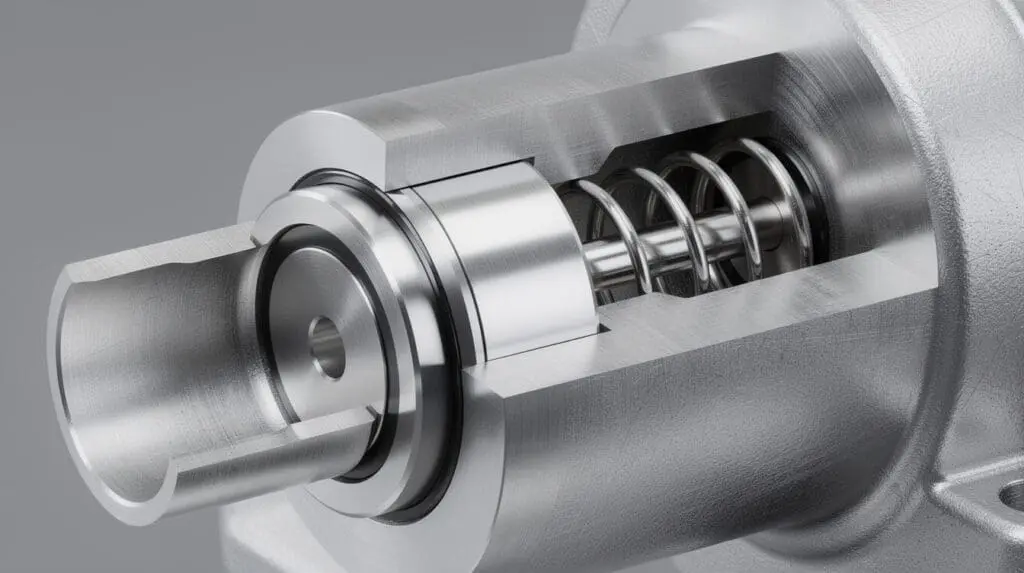
The mechanical seal is the beating heart of any process pump. While our Chintan CE Series offers flexible shaft sealing arrangements (including standard gland packing), a mechanical seal is mandatory for hygienic dairy, chemical transfer, or volatile liquids.
Mechanical seals rely on a microscopic fluid film between the rotating and stationary faces (typically Silicon Carbide vs. Carbon, or SiC vs. SiC) for lubrication and cooling.
Commissioning Steps
- Venting: Never start a centrifugal pump dry. The volute casing must be completely flooded, and all trapped air must be vented. A dry run of just 15 seconds will shatter a silicon carbide seal face due to thermal shock—it sounds exactly like a cracking gunshot.
- Seal Flushing: If you are pumping liquids with suspended solids, sugar syrups that crystallize on cooling, or highly volatile liquids, utilize an API flush plan (like Plan 11 or Plan 32) to keep the seal faces clean and cool.
- Voltage Monitoring: In local industrial estates, voltage fluctuations (e.g., dropping from 415V to 360V) cause motors to draw excessive current, overheat, and transmit thermal expansion directly down the shaft to the mechanical seal. Ensure proper VFD or overload relay protection.
Experiencing recurring mechanical seal failures?
Our CE Series SS Pumps feature modular construction with robust shaft sizing to eliminate deflection and protect your seals even under high suction pressures.
Industrial Pump Alignment Checklist
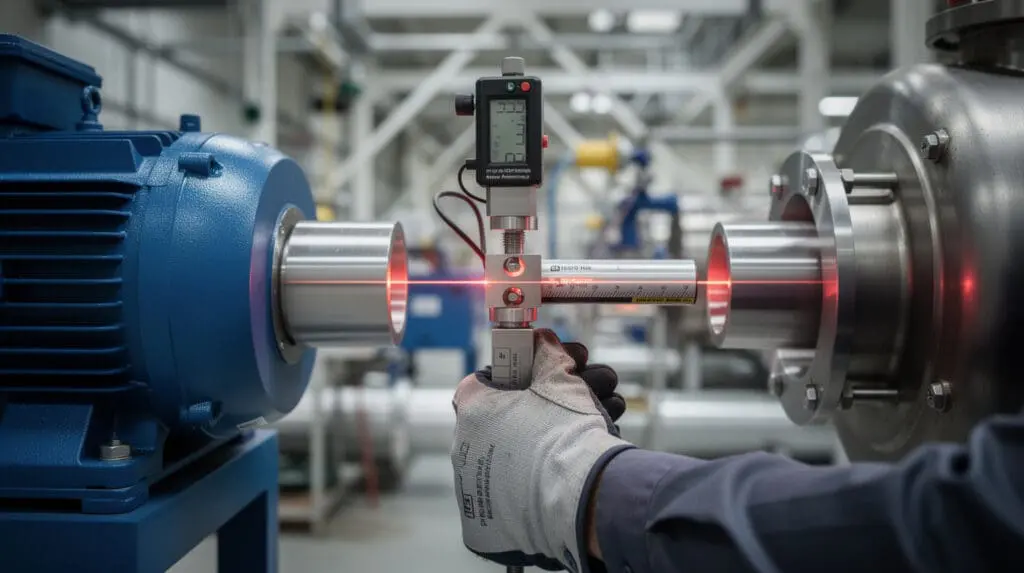
Even monoblock pumps, where the pump and motor share a single shaft, require precise leveling. For baseplate-mounted back-pullout pumps, laser alignment is mandatory. A straightedge and feeler gauge are entirely inadequate for modern 2880 RPM machinery.
Here is the non-negotiable alignment protocol my team follows:
- Rough Alignment: Perform preliminary alignment before grouting.
- Pipe Strain Check: Check alignment before bolting piping, then check again after bolting. If alignment shifts by more than 0.05 mm, rework the pipe supports. Do not compromise here.
- Thermal Growth Calculation: Electric motors and process pumps grow vertically as they reach operating temperatures. A pump handling 90°C water will expand upward. You must intentionally offset the cold alignment (setting the motor slightly higher or lower, depending on thermal calculations) so that the shafts expand into perfect alignment at operating temperature.
- Final Laser Alignment: Target a maximum parallel offset of 0.05 mm and an angular misalignment of less than 0.05 mm per 100 mm.
Core Specifications: Chintan SS Centrifugal Pumps
If you want to see what actual industrial robustness looks like, examine the baseline specs for our standard Stainless Steel Centrifugal Pumps (CE Series and BPO Series).
| Specification | Parameter Standard |
| :— | :— |
| Capacity Range | Up to 120 M³/hr (CE Series) / Up to 990 M³/hr (BPO Series) |
| Head | Up to 60 Meters (CE Series) / Up to 120 Meters (BPO Series) |
| Power Rating | 1.0 HP to 20 HP (Three Phase) / 0.5 HP to 2.0 HP (Single Phase) |
| Voltage | 380 V to 415 V (Three Phase) / 200 V to 240 V (Single Phase) |
| Speed | Up to 2880 RPM |
| Discharge Size | 25 mm to 100 mm (CE) / Up to 250 mm (BPO) |
| M.O.C. | SS-304, SS-316 (Rolled construction with pore-free non-pitting surface) |
| Viscosity Limit | Handles up to 1500 centipoise (cP) |
| Flange Standards | DIN 24255 / ISO 2858 or Custom |
These pumps are engineered with a back-pullout design. This allows your maintenance team to withdraw the entire rotating assembly (impeller, shaft, seal, and bearings) for inspection without disturbing the suction and delivery piping connections—a feature that reduces maintenance downtime by up to 60%.
Did You Know: Viscosity limits matter. The CE Series easily handles up to 1500 cP. Attempting to pump fluids higher than this with a standard centrifugal design results in severe efficiency drops and motor overloading. For higher viscosities, we integrate positive displacement solutions.
Integrating SS Pumps with Liquid Batching Systems
In chemical manufacturing, pharmaceutical dosing, and dairy processes, a pump rarely operates in isolation. It is usually the prime mover for a highly accurate flow measurement and batching setup.
When we design liquid batching systems, the installation protocols outlined above become even more critical. A pump that cavitates or pulses due to bad piping geometry will send entrained air through the downstream flow meter. If you are using a Coriolis or Oval Gear meter for precise batching, entrained air causes drastic measurement errors.
For a deep dive into sizing the downstream flow measurement components that pair perfectly with our SS pumps, read my Liquid Batching System Specs: Engineer's Guide.
Furthermore, if you are currently evaluating automated dosing setups, understanding the integration of VFD-controlled SS centrifugal pumps with batch controllers is paramount. I recommend reviewing our field-tested methodology in Selecting Industrial Liquid Batching Systems.
5-Year TCO: The Cost of Getting It Right
I have this argument with procurement managers monthly. They push back against the initial costs of epoxy grouting, independent pipe supports, and laser alignment. Let me break down the reality based on actual field data from an Ahmedabad chemical plant.
If you install a 15 HP SS-316 pump improperly, you might save ₹45,000 upfront on installation contractors. However, pipe strain and misalignment will cost you approximately ₹2.5 lakhs over 5 years in repeated mechanical seal replacements, bearing failures, and the associated production downtime.
Conversely, a properly installed pump requires little more than routine bearing lubrication and scheduled seal inspections. For a financial breakdown of pump lifecycles, I've mapped the data out in our 5-Year TCO Analysis of Industrial SS Pumps.
Ready to upgrade to a vibration-free, highly efficient pumping solution?
Explore our CE and BPO series stainless steel pumps, designed for 16-bar working pressure and high-viscosity industrial applications.
Frequently Asked Questions
Why does my stainless steel centrifugal pump vibrate excessively after installation?
Excessive vibration is typically caused by one of four issues: soft foot (uneven mounting causing baseplate distortion), pipe strain (piping weight resting on the nozzles), shaft misalignment, or cavitation due to poor suction piping geometry (such as using a concentric reducer).
What is the maximum viscosity a standard SS centrifugal pump can handle?
Our Chintan CE Series SS centrifugal pumps can efficiently handle fluids up to 1500 centipoise (cP). Beyond this threshold, internal friction losses become too great, and a positive displacement pump (like a rotary lobe or gear pump) is heavily recommended.
Why is a back-pullout design critical for industrial pumps?
The back-pullout design allows maintenance personnel to remove the motor, coupling, bearing housing, and impeller as a single unit without unbolting the heavy suction and discharge piping from the pump casing. This dramatically reduces downtime and prevents the re-introduction of pipe stress during reassembly.
How long should the straight run of suction piping be before the pump inlet?
To ensure a uniform, laminar flow profile into the impeller eye and prevent cavitation, you must maintain a straight, undisturbed run of pipe for at least 5 to 10 times the pipe's internal diameter immediately before the suction flange.
Can I use cement instead of epoxy for grouting the baseplate?
While standard cementitious grout is cheaper, it is prone to shrinkage, cracking under high-frequency vibration, and chemical degradation. For heavy-duty industrial environments, especially where aggressive chemicals are present, high-strength, non-shrink epoxy grout is the only standard I recommend.
*
Vikram Desai is a Senior Flow Measurement Engineer at Chintan Engineers, Ahmedabad. He specializes in the design, calibration, and commissioning of high-accuracy fluid transfer and measurement systems across India's harshest industrial environments.
