
















A 1% calibration drift on a standard 5,000 L/day fleet throughput costs your operation ₹1.35 lakh per month in untracked diesel. I've spent 22 years calibrating flow measurement systems across India, from major ONGC refineries to remote GIDC industrial estates, and the underlying issue is usually identical. Fleet managers install cheap, uncertified agricultural flow meters on their diesel bowsers, experience massive volume reconciliation failures at the end of the month, and wonder where the fuel went.
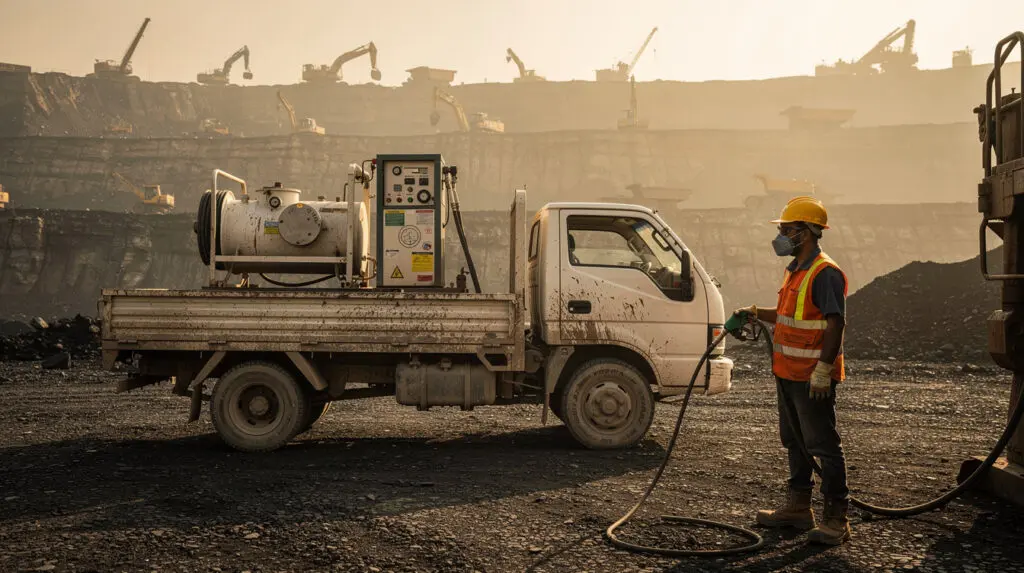
Mobile dispensing is fundamentally different from static depot fueling. When you mount a pump and meter on a Tata chassis or a utility pickup heading into an open-cast mine, you subject the metrology equipment to severe chassis vibration, 12V/24V voltage fluctuations, heavy dust ingress, and constant diesel aeration from fuel sloshing in the tank. You simply cannot solve this with a standard water meter housing and a centrifugal pump. You need metrology-grade mobile fuel dispensing equipment engineered specifically for the punishing conditions of the road.
After logging decades of field data, here is the unfiltered truth about what makes a mobile fuel dispenser accurate, auditable, and compliant with Legal Metrology requirements—and how to specify the right skid for your bowser.
In This Article
- Fluid Dynamics in Transit: Why Meter Selection Matters
- Overcoming Indian Site Conditions: Power, Dust, and Grounding
- Equipment Comparison: Selecting the Right Dispenser Configuration
- The Financial Case for Telemetry and Batch Controllers
- Installation Protocols and Bowser Maintenance
- Frequently Asked Questions
- Engineering the Right Mobile Solution
Fluid Dynamics in Transit: Why Meter Selection Matters
I've crawled under enough service trucks in Kutch to know that standard turbine flow meters have no place on a mobile diesel bowser. Diesel is a moderately viscous fluid (around 2.5 to 4.0 cSt at 40°C), and its viscosity fluctuates wildly depending on ambient Indian temperatures. Ask any site manager running rigs—diesel behaves very differently at 45°C in Rajasthan compared to near-freezing conditions in the Himalayas.
When a bowser traverses rough terrain, the fuel inside the tank sloshes violently, introducing dissolved air and foam into the suction line. If your mobile dispenser relies on a basic velocity-based turbine meter, that air spins the turbine rotor just as effectively as the liquid diesel. The meter registers air volume, your fleet manager records a 50-liter delivery, but the receiving excavator only gets 48 liters. You aren't losing fuel to theft; you're losing it to basic physics.
True accuracy requires a Positive Displacement (PD) flow meter—specifically, an oval gear or rotary vane mechanism. PD meters capture a specific, finite volume of fluid in a mechanical chamber before passing it downstream. They are largely immune to upstream viscosity changes and, when paired with an integrated air eliminator, guarantee that you are measuring liquid fuel, not air. Why put a 0.5% accurate meter on a truck if you're just going to feed it foam?
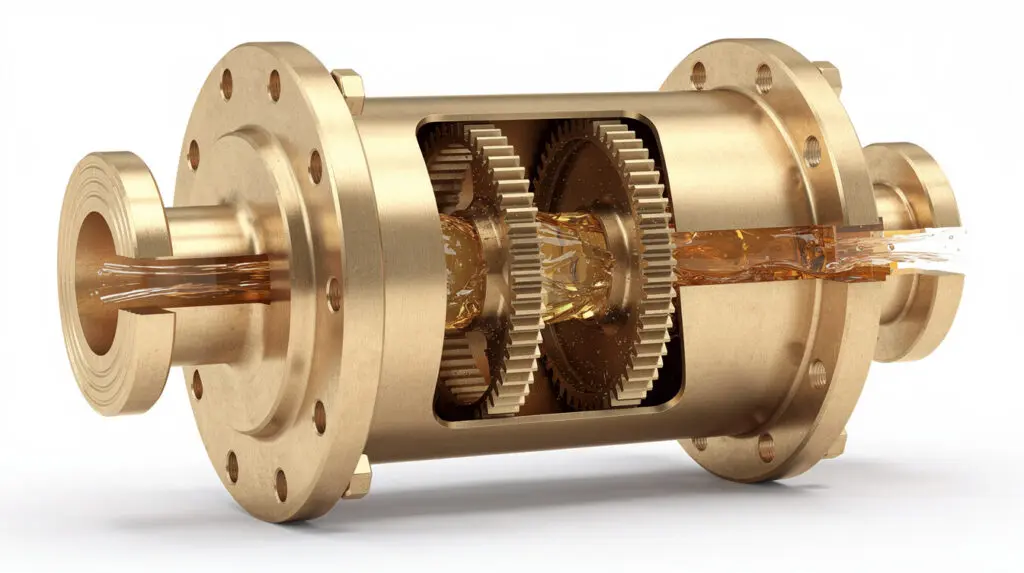
Warning: Never run a mobile dispenser directly from a sloshing bowser tank without an upstream air eliminator and a 10-micron filtration system. Aerated diesel will destroy the repeatability of even the best mechanical meters.
Overcoming Indian Site Conditions: Power, Dust, and Grounding
Before we even talk about meters, we have to talk about power. When designing a mobile dispenser skid, power availability dictates pump selection. Most fleet operators utilize the vehicle's onboard battery, requiring a 12V or 24V DC rotary vane pump.
However, vehicle batteries do not provide clean, steady power. A standard 24V battery bank might drop to 21V under heavy cranking or when the alternator struggles. I've seen standard controllers fry because they lacked basic voltage regulation, resetting the CPU mid-batch and wiping the transaction data entirely.
This is exactly why we designed our CE-Series digital dispensers (like the CE-206 and CE-204) with heavy-duty voltage regulation circuits specifically mapped for Indian truck chassis wiring. Then there's the Indian monsoon to consider. An IP55 rating is the absolute baseline. High humidity combined with diesel fumes creates a highly corrosive environment for printed circuit boards. We seal the preset controllers in powder-coated, weatherproof enclosures and utilize brass and cast iron wetted components to prevent oxidation.
Pro Tip: I always recommend wiring the DC dispenser directly to the vehicle's secondary battery via a dedicated isolator switch and heavy-gauge marine wire. Tapping into the main starter battery harness invites electrical noise that can interfere with digital pulse outputs.
Equipment Comparison: Selecting the Right Dispenser Configuration
Not every fleet needs a high-end digital preset unit, but every fleet needs rugged reliability. If you are comparing systems for Mobile Fuel Dispensers: Specs, Sizing & ROI, look at the actual throughput requirements and the level of data logging demanded by your accounting department.
When fleets ask me what skid to specify, I break it down by throughput and audit requirements:
| Model | Flow Range | Metering Technology | Power Supply | Ideal Fleet Application |
| :— | :— | :— | :— | :— |
| CE-101 Mechanical | 40 – 60 L/min | Mechanical Counter (0.5% Acc) | 12/24V DC or AC | Basic agricultural bowsers, small construction sites where manual logbooks are used. |
| CE-202 Compact | 20 – 60 L/min | Digital PD with LCD | 12/24V DC or AC | Service pickups and on-site maintenance rigs requiring lightweight, accurate metering. |
| CE-204 High Accuracy | 20 – 80 L/min | Digital Preset (±0.2% achievable) | 12/24V DC or AC | Bowser fleets needing strict metrology, batch preset, and high-accuracy delivery. |
| CE-206 Digital | 20 – 80 L/min | CPU-based PD (0.5% Acc) | 12/24V DC | Large mining/infrastructure fleets requiring onboard 365-day data storage and receipt printing. |
| CE-201 Heavy Skid | Up to 110 L/min | Mechanical Oval Gear | 220/440V AC (Gen) | High-volume tanker trucks fueling massive earthmoving equipment. |
Tired of unaccounted fuel losses in your fleet?
Upgrade to a metrology-grade mobile dispenser with preset batching and integrated data logging.
The Financial Case for Telemetry and Batch Controllers
If you ask me, the biggest game-changer in mobile fueling isn't the pump—it's the preset controller.
In a manual setup, the operator squeezes the nozzle, watches the mechanical dial, tries to stop precisely at 50 liters, and writes it down on a clipboard. The reality? They stop at 51.2 liters, write down 50, and pocket the difference or chalk it up to spillage.
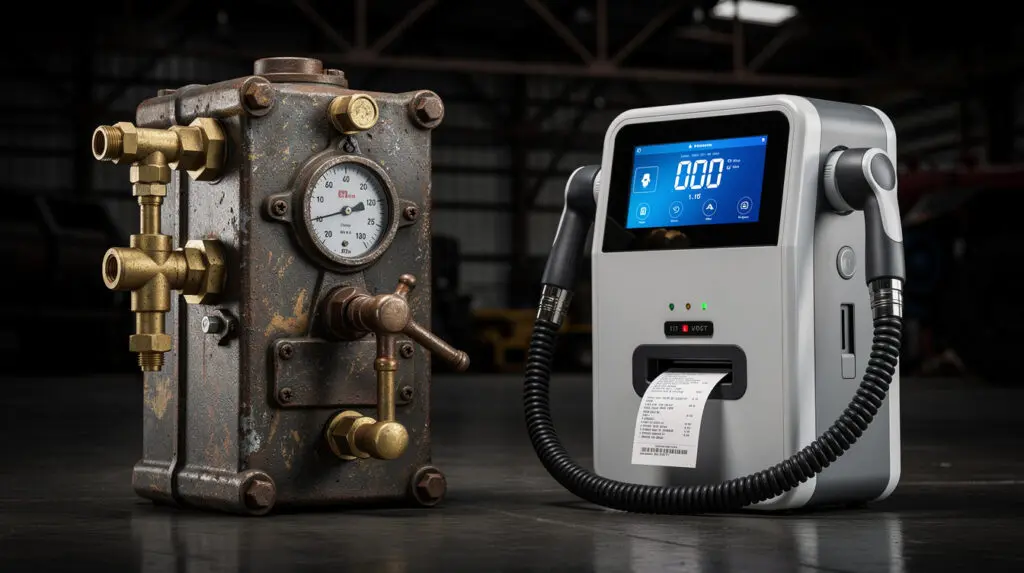
Take a standard CE-206 preset setup instead. The site supervisor inputs "50.00 Liters" on the digital keypad. The CPU activates the 12V/24V pump and opens the solenoid valve. The integrated flow meter sends high-frequency pulse data back to the controller. At 49.5 liters, the system automatically chokes the flow to a trickle and shuts off exactly at 50.00 liters. No human intervention required. This is the exact same logic we apply to industrial manufacturing setups, as detailed in our analysis of Automated vs Manual Drum Filling: ROI & Price in India.
Better yet, the CE-206 locally stores daily delivery data for 365 days and monthly aggregated data for the last 12 months. An integrated thermal printer ejects a time-stamped receipt showing the exact volume dispensed. This turns a basic pickup truck into a fully auditable rolling fuel station.
Did You Know: Legal Metrology Fact: Under Indian regulations, fuel dispensers used for commercial transactions must comply with IS 14883 and OIML R117 standards. While internal fleet transfer often falls under a gray area, using metrology-certified equipment ensures your internal audits hold up to scrutiny.
Installation Protocols and Bowser Maintenance
You can buy a highly accurate ±0.2% CE-204 system, but if your site welder mounts the skid directly to a generator frame without vibration dampening, you've just thrown your money away. I see it happen constantly.
1. Suction Line Integrity
Your suction line from the bowser tank to the rotary vane pump must be absolutely airtight. Even a pinhole leak at a threaded joint will introduce cavitation into the pump. We mandate a maximum suction lift of 2 to 3 meters, using reinforced, non-collapsible 25mm (1-inch) suction hose.
2. Static Grounding and Safety
Mobile fueling generates massive amounts of static electricity as diesel rushes through rubber hoses. The dispenser chassis, the pump casing, and the bowser tank must share a common ground. If you are fueling in a hazardous zone (like an active refinery site), you must specify Flameproof (EX/FLP) motors and enclosures, abandoning DC battery power in favor of properly routed generator-supplied AC power.
3. Filtration
I can't stress this enough: never feed dirty tank-bottom sludge into a precision positive displacement meter. Our standard configuration includes inline filtration before the pump to catch large debris, and secondary finer filtration before the meter. If you operate in heavy dust environments, those filters must be checked weekly.
Need to ensure compliance with Indian metrology laws?
Read our engineering brief on dispenser certification requirements for commercial and internal use.
Frequently Asked Questions
Can I run a high-flow 80 L/min dispenser entirely on my truck's battery?
Yes, but you must match the voltage. A 12V DC system will draw significant amperage to achieve 80 L/min. We highly recommend utilizing a 24V DC architecture for flows above 60 L/min to reduce heat generation in the pump motor and prevent rapid battery drain.
How does the preset system prevent fuel pilferage on remote sites?
Systems like the CE-204 and CE-206 feature password-protected preset controllers. The operator cannot dispense fuel without entering an authorized batch quantity, and every transaction is permanently logged in the 365-day internal memory. This memory cannot be wiped without administrative access, providing an immutable audit trail.
What is the maximum operating pressure for these mobile skids?
Our standard DC mobile dispensing kits operate safely up to 0.3 MPA (3 Bar). This is perfectly calibrated for the 4-meter to 6-meter delivery hoses and ambient noise automatic shutoff nozzles supplied with models like the CE-117.
Does the equipment require periodic recalibration?
Without question. Mechanical wear on the brass internals of positive displacement meters will cause slight drift over millions of liters. I recommend a volumetric proving test using a certified 20-liter or 50-liter proving measure every six months. The digital controllers on the CE-204 and CE-206 allow for simple electronic K-factor adjustments to bring the unit back to ±0.2% or ±0.5% accuracy.
Can we pump AdBlue / DEF with the standard diesel dispensers?
No. Diesel dispensers utilize brass, cast iron, and specific buna-N/Viton seals that will quickly corrode if exposed to AdBlue (Urea solution). For DEF, you must specify dedicated stainless steel or engineered polymer dispensers like our CE-130 AdBlue configuration.
Are hose management systems included with the skid?
By default, units like the CE-101 and CE-117 come with a standard 4-meter rubber delivery hose. However, for true fleet efficiency, we heavily advise upgrading to a spring-rewind hose reel capable of holding 10 to 15 meters of hose, which prevents crushing damage on job sites.
Engineering the Right Mobile Solution
Bottom line: your mobile bowsers handle millions of rupees of product every year. Stop treating them like basic farm equipment. Relying on cheap velocity sensors and uncalibrated analog dials is a guaranteed way to bleed lakhs of rupees in operational expenses.
If your fleet demands traceability, specify a digital preset system like the CE-206 with its onboard transaction logging and receipt printer. If you need a bulletproof, rapid-deployment kit for basic mechanical tracking, the CE-101 remains a field-tested workhorse.
Based on my 22 years of field installations, I advise moving away from mechanical tracking entirely if your fleet dispenses more than 2,000 liters daily. The ROI on upgrading to a CE-204 high-accuracy (±0.2%) digital skid pays for itself in prevented fuel losses within the first fiscal quarter.
Ready to upgrade your fleet's fuel tracking accuracy?
Chintan Engineers designs and calibrates custom mobile dispensing skids for mining, construction, and agricultural fleets across India.
