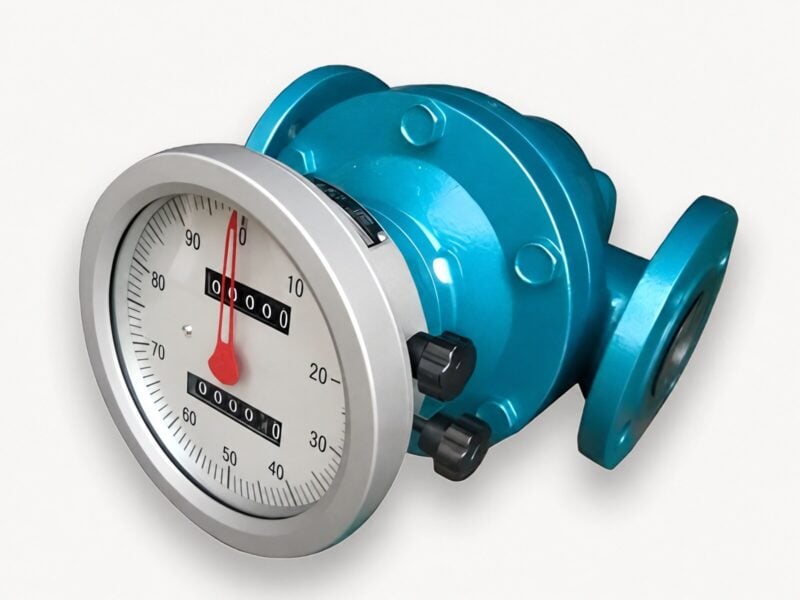
₹2.8 Lakhs/month€” The average financial bleed at a 10MW data center relying on float-level sensors instead of positive displacement flow meters for diesel accountability.
A standard 2-megawatt backup generator running at full load consumes approximately 400 liters of high-speed diesel (HSD) per hour. At a Tier III or Tier IV data center operating four such gensets during a localized grid failure, you are burning 1,600 liters per hour. If your measurement instrumentation has a 2% calibration drift—a common reality for unmaintained mechanical meters—a 48-hour outage results in over 1,500 liters of untracked diesel. At current commercial HSD rates in India, that's nearly ₹1.4 Lakhs vanishing into the atmosphere, unrecorded and unbilled.
Over my 22 years designing flow measurement systems at Chintan Engineers, I've audited fuel setups across hundreds of critical infrastructure sites. Frankly, it still surprises me. Facility managers will readily spend millions on uninterrupted power supply (UPS) units and battery banks, but when it comes to fuel auditing for backup power, they fall back on archaic day-tank sight glasses or notoriously inaccurate tank telemetry.
If you manage high-availability server farms, 99.999% uptime relies entirely on knowing exactly how much fuel you have, how fast your engines are burning it, and verifying that every drop purchased from the bulk tanker actually made it into your underground storage.
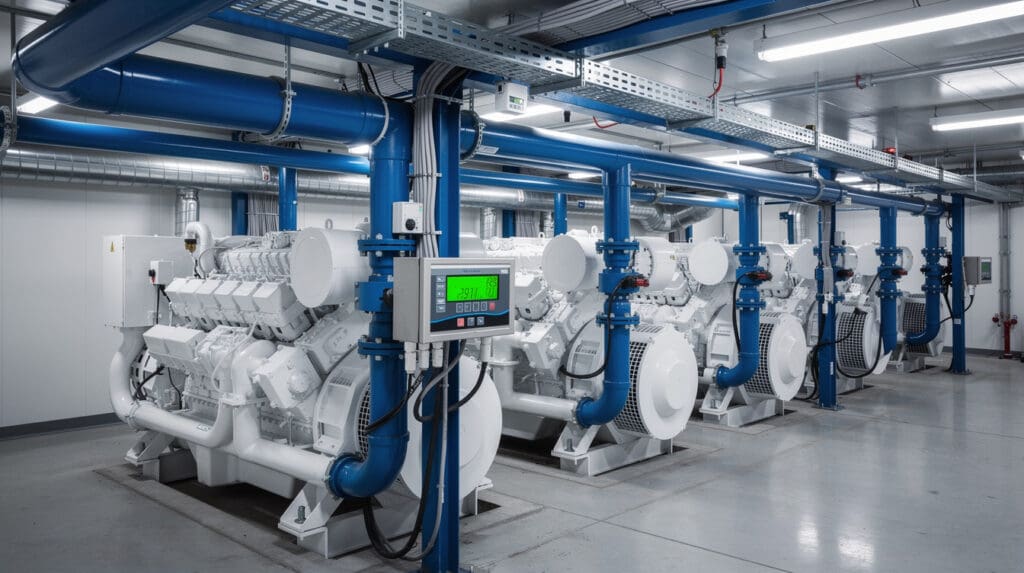
The Physics of Diesel Consumption Monitoring in High-Availability Sites
You would be surprised how often I see a single meter slapped onto the pipe connecting the day tank to the engine, with the operator assuming that gives them their consumption rate. It doesn't.
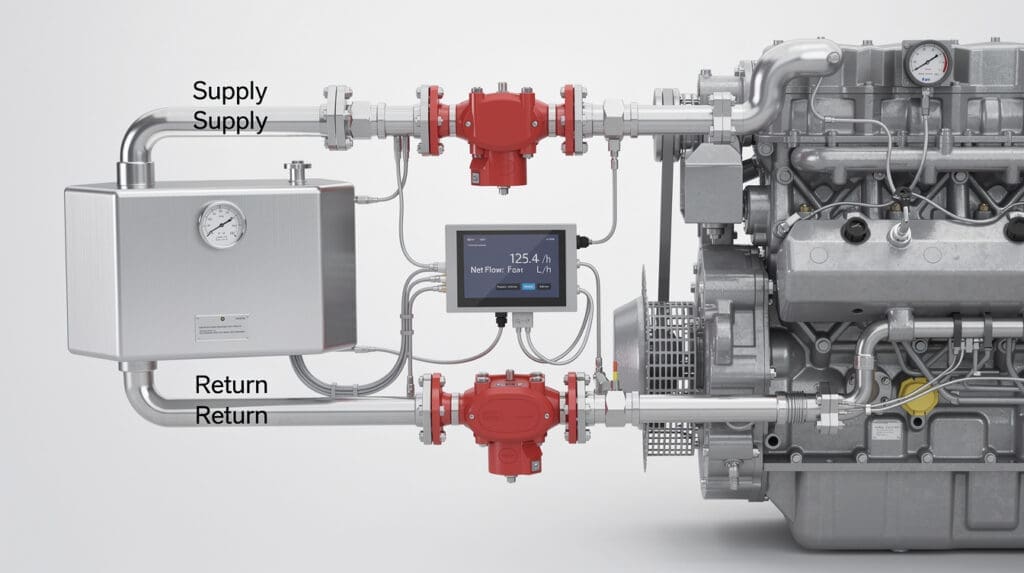
Modern high-horsepower diesel engines (like the heavy-duty Cummins, Caterpillar, or Perkins units typical in data centers) operate with a continuous flow of fuel that serves a dual purpose: combustion and cooling. The fuel transfer pump pulls significantly more diesel from the day tank than the engine actually requires for combustion. The excess fuel circulates through the fuel injection system, cooling the injectors, and is then pumped right back to the day tank.
This means a single flow meter only tells you what the engine pulled, not what it consumed. To get the real burn rate, you must measure the supply flow and subtract the return flow. This is true differential flow measurement.
I've calibrated enough turbine meters in my career to know they do not belong anywhere near generator return lines. The pulsating flow from the fuel injection pump completely skews the K-factor of a turbine rotor. You must use Positive Displacement (PD) meters for this application.
The Thermal Expansion Trap
Then there's the trap that catches even seasoned facility managers: thermal expansion. The return fuel has absorbed serious heat from the engine block. High-speed diesel has a volumetric coefficient of thermal expansion of approximately 0.00083 per °C. If the supply fuel is drawn at an ambient 30°C, and the return fuel comes back at 65°C, the return volume has artificially expanded by nearly 3%.
If your generator fuel flow meter system doesn't account for this expansion mathematically—either via integrated temperature compensation or by utilizing mass-flow principles rather than purely volumetric ones—your net consumption calculation will be flawed from the start. You'll record a lower net consumption than reality, leading to premature day-tank depletion when you need that fuel most.
Core Technologies for Generator Fuel Flow Meters
If you are specifying meters for diesel consumption monitoring in India, your choice of measurement technology directly dictates the long-term reliability of your data.
1. Oval Gear Positive Displacement (PD) Meters
For viscous fluids like HSD, oval gear meters are the gold standard. As fluid passes through the measuring chamber, it forces two interlocking oval gears to rotate. Each rotation displaces a highly precise, known volume of fluid. Because they operate on positive displacement, they ignore the flow profile distortions caused by pipe elbows or the pulsating nature of engine fuel pumps.
For example, our CE-121 Fuel Consumption System utilizes specialized aluminium-anodized oval gear sensors designed specifically for this differential application, delivering a standard 1% accuracy out of the box, with options to calibrate tighter based on specific viscosity bands.
2. Piston PD Meters
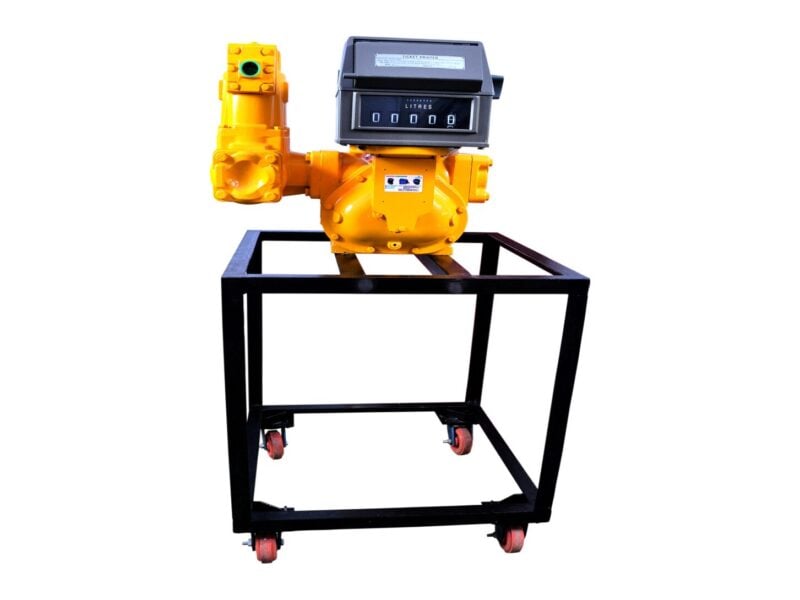
For micro-accurate measurement (±0.2%), particularly in custody transfer scenarios or bulk fuel receipts, piston-based positive displacement meters (like the CE-212 Piston PD Meter) are required. These utilize a 4-piston assembly and are strictly governed by Legal Metrology Act requirements when fuel is being resold or financially audited against external vendors.
3. Turbine Flow Meters
While a CE-210 Turbine Sensor is excellent for low-viscosity, high-volume transfer (like water or light chemicals), I rarely recommend them for heavy diesel engine consumption. Turbines require a steady flow velocity to maintain their ±0.5% accuracy. They struggle heavily at the low-flow thresholds we often see when a generator is idling or running at 20% load.
Struggling to reconcile generator fuel logs?
Upgrade to the CE-121 Fuel Consumption System with differential measurement and true positive displacement accuracy.
Sizing and Selection Guide: The Right Meter for the Right Node
A robust fuel management architecture demands measurement at three distinct nodes. Don't make the mistake of using the same meter type across the board.
| Measurement Node | Required Application | Recommended Model | Technology & Specs | Why it Works Here |
| :— | :— | :— | :— | :— |
| Node 1: Bulk Unloading | Verifying tanker deliveries to underground storage | CE-113 High Accuracy Transfer Meter | PD with Air Eliminator, ±0.2% Accuracy | Prevents paying for aerated fuel. OIML R117 compliant for custody transfer. Ticket printer generates instant receipts. |
| Node 2: Day Tank Transfer | Pumping from underground tanks to daily service tanks | CE-111 Digital Flow Meter | Digital PD, 20-300 L/min, ±0.5% Accuracy | Battery-backed electronics survive power transitions. Easy pulse integration to transfer PLCs. |
| Node 3: Engine Consumption | Real-time differential burn rate | CE-121 Fuel Consumption System | Dual Oval Gear, 1% Accuracy, RS485 Modbus | Calculates Net Flow (Supply – Return) internally. Directly feeds BMS systems. |
BMS Fuel Meter Integration and Telemetry
Isolated data doesn't help you when the grid goes dark. Your facility's Building Management System (BMS) or Data Center Infrastructure Management (DCIM) software requires continuous, real-time input to calculate Power Usage Effectiveness (PUE) and remaining runtime during an outage.
This is where BMS fuel meter integration becomes critical. Mechanical registers are robust, but who has time to send a technician with a clipboard to read dials during a blackout? In 2024, your meters must speak the language of your control systems.
The CE-121 and CE-111 series feature integrated RS485 Modbus communication. This allows the flow meter to transmit:
- Cumulative fuel consumed (Totalizer)
- Instantaneous flow rate (Liters/Hour)
- Engine supply flow vs. Return flow diagnostics
When integrating these outputs, ensure the on-board power supply is robust. Standard 12V meters often fail during the harsh voltage spikes of a grid-to-generator transition. We engineered the CE-121 to operate on a wide 8-30VDC band explicitly to survive the electrical noise inherent in heavy backup power generation.
Under IS 14883 guidelines, telemetry data from fuel measurement devices used for regulatory compliance should be time-stamped and stored locally before transmission, preventing data loss during network interruptions.
Fuel Auditing Against Vendor Shortages
Take a scenario I handled recently at a major financial sector data center in the GIDC industrial estate near Mumbai. The facility manager was recording a consistent 4% shortage between the diesel purchased from the oil marketing company (OMC) and the fuel visually registered in their bulk tanks.
They assumed the underground tank was leaking. We ran a flow study and discovered the issue wasn't a leak; it was aeration. The bulk tanker delivery pumps were sucking air at the end of the load, and their basic mechanical flow meter was registering that pressurized air as liquid volume.
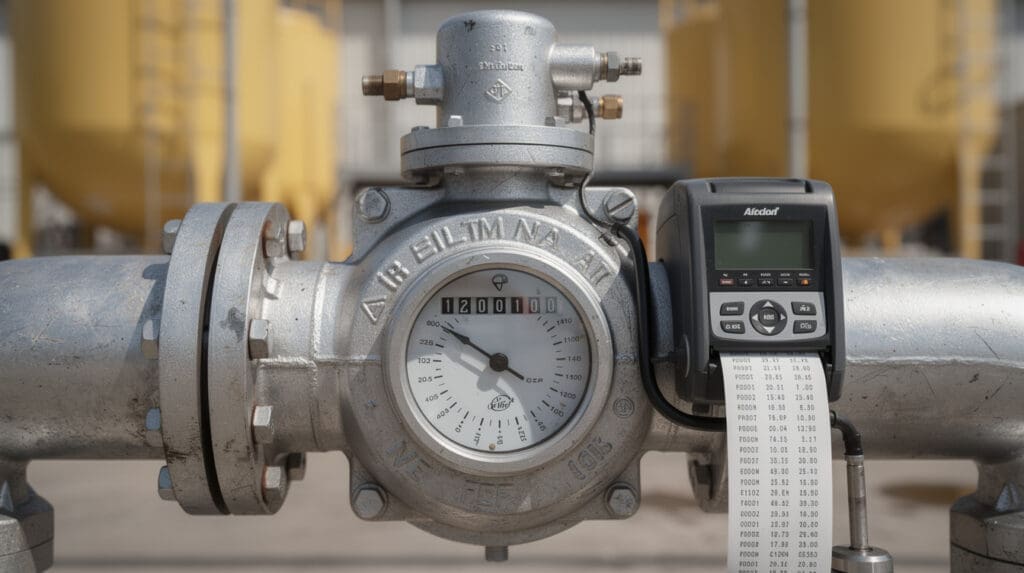
By installing a CE-113 High Accuracy Transfer Meter equipped with a mechanical air eliminator and strainer at the decanting point, we stopped the phantom billing immediately. The air eliminator purges entrained air before it reaches the measurement chamber. At ±0.2% accuracy, this setup acts as your facility's financial firewall. If the receipt from the smart print module says 12,000 liters, you pay for exactly 12,000 liters. Not a liter more.
Navigating Indian Environmental Challenges
Deploying flow instrumentation in India requires engineering for the environment, not just the fluid. Data centers are often located in industrial corridors exposed to severe environmental stressors.
1. Monsoon Humidity & Condensation
Underground storage tanks and piping galleries experience massive temperature gradients during the Indian monsoon, leading to heavy condensation. Meter electronics must be IP65/IP68 rated. If you are using digital readouts (like the CE-111), ensure the enclosures are hermetically sealed, otherwise the LCDs will fog and fail within two seasons.
2. Dust Ingress in Industrial Estates
Particulate matter is the absolute enemy of positive displacement meters. Abrasive dust entering the fuel lines during decanting will score the oval gears, destroying the meter's ±0.5% accuracy. A 100-micron strainer is non-negotiable upstream of any PD meter.
3. Piping and Transfer Infrastructure
When designing the transfer lines from underground tanks to day tanks, the choice of transfer pumps matters just as much as the meter. Cavitation from poorly sized pumps introduces vapor bubbles, skewing meter readings. If you are evaluating pump metallurgy for these diesel transfer lines, I highly recommend reviewing our field notes on SS vs Cast Iron Pumps: An Engineer's Guide to ensure you aren't introducing rust scale into your flow meters.
Need a bulletproof fuel decanting station?
Protect your bulk diesel purchases with our custody-transfer accurate CE-113 series.
Installation & Maintenance Imperatives for Continuous Uptime
An improperly installed meter is worse than no meter at all, as it provides false confidence. Follow these engineering guidelines for installing fuel flow meters in critical backup systems:
Mechanical Fitment
- Orientation: While oval gear meters (CE-110/CE-121) can generally be installed horizontally or vertically, the rotor shafts must remain in a horizontal plane to prevent uneven bearing wear.
- Filtration: Install a Y-strainer immediately upstream of the meter. Diesel in India often contains suspended particulate matter from poorly maintained transport tankers.
- Bypass Lines: If there is one rule you take away from this, let it be this: never install a fuel flow meter on a critical data center generator without a valved bypass line. If the meter jams due to debris, you must be able to bypass it instantly to keep the engine running. Uptime always trumps auditing during an emergency.
Signal Integrity and Wiring
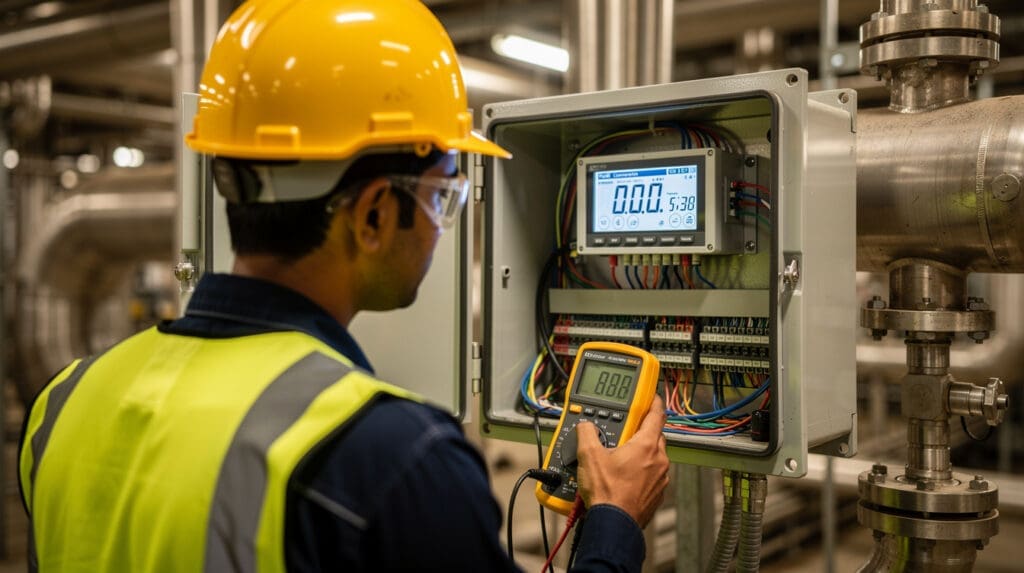
- When running pulse or 4-20mA lines from the generator skid back to the BMS control room, use shielded twisted pair cables. Unshielded cables running parallel to high-voltage generator outputs will pick up electromagnetic interference (EMI), resulting in phantom pulses and artificially inflated fuel consumption numbers.
Calibration Intervals
Frequently Asked Questions
How does a differential fuel flow meter work on a diesel generator?
Differential fuel flow meters utilize two precision sensors—one on the fuel supply line from the day tank to the engine, and one on the return line back to the tank. The system's microprocessor continuously subtracts the return volume from the supply volume, outputting the exact net fuel consumed by the combustion process.
Can the CE-121 integrate directly with our existing DCIM/BMS software?
Yes. The CE-121 is designed for seamless BMS fuel meter integration. It utilizes standard RS485 Modbus communication, which is universally accepted by nearly all Data Center Infrastructure Management (DCIM) and Building Management Systems (BMS) for real-time telemetry.
Why do we need an air eliminator for bulk fuel unloading?
When underground tanks are filled by bulk tankers, the transfer pumps inevitably draw in air as the tanker empties. Without an air eliminator, standard flow meters will measure this pressurized air as liquid diesel, causing you to overpay for fuel you never received. The CE-113's air eliminator physically separates and vents this air before it reaches the measuring chamber.
What is the acceptable accuracy for internal fuel auditing for backup power?
For internal auditing and generator efficiency calculations, a positive displacement meter with ±0.5% to ±1.0% accuracy (like the CE-111 or CE-121) is standard. However, for custody transfer—where money changes hands based on the meter reading—Legal Metrology standards require ±0.2% accuracy, necessitating precision units like the CE-113 or CE-212.
Are turbine flow meters suitable for high-speed diesel?
While functionally possible, I don't recommend them for generator consumption. Turbine meters rely on fluid velocity to spin a rotor. Generator fuel injection pumps create a pulsating flow profile, and generators running at partial loads create very low flow velocities. Both conditions severely degrade a turbine meter's accuracy. Oval gear PD meters are far superior here.
How often should data center fuel flow meters be calibrated?
In critical infrastructure applications, fuel flow meters should be field-verified every 6 months and formally calibrated against a certified master volumetric prover every 12 months, or as mandated by your facility's ISO 50001 Energy Management compliance requirements.
The Engineering Verdict
In this industry, uptime is absolute. But ensuring that uptime requires total visibility into your energy reserves. Managing a Tier III or Tier IV facility with sight-glasses and uncalibrated mechanical totalizers is an operational vulnerability you simply cannot afford.
Based on my 22 years of field data, here is what I recommend for comprehensive data center fuel management:
- Secure your decanting points with the CE-113 High Accuracy Transfer Meter (±0.2% with air elimination) to guarantee you get exactly what you pay for.
- Equip every backup generator with the CE-121 Fuel Consumption System to measure true differential burn rates.
- Hardwire everything via RS485 back to your BMS for real-time PUE and remaining-runtime calculations.
When the grid goes down, your fuel data needs to be just as reliable as your UPS.
Ready to audit-proof your data center's fuel infrastructure?
Contact Chintan Engineers for a specialized sizing and selection consultation for your generator fleet.