A 1% calibration drift on a 5,000-litre-per-day throughput costs your operation ₹1.3 lakh per month in untracked product giveaway. I have walked into dozens of chemical plants and lube blending facilities across GIDC industrial estates where operators are still relying on dipsticks, stopwatch timing, or uncalibrated rotameters to fill drums. When you are dispensing expensive additives, petrochemicals, or high-viscosity lubricants, "close enough" is an engineering failure that drains your profit margins directly into the barrel. Why do we still accept this?
₹15.6 Lakhs/Year€” The average financial leakage an uncalibrated manual drum-filling station creates through 1.5% overfill on standard industrial lubricants.
Over the last 22 years at Chintan Engineers, I have designed and calibrated over 5,000 flow measurement systems. I've seen exactly what happens when procurement chooses a generic liquid batching system based solely on the lowest quote, completely ignoring fluid viscosity dynamics, pneumatic response times, and OIML R117 metrology standards.
If you need a system that actually delivers ±0.5% to ±0.2% repeatability—day in, day out, regardless of line pressure or monsoon humidity—you must get the architecture right from day one. Here is how I approach sizing, selecting, and installing a batching system that pays for itself in under six months.
The Core Architecture of an Automatic Liquid Batching System
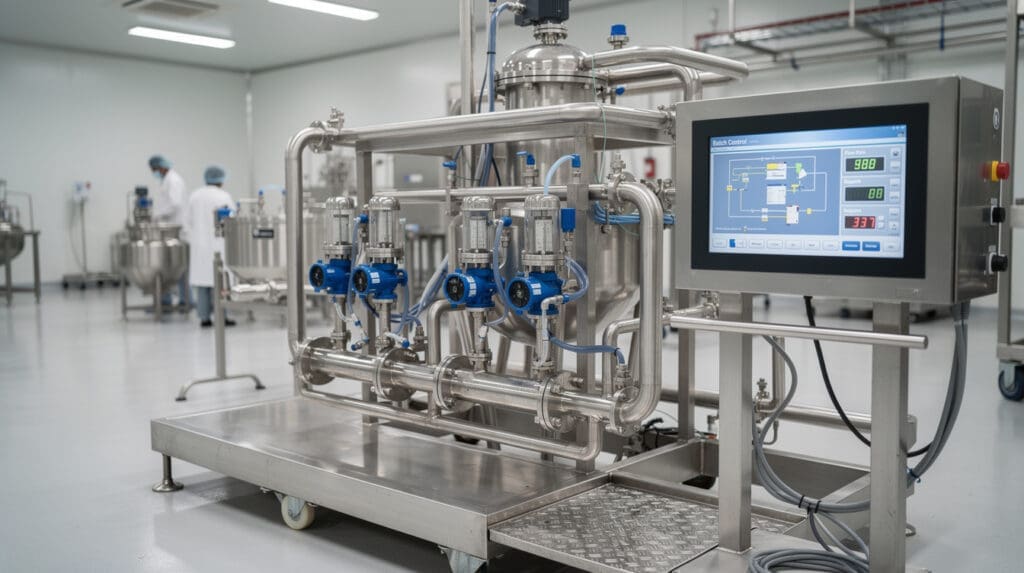
An industrial batching system is not just a flow meter wired to a pump. It is a highly tuned closed-loop control sequence. To achieve precise target volumes without overshoot, every single component in the skid must be mathematically matched.
1. The Metering Element: Viscosity Dictates the Sensor
I've calibrated enough turbine meters to know they don't belong anywhere near viscous fluids. Turbine rotors rely on fluid velocity. If viscosity shifts due to ambient temperature changes—say, a cold January morning in Ahmedabad versus a 45°C May afternoon—the slip factor changes, and your accuracy is destroyed.
For fluids like lube oil, resins, or syrups (up to 5,000 mPa·s), you strictly require a Positive Displacement (PD) meter. We typically spec our CE-110/111 series for this exact reason. PD meters trap exact fluid pockets, making volumetric accuracy completely independent of viscosity. If you handle water-like chemicals or solvents, you can safely use CE-210 turbine or helical sensors, which offer a highly cost-effective profile.
Always specify your maximum operating viscosity at your lowest ambient temperature. A gear pump pushing 5,000 mPa·s fluid at 20°C demands significantly more motor torque and strains the meter differently than it would at 40°C.
2. Dual-Stage Valve Logic for Overshoot Prevention
If you try to stop a 120 L/min flow instantly with a single electric solenoid, two things happen: water hammer fractures your manifold, and fluid inertia causes a 2 to 3-litre overshoot. I've seen plant managers learn this the hard way.
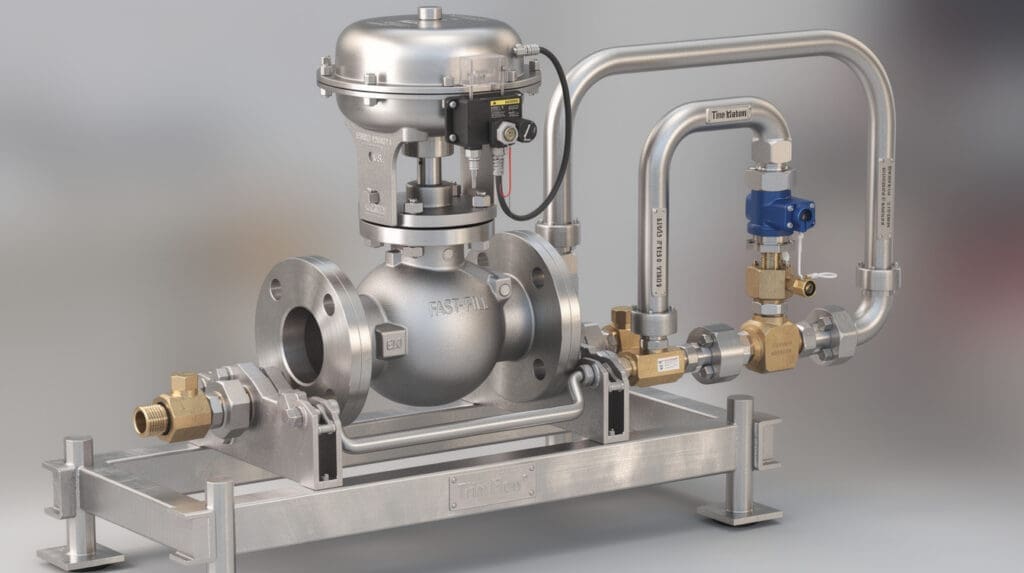
Professional skids use pneumatically actuated valves with fast/slow dual-stage logic. The PLC or preset controller runs the system at 100% flow until you reach 95% of your target batch. It then chokes the valve to a "trim" or "dribble" flow (say, 10 L/min) for the final 5%. The valve snaps shut precisely on the final pulse. This is how we guarantee that ±0.5% accuracy.
3. Pumping and Filtration
Liquid transfer pumps must be sized properly to maintain steady line pressure. For high-temperature applications like furnace oil or bitumen, we integrate a specialized Liquid Transfer Pump with a single helical gear design rated up to 200°C. For chemical transfer requiring different metallurgy, I strongly advise reviewing our PP Pump vs AODD Pump TCO Analysis to select the right driver for your skid.
Losing product to inaccurate manual filling?
Our liquid batching systems combine PD meters and dual-stage pneumatic valves to hit exact volumes every single time, from 5L to 1,000L.
Preset Controllers vs. PLC-Based Skids: Making the Call
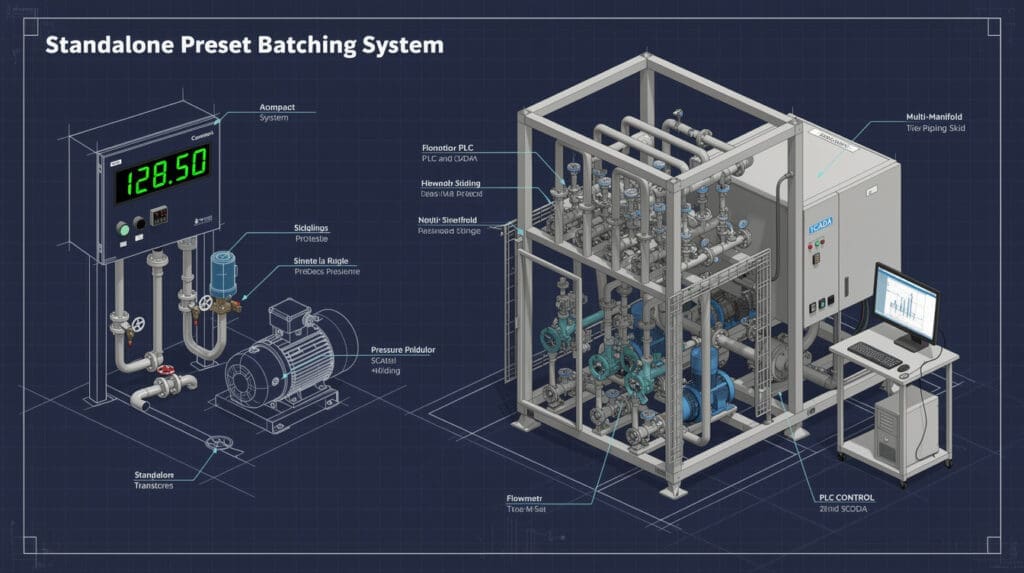
People often ask me about the liquid batching system price in India. The hard truth? The primary cost differentiator isn't the meter itself—it's the control architecture. You essentially have two routes: Standalone Preset Controllers or Full PLC/HMI Skids.
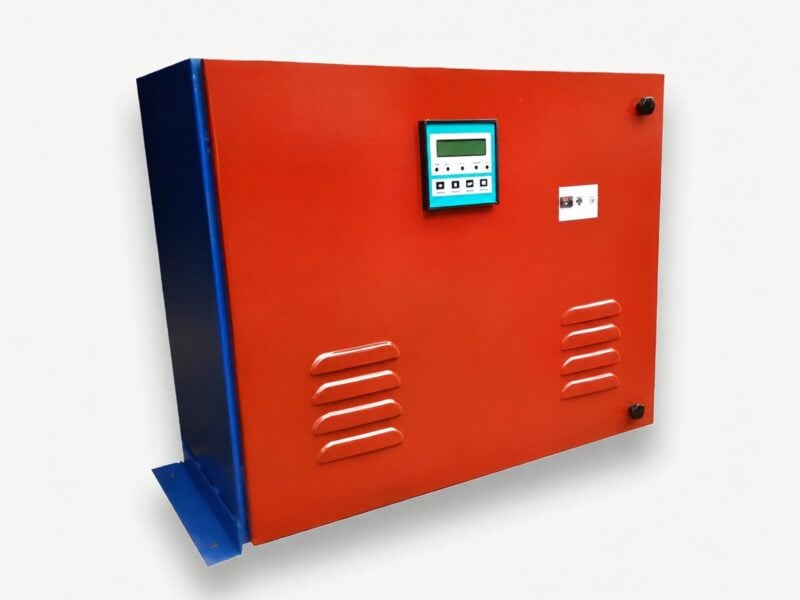
CE-136 Preset Batching System (Standalone)
The CE-136 is an absolute workhorse for single-recipe operations. It is a dedicated preset dispensing system that provides exact quantity dispensing to reactors or storage tanks.
- Accuracy: ±0.5%
- Best For: Drum filling, simple water/solvent dosing, single-fluid lines.
- Advantages: Lower initial CapEx, extremely simple for operators (punch in the number, hit start), zero software licensing, and it is highly resilient to the voltage fluctuations common in rural Indian industrial grids.
Custom PLC/HMI Skids (CE-113 Custody Standard)
When you move into multi-stage batching, ratio blending, or require deep SCADA integration, a PLC-based architecture becomes mandatory.
- Accuracy: Achievable ±0.2% (OIML R117 compliant capability).
- Best For: Automotive assembly lines filling exact gearbox reservoirs, complex chemical mixing skids, automated multi-head filling.
- Advantages: Stores hundreds of recipes, logs every batch to an ERP system (via Ethernet/Modbus), provides pulse/analog outputs, and guarantees digital traceability.
| Feature | CE-136 Preset Counter | PLC/HMI Skid System |
| :— | :— | :— |
| Accuracy | ±0.5% | ±0.2% to ±0.5% |
| Data Logging | Local Ticket Printer (Optional) | Full ERP/MES Integration |
| Multi-Fluid Blending | No (Single stream) | Yes (Complex manifold control) |
| TCO over 5 Years | Low | Medium-High (offset by automation gains) |
| Operator Skill Req. | Unskilled | Semi-skilled |
The Indian Industrial Context: Designing for Reality
Designing a flow measurement system in a pristine European lab is very different from making it survive a decade in an Indian GIDC estate. I can't count the number of times I've seen imported skids fail here simply because they weren't ruggedized for local conditions.
Power Quality and Isolation:
We frequently see severe voltage drops or spikes when neighboring heavy machinery powers up. Our control panels are engineered with proper galvanic isolation and 220V AC single-phase voltage regulators. If your application involves petrochemicals or solvents, standard panels are a serious fire hazard. We build flameproof (FLP) configurations certified to IS/IEC 60079 standards for hazardous locations.
Legal Metrology and Custody Transfer:
If you are selling product based on the meter reading—such as depot operations dispensing fuel loads—your system falls under the Legal Metrology Act. The meter must comply with IS 14883. For fleets and fuel yards looking to handle automated dispensing securely, I recommend reviewing our detailed Mobile Fuel Dispensers: PESO & Metrology Guide to understand the exact compliance matrix.
Monsoon Impact: High humidity during Indian monsoons regularly causes condensation inside poorly sealed electronic panels, shorting out analog output cards. Always specify IP65/IP67 rated enclosures for preset controllers and HMI units.
TCO Calculation: Manual vs. Automated Batching
Let's look at the actual numbers. Assume a medium-sized specialty chemicals plant is filling 200 drums (210 L each) per day with a manual pump and scale setup.
- Product Value: ₹120 per litre.
- Manual Inaccuracy: Operators typically overfill by 1.5% to avoid customer complaints (approx. 3.15 L per drum).
- Daily Giveaway: 630 Litres.
- Daily Cost of Giveaway: ₹75,600.
- Monthly Cost (25 days): ₹18,90,000.
By installing an automatic liquid batching system with a CE-110 PD meter and CE-136 preset controller (delivering ±0.5% accuracy), you reduce that giveaway by at least 66%. The system literally pays for itself in the first 14 days of operation. Any procurement manager balking at the liquid batching system price in India needs to evaluate this math immediately. It's not a capital expense; it's a leak prevention measure.
Stop guessing, start measuring.
Upgrade your plant with our CE-136 Preset Batching System for high-accuracy chemical and solvent dispensing with automatic cutoff.
Critical Installation and Sizing Parameters
Do not let your installation contractor ruin a perfectly engineered skid. I mean it. Based on field data, 80% of batching inaccuracies stem from poor plumbing upstream of the meter.
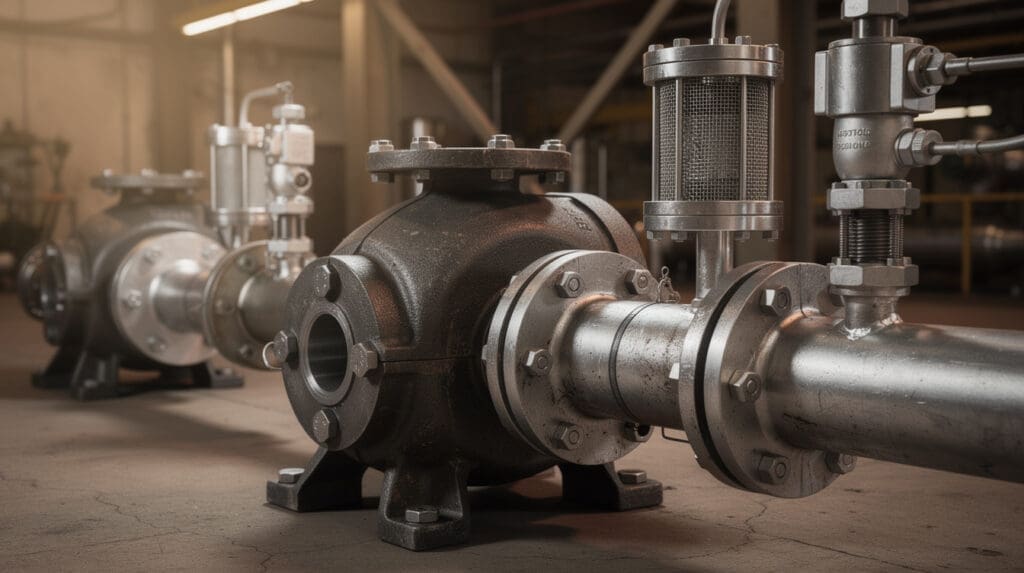
- Air Elimination: PD meters measure volume. If your pump pulls air through a loose suction joint or cavitates, the meter measures that air as liquid. You will overcharge your customer and underfill the drum. Always install an air eliminator upstream of the flow meter, especially in tank-stripping operations.
- Inline Filtration: A 100-micron inline strainer is non-negotiable. A single welding slag piece or rust flake from an old pipeline will jam the rotors of a PD meter instantly.
- Pipe Strain: I see this constantly—contractors misalign pipe flanges and force the bolts tight, putting immense mechanical stress on the meter casing. This warps the internal measuring chamber, causing the rotors to scrape. The skid must drop into your process tension-free.
Frequently Asked Questions
I get these questions weekly from plant managers looking to upgrade their lines:
What batch sizes can your systems handle?
Our typical liquid batching systems handle anywhere from 5 to 1,000 litres per batch. By utilizing multi-stage pneumatic valve logic, we keep overshoot below ±0.5% even on rapid, small-volume fills.
Can the system handle multiple fluids of varying viscosities?
Yes. For multi-fluid environments, we design manifolds with either dedicated meters and valves per fluid stream, or shared headers equipped with automated flushing cycles to prevent cross-contamination.
How does the CE-215 Custom Liquid Dispenser differ from the CE-136?
The CE-215 is an all-in-one dispenser unit featuring a digital LCD display, custom flow calculator, and integrated pump, typically built for bespoke industrial transfer needs. The CE-136 is a preset controller integrated into larger pipeline systems controlling external valves.
Are these systems compatible with highly corrosive chemicals?
Absolutely. While our standard skids use Cast Iron or Carbon Steel for petroleum, we upgrade wetted parts to SS-304, SS-316, or PTFE-lined components for corrosive chemical batching.
Do you support hazardous/explosive locations?
Yes. For petrochemical and refinery sites, we supply flameproof (FLP) motors, intrinsically safe barriers for pulse transmitters, and fully certified explosion-proof enclosures.
Can batch data be logged directly to our ERP system?
For our PLC-based architectures, yes. We provide pulse, 4–20 mA, Ethernet/Modbus, and serial outputs that seamlessly feed into plant SCADA, MES, or ERP dashboards for live inventory tracking.
My Final Takeaway
Manual dispensing and basic rotameters have no place in a modern, profitable manufacturing facility. The cost of material giveaway, human error, and quality control rejections infinitely outweighs the initial investment in precise automation.
If you are filling standard drums with a single consistent fluid, choose the CE-136 Preset Batching System paired with a PD meter. It provides robust, unskilled-operator-friendly accuracy. If you are operating a multi-fluid blending reactor or require strict digital traceability for automotive OEMs, you must invest in a custom PLC/HMI batching skid with dual-stage valves.
Stop the giveaway. Do the math on your current losses, then bring those numbers to our engineering team.
Ready to engineer your liquid batching system?
Share your fluid specs, maximum viscosity, and target batch volumes with our engineering team for a precise system sizing and quote.