
Engineer’s Guide to Mobile Fuel Dispensers
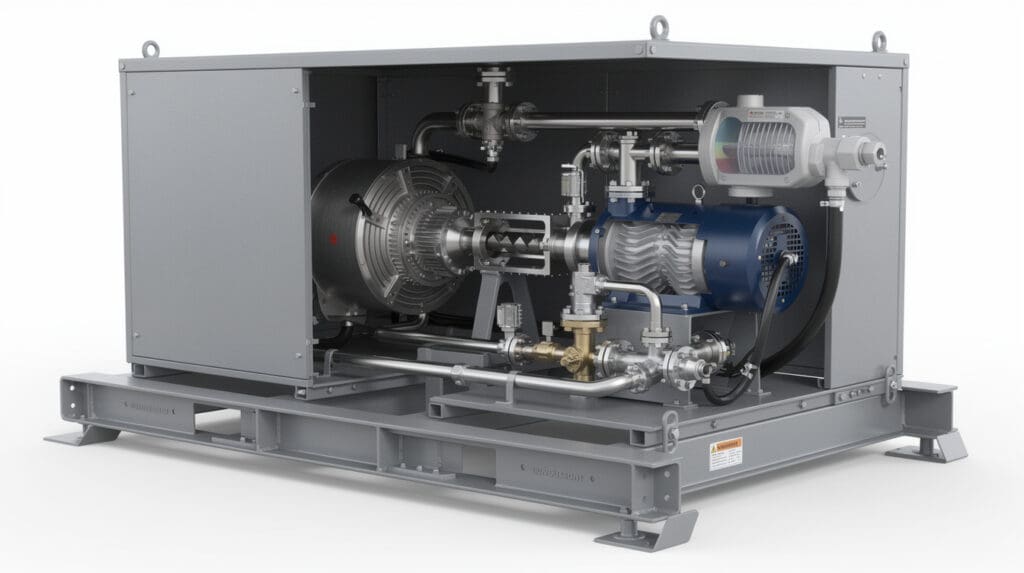
I have spent 22 years calibrating flow systems across India, from stationary ONGC refinery racks to service trucks deep inside GIDC industrial estates. While companies spend millions securing their main fuel depots, they frequently overlook the most vulnerable point in their operation: the mobile fuel bowser.
A mobile dispenser isn't just a pump attached to a tank; it is a dynamic custody transfer point moving through hostile environments. If you are pumping 5,000 liters of diesel a day through a standard mechanical gravity-fed or uncalibrated meter with a typical 2% drift, you are losing 100 liters of diesel daily. At current fuel rates, that is a direct bottom-line hit of approximately ₹2.7 Lakhs per month in untracked, unaccounted fuel. I see this math ignored constantly by fleet operators.
Below, I am going to outline exactly how to specify, install, and maintain mobile fuel units that actually align with IS 14883 and OIML R117 metrological standards. Your road dispensers should be as accurate as your static depot—no excuses.
The Anatomy of Metrology-Grade Mobile Dispensing
Mobile fueling environments are inherently violent. Have you ever ridden in the back of a bowser truck on a dirt road? Dispensers mounted on vehicle beds, trailers, or trolley systems endure constant multi-axis vibration, severe dust ingress, and voltage fluctuations from vehicle alternators. To maintain ±0.5% (or better) accuracy under these conditions, the internal architecture must be robust.
1. The Measurement Element: Positive Displacement
I have calibrated enough flow meters to know that cheap turbine meters do not belong anywhere near a mobile diesel bowser. Diesel's kinematic viscosity changes dramatically between a 45°C summer afternoon in Rajasthan and a 10°C morning. Turbine meters drift wildly when viscosity shifts; positive displacement (PD) meters do not.
That is why Chintan Engineers' CE-series dispensers utilize precision-machined rotary vane or oval gear positive displacement mechanisms. The CE-204, for instance, achieves ±0.2% accuracy by displacing a mathematically exact volume of fluid per rotation, completely independent of upstream flow profile or fluid viscosity.
2. Air Elimination and Filtration
When a bowser tank sloshes during transit, aeration occurs in the diesel. Pumping aerated fuel through a meter means you are paying for air—literally. It frustrates me how often I see setups lacking basic air elimination. A legally compliant mobile dispenser must include a mechanical air eliminator before the measuring chamber. Furthermore, onboard 10-micron filtration is non-negotiable to protect the PD meter's tight internal tolerances from tank rust and silica dust.
Always size your inline filtration to at least 150% of your maximum flow rate. For a 60 L/min dispenser like the CE-202, use a filter rated for 90 L/min to prevent cavitation as the filter loads with particulates over time. For more on this, refer to our Diesel Flow Meter Maintenance Guide: Preventive Checks to Maintain Accuracy, Repeatability, and Uptime.
Power Dynamics: DC vs AC Power on the Road
Specifying the drive motor is where many procurement managers make critical errors. They look at the price tag and forget the physics. You have two primary options for mobile power: DC systems running off the vehicle's electrical grid, and AC systems powered by onboard gensets or grid plug-ins.
12/24V DC Systems (CE-130, CE-202, CE-204)
These are the standard for true mobility, drawing directly from the truck's battery. However, you must account for voltage drop across long cable runs. I cannot count the number of times I have been called to fix a 'broken pump' that was actually just starved of voltage. A standard 12V DC rotary vane pump drawing 25 amps will stall under load if wired with undersized gauge cables from the cabin battery to the rear chassis.
Never hardwire a 24V DC dispenser directly across two 12V batteries in series without a dedicated isolation switch and inline 40A fuse. Voltage spikes from alternator load dumping can fry the digital preset CPU instantly.
220V AC Systems (CE-201 Heavy Duty Skid)
For high-throughput applications (up to 110 L/min) requiring continuous duty cycles, DC motors will overheat. The CE-201 utilizes a 1.2 kW AC motor, relying on a truck-mounted generator. When evaluating the casing materials for these larger setups, you must decide between different metallurgies based on environmental exposure. If your bowser operates near coastal corrosive zones, you should consult our breakdown on SS vs Cast Iron Pumps: An Engineer's Guide to understand casing longevity.
Struggling with battery drain on your current bowsers?
Our 12/24V DC mobile kits are engineered with high-efficiency rotary vane pumps that maximize flow while minimizing amp draw.
Selection Guide: Specifying the Right Mobile Fuel Kit
Over the last decade, I have compiled extensive field data to standardize our mobile dispenser builds. Below is the multi-factor comparison I use when consulting with fleet operators.
| Specification | CE-202 Compact Digital | CE-204 High Accuracy | CE-201 Heavy Duty Skid | CE-206 Advanced Data |
| :— | :— | :— | :— | :— |
| Flow Range | 20 – 60 L/min | 20 – 80 L/min | Up to 110 L/min | 20 – 80 L/min |
| Accuracy | ±0.5 % | ±0.2 % (achievable) | ±0.5 % | ±0.5 % |
| Power Option | 12 / 24 V DC, 220V AC | 12 / 24 V DC, 220V AC | 220 / 440 V AC | 12 / 24 V DC |
| Metering Tech | Digital PDP | Digital Preset | Mechanical Oval Gear | Digital Preset CPU |
| Max Pressure | 3 Bar | 3 Bar | 5 Bar | 0.3 MPa (3 Bar) |
| Data Logging | Current Batch | 365-day memory, Printer | Mechanical Totals | 365-day log, 12-mo history |
| Ideal For | Service Pickups | Auditable Bowser Fleets | Tanker Transfer | High-Security Operations |
Return on Investment (ROI) Calculation
Let's look at the actual Total Cost of Ownership (TCO) when upgrading a rudimentary bowser to a CE-206 Advanced Data dispenser with a receipt printer and 365-day memory log.
- Current State: 3,000 L/day dispensed via mechanical uncalibrated meter.
- Pilferage/Drift Rate: 1.5% (45 Liters/day).
- Daily Financial Loss: 45L × ₹90 = ₹4,050/day.
- Monthly Loss: ₹1,21,500.
- Upgrade Action: Install CE-206 with password-locked CPU preset and printer (Capital outlay approx. ₹85,000 – ₹1,10,000 depending on exact accessories).
- ROI Realization: The equipment pays for itself in less than 28 days of operation by locking the custody transfer loop.
Real-World Applications in Indian Infrastructure
A mining rig in Odisha has very different needs than a highway project in Gujarat. The deployment must dictate the engineering requirements.
1. NHAI Highway Construction Projects
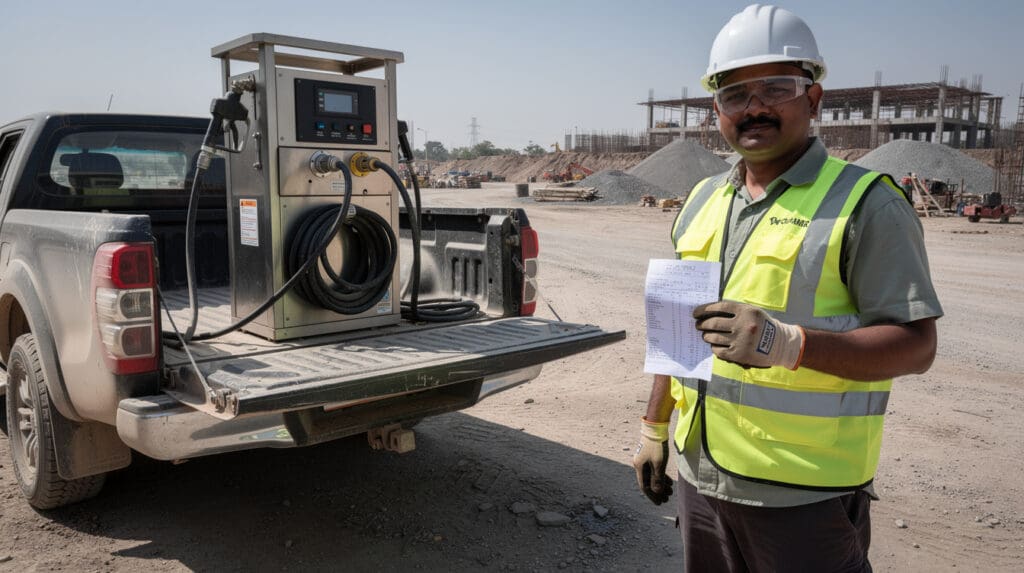
Earthmoving equipment on highway stretches cannot travel 15 kilometers back to a static depot to refuel. Bowsers mounted on 4×4 trucks deliver fuel directly to excavators and graders. In these high-dust environments, the CE-117 and CE-101 models, which feature brass components and robust ambient noise automatic shutoff nozzles, perform exceptionally well.
Dust ingress is the number one cause of preset keypad failure in construction site bowsers. All our digital CPU models use sealed membrane keypads rated to IP65, specifically selected after rigorous field testing in Rajasthan's cement plants.
2. Mining Operations and Remote Quarries
In hazardous mining zones, electronic components present a massive ignition risk if not properly rated. For these sites, we specify Flameproof (FLP/EX) motors and enclosures. Grounding static electricity is paramount. A mobile dispenser must utilize continuity-checked grounding wire reels before fuel transfer begins, aligning with petroleum safety organization (PESO) guidelines. Never skip the grounding reel.
3. Agricultural and Farm Fleet Fueling
Tractor fleets in large-scale farming require rapid refueling during harvest season. The CE-130, while primarily designed for Adblue/DEF with its digital LCD display, has mechanical equivalents in our range that provide perfect, low-cost metering for tractor depots that run directly off 12V tractor batteries.
Need a mobile fueling solution built for extreme conditions?
Our skids feature powder-coated enclosures, heavy-duty hose reels, and FLP options for hazardous zones.
Installation and Calibration Best Practices
You can buy the best meter on earth, but if your local fabricator welds it wrong, it is useless. Based on thousands of field commissioning reports, here is my protocol for setting up a mobile dispenser:
- Vibration Isolation: Do not bolt the dispenser skid directly to the rigid vehicle chassis without elastomeric isolation mounts. Frame torsion during off-road driving will eventually crack the pump manifold. I see this structural failure far too often.
- Suction Line Geometry: The suction pipe from the bowser tank to the rotary vane pump must be absolutely rigid (no collapsible hoses) and possess a dedicated foot valve. Air leaks on the suction side destroy accuracy.
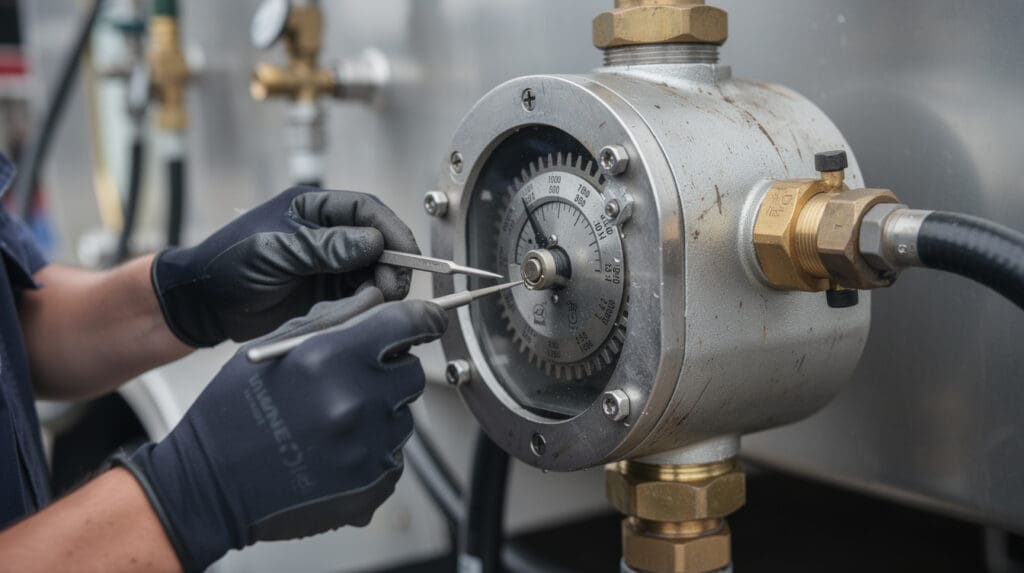
- Proving and Calibration: Mobile meters must be calibrated dynamically. We run volume proving at 30%, 60%, and 100% of the flow range. We issue calibration certificates that trace back to Legal Metrology standards. If you are also managing stationary bulk tanks, the calibration principles are similar to what I discussed in our guide on Data Center Generator Fuel Flow Meters & Auditing.
Common Technical Questions from the Field
Will the DC dispenser drain my truck's battery?
Yes, if you aren't careful. Our 12V and 24V DC systems are designed to pull directly from the vehicle, but we mandate that the vehicle engine must be running during extended dispensing operations. This ensures the alternator continuously charges the battery, preventing deep discharge.
How do I stop drivers from stealing fuel on the road?
The CE-206 features a CPU-based preset controller requiring operator authentication. It records the exact volume, date, and time of every transaction in a 365-day internal log. If fuel is dispensed without authorization, the audit trail captures the discrepancy immediately.
Do the mobile dispensers come with hose management?
Yes. Leaving hoses loose on a truck bed invites damage and contamination. Each kit can be integrated with heavy-duty auto-retract hose reels holding 4m to 6m of steel-wire reinforced rubber hose, terminating in an automatic shut-off nozzle with an integrated swivel.
Are these systems compatible with viscous liquids like lubricants?
While the mechanical oval gear models (like the CE-201 skid) can handle oils and higher viscosity lubricants, the standard rotary vane pumps on the CE-117/101 are optimized strictly for diesel. Always specify your fluid type before ordering.
What documentation is provided for Legal Metrology compliance?
Every mobile dispenser ships with a factory calibration certificate, volumetric test reports across three flow rates, detailed wiring schematics, and standard operating procedures (SOPs) for field grounding and operation.
The Engineer's Verdict
Treating a mobile fuel bowser as an unmonitored utility is an operational error that costs Indian fleets crores of rupees annually. By implementing a metrology-grade mobile fuel dispenser, you close the custody transfer loop, ensuring that every drop drawn from your bulk storage securely makes it into your machinery's fuel tank.
Based on 22 years of field data, here is my recommendation: If you are outfitting a service pickup for localized maintenance, the CE-202 Compact Digital Kit provides the perfect balance of weight, DC power efficiency, and ±0.5% accuracy. If you are managing a dedicated 10,000L highway bowser where strict auditing is required, do not compromise—install the CE-206 or CE-204 with the 365-day data log and receipt printer.
Stop paying for calibration drift and start measuring your mobile inventory like an engineer.
Ready to turn your bowsers into certified mobile fueling stations?
Contact Chintan Engineers to discuss vehicle tank capacity, power availability, and integration requirements.
Need a meter or dispenser for a specific duty?
Tell us the fluid, flow range and site; we reply with a model and a quote within one working day.