
Mobile Fuel Dispensers: Engineering & Sizing
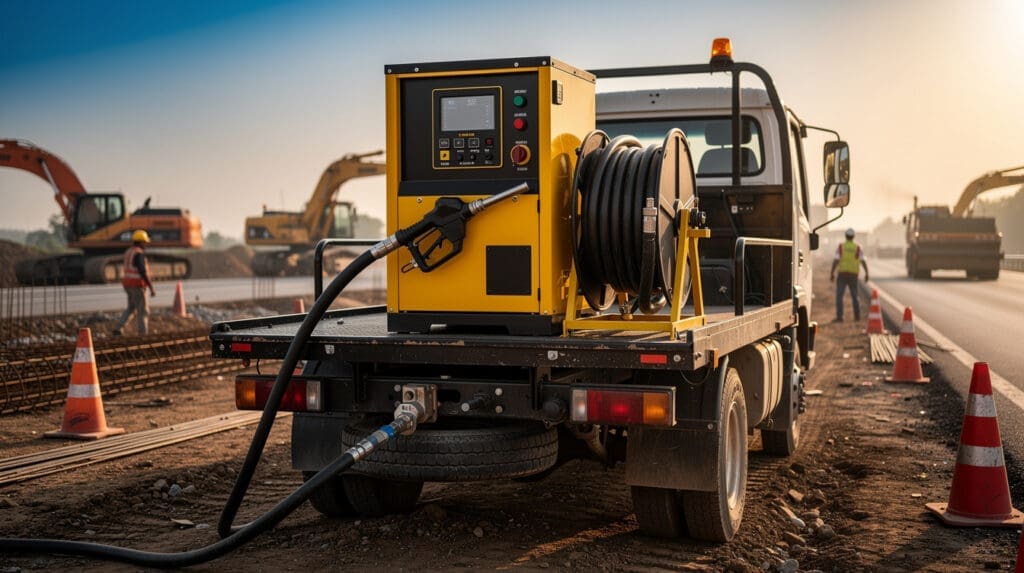
I am Vikram Desai, and over the last 22 years at Chintan Engineers, I have calibrated more than 5,000 flow measurement systems. I have spent my career out in the field—from the polished infrastructure of ONGC refineries to the dust-choked mining roads of rural Gujarat. If there is one reality I constantly force procurement managers to accept, it is this: dispensing fuel at a static, concrete-paved retail outlet is easy. Dispensing fuel from the back of a vibrating, sloshing 4×4 pickup truck using variable DC power is an entirely different physics problem.
When heavy industrial equipment—excavators, dumpers, and mobile cranes—cannot come to the fuel depot, the depot must go to them. But the moment you transfer High-Speed Diesel (HSD) into a mobile bowser, your risk of pilferage, measurement error, and contamination skyrockets. You are no longer just fighting gravity and friction; you are fighting chassis vibration, voltage drops from vehicle alternators, and severe off-road dust ingress.
Instead of theoretical fluff, I am going to break down exactly how to specify, size, and deploy a mobile fuel dispenser skid. We will rely on real-world BIS standards (IS 14883), OIML R117 compliance parameters, and actual test bench data. No sales pitches—just the uncompromising technical reality of mobile flow measurement.
The Physics of Mobile Fuel Measurement
To understand why a cheap, unbranded transfer pump inevitably fails within three months on a mining site, you have to understand the brutal operating conditions of a mobile bowser. It is basic physics, yet it gets ignored every single day.
In a static retail dispenser, you have stable 230V AC power, a fixed static suction head, and rigid piping. In a mobile environment, your power source is usually a 12V or 24V DC vehicle battery. As the vehicle's engine RPM fluctuates, the alternator output fluctuates. A drop from 13.8V to 11.5V under load changes the RPM of your transfer pump. If your pump speed varies, the fluid velocity varies.
I have ripped out enough cheap turbine meters to know they do not belong anywhere near viscous fuels in variable-flow environments. Turbine rotors rely on a consistent fluid velocity profile (Reynolds number) to maintain their K-factor. If your pump slows down due to a battery voltage drop, your turbine meter's accuracy collapses. You will literally be giving away fuel for free.
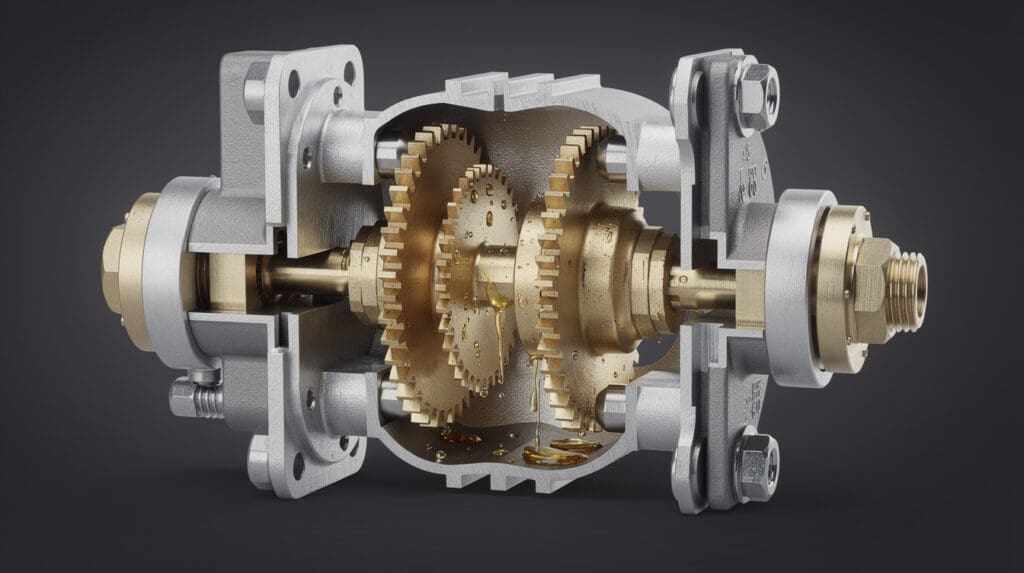
This is why true mobile dispensers rely exclusively on Positive Displacement (PD) technology—specifically oval gear or rotary vane meters. A PD meter does not care about fluid velocity. It mechanically traps a specific, unvarying volume of liquid between its gears for every rotation. Whether the fluid is moving at 20 Liters Per Minute (LPM) or 80 LPM, the volume per pulse remains absolute.
The Viscosity Variable: High-Speed Diesel (HSD) changes viscosity based on ambient temperature. On a cold desert night in Rajasthan, diesel is thicker than during a 45°C afternoon in Ahmedabad. Positive displacement meters negate this viscosity variable, maintaining strict ±0.5% or better accuracy across extreme temperature shifts.
Core Architecture of a Certified Mobile Skid
When we build a system like the CE-204 High Accuracy Mobile Dispenser, we are not just assembling loose parts. In fact, I despise the word "kit." A ruggedized setup is a self-contained fluid custody transfer system. A proper skid consists of four critical stages:
1. Prime Mover and Pumping Stage
The heart of the skid is typically a rotary vane pump. Unlike centrifugal pumps, rotary vane designs are self-priming and handle the suction lift required to pull diesel from a deep bowser tank. Most importantly, they feature an internal mechanical bypass valve. If a frustrated operator shuts the delivery nozzle while the pump is still running, the bypass opens, recirculating the fluid internally to prevent deadheading and motor burnout.
2. Filtration and Air Elimination
Mobile tanks slosh continuously, aerating the fuel and kicking up bottom sludge. An inline strainer (usually 100-micron or finer) is mandatory before the meter. Furthermore, if you are seeking Legal Metrology stamping, the system must ensure air is not metered as fluid. High-end systems utilize robust air separators before the measurement chamber.
3. Metering and Pulse Generation
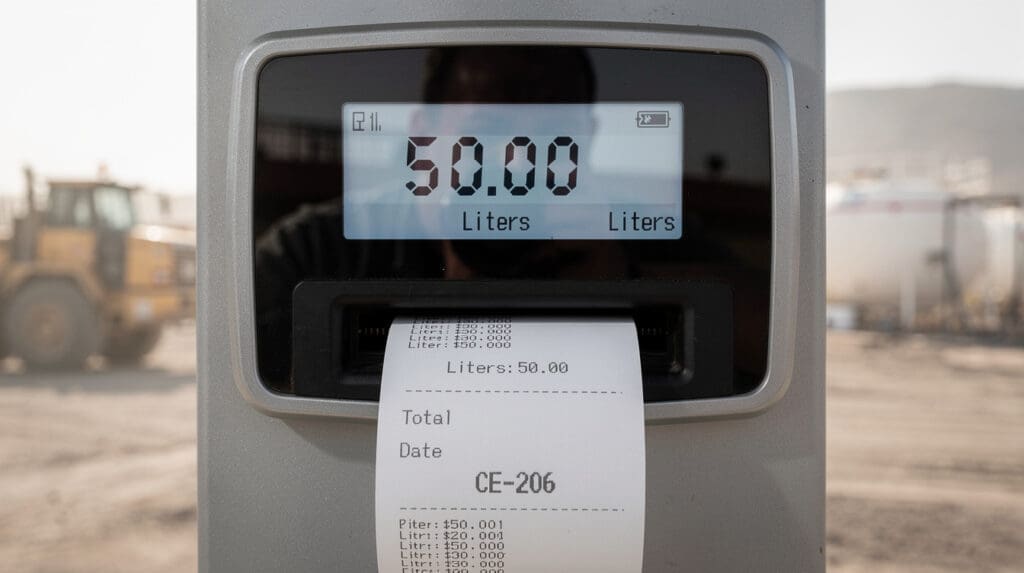
For mechanical systems like the CE-101, the meter drives a physical numeral counter via a gear train. For digital systems like the CE-206, the rotation of the oval gears passes a magnet over a Hall-effect sensor, generating high-resolution electrical pulses. The CPU converts these pulses directly into volume.
4. Control and Auditing (The Brain)
The defining feature of a modern fleet dispenser is the preset controller. Instead of an operator manually watching a dial and trying to stop exactly at 50 liters, the CPU handles it. The operator inputs "50 L", hits start, and the CPU manages the solenoid valve, executing a precise two-stage shutdown (slow flow, then complete shutoff) to hit exactly 50.00 liters without water-hammering the hoses.
Losing track of diesel in the field?
Upgrade your bowsers with CE-206 preset digital controllers featuring 365-day data logging and built-in thermal receipt printers.
Sizing and Selection Guide: The Chintan Lineup
After two decades, I have stopped letting clients guess what they need. I strictly categorize fleet requirements into a few distinct operational profiles. You do not always need a printer-equipped digital unit if you are just filling agricultural tractors, but you absolutely need one if you are running a commercial remote refueling service.
Here is the hard data on how our systems compare based on real bench testing and field deployment—not glossy brochure numbers:
| Model | Flow Range | Metering Technology | Accuracy | Power Requirement | Best For / Key Features |
| :— | :— | :— | :— | :— | :— |
| CE-101 Dispenser | 40 – 60 L/min | Mechanical Counter, Brass body | ±0.5% | 12/24V DC or AC | Dusty mines, highly abusive environments where electronics fail. |
| CE-117 Dispenser | 40 – 60 L/min | Digital CPU, Brass body | ±0.5% | 12/24V DC or AC | Basic fleet service pickups, robust functional life. |
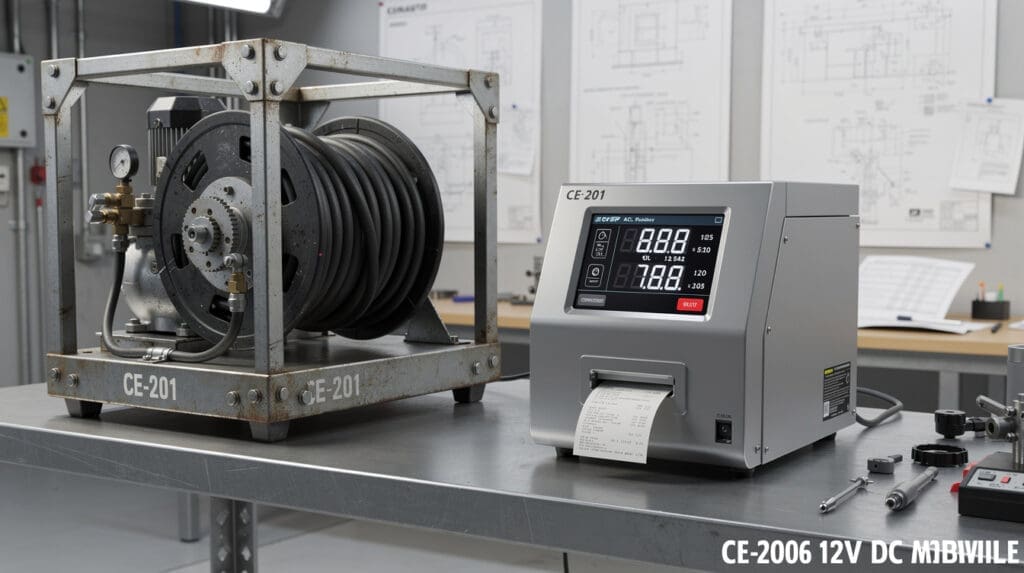
| CE-206 Digital Dispenser | 20 – 80 L/min | High Accuracy PD, Digital | ±0.5% | 12/24V DC | Fleet management. Stores daily data for 365 days. Built-in receipt printer. |
| CE-204 High Accuracy | 20 – 80 L/min | Precision Oval Gear, Digital | ±0.2% | 12/24V DC, 220V AC | Custody transfer, heavy bowser fleets needing strict transaction memory. |
| CE-201 Heavy Duty Skid | Up to 110 L/min | Large Mechanical Oval Gear | ±0.5% | 220/440V AC | High-volume tanker trucks. Features 1.2 kW pump for rapid transfer. |
Analyzing the Specifications
Looking at the CE-206, the standout feature is the 365-day onboard memory. I have investigated pilferage cases where site managers claimed the dispenser "reset itself" overnight. The CE-206 makes this excuse impossible. It holds a year of daily dispensing data and 12 months of cumulative monthly data. You can audit the bowser's totalizer against the depot's loading totalizer. If there is a discrepancy, you know exactly where the leak is.
For sheer durability, the CE-101 Mechanical Dispenser remains a staple in Indian stone quarries and coal mines. The brass construction withstands a maximum pressure of 3 BAR, and the lack of a complex digital display means there are no LCD screens to crack when a rogue piece of gravel inevitably hits it.
For deep dives into selecting the right flow rates based on your specific tank geometries and delivery schedules, I strongly suggest reviewing our Mobile Fuel Dispenser Engineering Specs & Sizing documentation.
Surviving the Indian Industrial Environment
Designing for a temperate European climate is one thing; European gear rarely survives its first monsoon here. Designing for the Indian industrial sector requires anticipating extreme operational abuse.
The Monsoon Humidity Factor
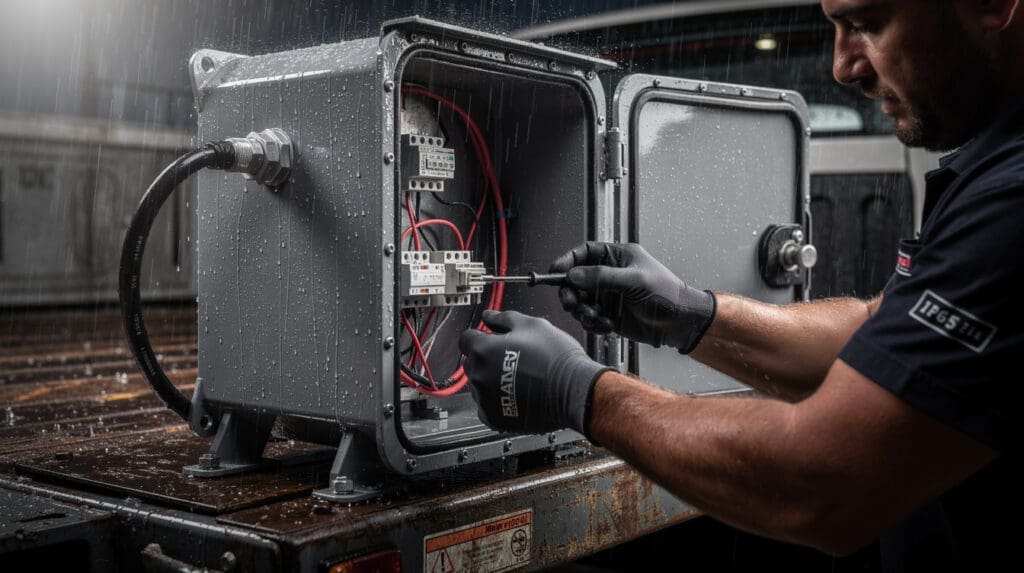
If you have ever been to a GIDC (Gujarat Industrial Development Corporation) estate during the monsoon, you know relative humidity routinely hits 95%. If the electronic enclosure of a digital dispenser is not hermetically sealed or conformal-coated, condensation forms directly on the internal PCB. This leads to erratic pulse counting or complete controller failure. Our CE-series digital units utilize sealed housings to prevent moisture ingress, but I still advise operators to ensure the outer weather doors of the bowser cabinets remain closed during transit.
Voltage Fluctuations and Generator Sets
On remote construction sites, AC power is often supplied by uncalibrated, poorly maintained diesel generators. A nominal 220V AC line might surge to 260V or drop to 180V in seconds. These extreme voltage sags will quickly burn out standard AC pump coils.
This is exactly why I generally recommend standardizing on 12V or 24V DC systems (CE-202, CE-206) for mobile setups. By pulling power directly from the truck's heavy-duty alternator and battery bank, you bypass the unstable AC site grid entirely. The truck's built-in voltage regulator acts as a buffer, ensuring the dispenser receives clean DC power.
The "Short Wire" Rule: When wiring a 12V DC fuel dispenser to a truck battery, voltage drop over long cable runs is your worst enemy. A 12V pump drawing 40 Amps requires thick-gauge copper wiring. If your cable is too thin or too long, the voltage reaching the motor might drop to 9V. The motor will overheat and flow rates will plummet. Keep DC cable runs as short as possible and over-spec the wire gauge.
Installation Protocol and Calibration Reality
Even the best engineered ±0.2% accuracy CE-204 dispenser will yield garbage data if installed incorrectly. Proper integration into the bowser is simply non-negotiable.
1. Mechanical Integration and Piping
The suction line from the bottom of the bowser tank to the pump inlet must be entirely airtight. Even a microscopic pinhole leak at a pipe thread will allow the rotary vane pump to draw in air. This aerates the fuel, causes pump cavitation (which destroys the vanes), and introduces air into the positive displacement meter, causing artificial over-registration of fuel.
2. Static Earthing (Crucial Safety Protocol)
Flowing diesel generates static electricity through fluid friction against the hoses and pipes. In a static depot, the underground tanks are deeply earthed. In a mobile bowser, the tank is sitting on rubber tires—it is electrically isolated from the ground.
Static Discharge Hazard: Never operate a mobile fuel dispenser without proper grounding. I have personally investigated sites where a spark jumped from an ungrounded nozzle. The dispenser skid, the bowser tank, and the delivery hose must all share a common earth bond, and the truck must be connected to an earth pit or grounding rod during dispensing. It is a fast track to a catastrophic fire if ignored.
3. Volume Proving and Calibration
Once installed, the system must be proved. You do not just turn it on and blindly trust the factory calibration. We run a certified 20-liter or 50-liter proving measure (a conical metallic vessel stamped by Legal Metrology). We dispense exactly 50 liters according to the dispenser's digital controller, and we read the physical meniscus in the proving measure.
If the dispenser shows 50.00 L but the physical measure shows 49.85 L, we access the dispenser's calibration menu and adjust the K-factor (the number of pulses the CPU expects per liter). We repeat this at high flow (nozzle fully open) and low flow (nozzle barely open) to ensure strict linearity across the operational range.
For a technical look at the plumbing and mechanical setup of flow meters, my earlier article, Oil Flow Meter Installation: Expert Setup Guide, covers the fluid dynamics in detail.
Require OIML R117 compliant accuracy?
Our engineering team provides end-to-end installation and proving for the CE-204 ±0.2% accuracy mobile dispensers.
Total Cost of Ownership (TCO) and Return on Investment
I always force procurement teams to look at the actual math, because they often balk at the upfront cost of a fully certified, ±0.2% accuracy digital skid like the CE-204 with a built-in printer, preferring to patch together a cheap ₹15,000 agricultural transfer pump.
Assume your bowser delivers 5,000 liters per day.
Over 30 days, that is 150,000 liters.
At roughly ₹90 per liter of HSD, that is ₹1,35,00,000 worth of liquid asset moving through that single pump every month.
A cheap, uncalibrated transfer pump routinely drifts by 1% to 2% within its first few months due to wear on the impeller and lack of proper mechanical measurement.
A 1% unrecorded error rate equals 1,500 liters of lost fuel per month.
1,500 liters × ₹90 = ₹1,35,000 lost per month.
A precision system like the CE-204 or CE-206 costs more upfront, but by reducing that error margin to an audited ±0.2% and eliminating physical pilferage through digital receipt tracking, the equipment pays for itself entirely within the first 45 days of operation. After that, it is pure operational savings.
If you are currently experiencing erratic totalizer readings or pump failures on your existing mobile setups, do not immediately scrap the hardware. Consult our Fuel Dispenser Troubleshooting Guide & Fixes to identify if the issue is a simple PCB fault or a deeper mechanical failure.
Frequently Asked Questions
Can I run a mobile fuel dispenser entirely on vehicle battery power?
Yes. Models like the CE-206 and CE-117 are equipped with 12V or 24V DC motors specifically designed to operate off standard vehicle batteries or alternators. They draw manageable amperage, allowing the pump, meter, and digital controller to function completely independent of an erratic AC grid.
How do I prevent diesel pilferage during mobile fueling operations?
Preventing pilferage requires hardware-level logging. Deploying a unit like the CE-204 or CE-206 provides a digital preset controller with password protection, an integrated receipt printer, and storage for 365 days of daily data. This ensures every drop delivered is logged against a specific vehicle or asset, practically eliminating unaccounted fuel shrinkage.
What is the difference between mechanical and digital mobile dispensers?
Mechanical dispensers (like the CE-101) use a physical numeral counter driven by gears and do not require external control power beyond the pump motor; they are highly resistant to electrical faults and dust. Digital dispensers (like the CE-206) use pulse outputs from the meter to an electronic CPU, allowing for preset batching, higher accuracy (±0.2% to ±0.5%), data storage, and thermal printer integration.
Why use an oval gear meter instead of a turbine meter for diesel dispensing?
Turbine meters rely on fluid velocity and are heavily affected by changes in diesel viscosity (which fluctuates with ambient temperature) and variable pump flow rates. Oval gear positive displacement meters physically measure discrete volumes of fluid mechanically, ensuring high accuracy (up to ±0.2%) regardless of temperature, viscosity, or varying battery voltages causing pump speed fluctuations.
Are these mobile fuel skids approved by Legal Metrology?
Mobile dispensing systems must meet OIML R117 standards and IS 14883 specifications for accuracy. Our high-accuracy systems (±0.5% and ±0.2%) are built to meet these rigorous standards, and we facilitate proper calibration and proving to ensure Legal Metrology compliance for commercial transfer.
Do I need a flameproof motor for a diesel bowser?
Diesel (HSD) has a relatively high flashpoint compared to petrol (gasoline), meaning standard industrial enclosures are often permissible in open-air mobile environments. However, if the bowser is operating inside a designated hazardous zone (like an active refinery or chemical plant), EX/FLP (Flameproof) motors and enclosures must be strictly specified.
Final Engineering Recommendation
If I am staking my 22-year reputation on your site, analyzing failure rates across hundreds of Indian industrial facilities, here is what I recommend for your operation:
If you are running a heavy-duty commercial fuel delivery service where custody transfer accuracy is paramount and every drop must be billed, you cannot compromise. Specify the CE-204 High Accuracy Mobile Dispenser. The ±0.2% accuracy profile combined with a thermal printer guarantees zero disputes with your end clients.
If you are managing an internal fleet—say, a mining company fueling its own excavators—the CE-206 Digital Dispenser is the optimal balance. The 365-day internal data storage gives your logistics managers complete auditing capability, and the standard ±0.5% accuracy is more than sufficient for strict internal cost-center tracking.
Stop relying on dipsticks and uncalibrated transfer pumps. Treat mobile fuel delivery with the exact same engineering rigor as your static depots.
Ready to engineer a leak-proof mobile fueling strategy?
Contact our team with your bowser capacity and target flow rates. We will configure a skid matched to your exact operational physics.
Need a meter or dispenser for a specific duty?
Tell us the fluid, flow range and site; we reply with a model and a quote within one working day.