
Fuel Dispenser Troubleshooting Guide & Fixes
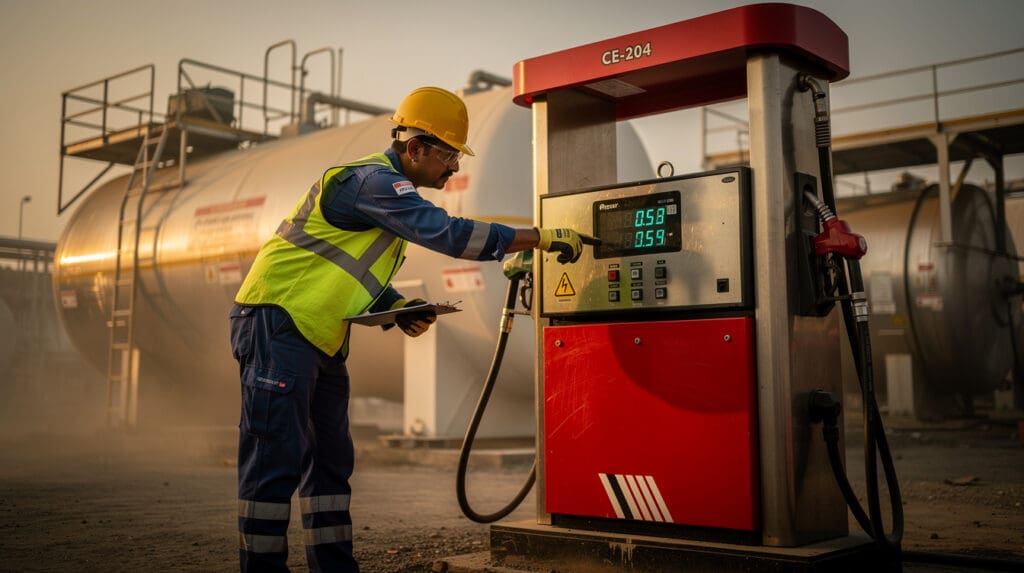
A 1% calibration drift on a standard 5,000-liter-per-day factory throughput costs your operation exactly ₹1,35,000 per month in untracked diesel. I spent three days at a massive cement plant in Kutch last summer tracking down what the plant manager swore was a faulty electronic motherboard. It wasn't the electronics. It was cavitation caused by a ₹200 blocked suction strainer that was sending air pockets through a positive displacement meter.
Over the last 22 years at Chintan Engineers, I have designed, installed, and calibrated over 5,000 flow measurement systems—from high-pressure ONGC refineries to dust-choked rural GIDC estates in Gujarat. If there is one truth I have learned about fuel dispenser troubleshooting, it is this: 80% of all diesel dispenser pump issues come down to basic hydraulics, poor site conditions, and neglected preventative maintenance, not catastrophic mechanical failure.
Instead of swapping out expensive parts on a hunch, let's look at how to actually diagnose the three most common industrial fuel dispenser issues: suction loss, auto shut-off nozzle failures, and electronic display errors. I'll show you exactly what to look for.
Diagnosing Suction Loss and Cavitation in Diesel Dispenser Pumps
When a plant engineer calls me complaining that their pump is running but no fluid is dispensing, or that the flow rate has dropped from a healthy 60 L/min down to a trickling 15 L/min, the immediate suspect is suction loss.
Most industrial units—including the CE-117 and CE-202 models we build here at Chintan Engineers—rely on rotary vane pumps. While self-priming and tough, relying on the centrifugal force of sliding vanes to create a vacuum, they are entirely at the mercy of inlet restrictions.
1. The Clogged Y-Strainer
I've seen enough bypassed strainers in dusty industrial estates to know one hard truth: skipping a ₹500 filter maintenance routine will invariably destroy a ₹15,000 positive displacement meter.
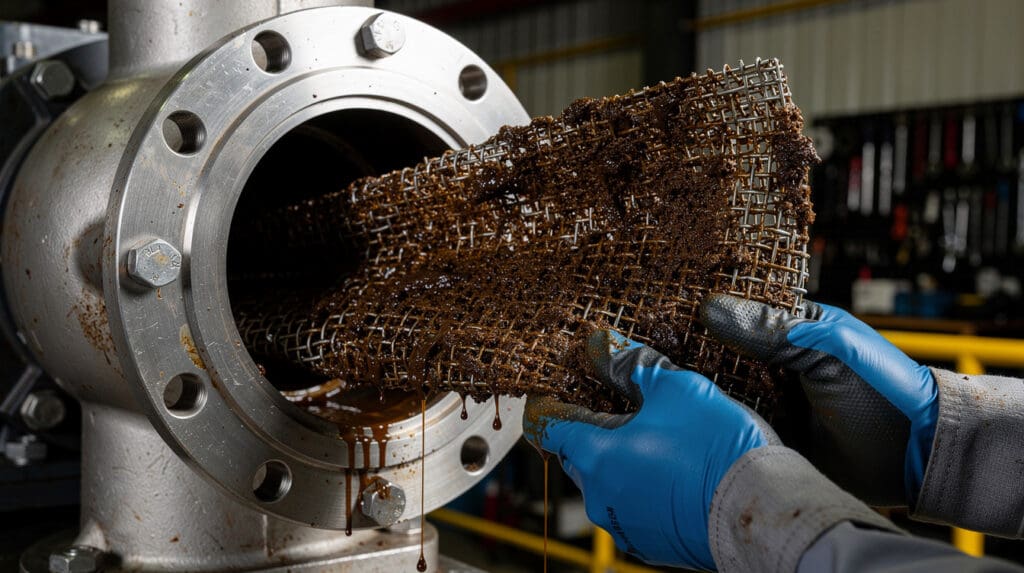
In Indian factories, diesel is rarely pristine. It picks up silica dust, rust from old MS (Mild Steel) storage tanks, and sludge. The suction strainer catches this. As the mesh blinds over, the pump works harder to pull fluid. This drops the pressure inside the suction line below the vapor pressure of the diesel, leading to cavitation. The pump ends up sounding like it is pumping gravel.
The Fix: Isolate the pump, open the strainer housing, remove the stainless steel mesh, and wash it in clean solvent. Never run the pump without the mesh installed.
2. Bypass Valve Malfunctions
Every industrial rotary vane pump has an internal bypass (relief) valve. If an operator shuts the delivery nozzle while the pump is running, the bypass valve opens, allowing the fuel to recirculate within the pump head to prevent dead-heading and motor burnout. If a piece of debris wedges this poppet valve partially open, it's a frustrating but common scenario: the pump will continuously recirculate fuel instead of pushing it out the delivery hose.
The Fix: Remove the hex nut covering the bypass valve, extract the spring and poppet, and inspect the seating surface for scoring. Clean and reassemble.
3. Air Leaks in the Suction Line
If you have an underground tank or a bottom-draw surface tank, the pump is operating under negative pressure. Even a microscopic pinhole leak at a threaded joint or a worn flange gasket will allow air to be sucked into the system. Since air is highly compressible and fuel isn't, the pump just spins uselessly, losing its prime.
Install a vacuum gauge on the suction inlet of the pump. A clean system pulling from a standard depth should read between 2-5 inches of mercury (inHg). If your gauge reads over 10 inHg, you have a severe blockage. If it reads 0 inHg but the pump is spinning, you have an air leak or broken vanes.
Why Your Fuel Dispenser Nozzle Is Not Working
Auto shut-off nozzle failures are easily the most reported issue in fleet yards. A nozzle that refuses to latch open, or one that overflows the tank without shutting off, presents a massive safety hazard.
Before you throw away a perfectly good nozzle, you have to understand how the auto shut-off mechanism actually works. Surprising to many, it isn't electronic at all—it's a purely mechanical Venturi system.
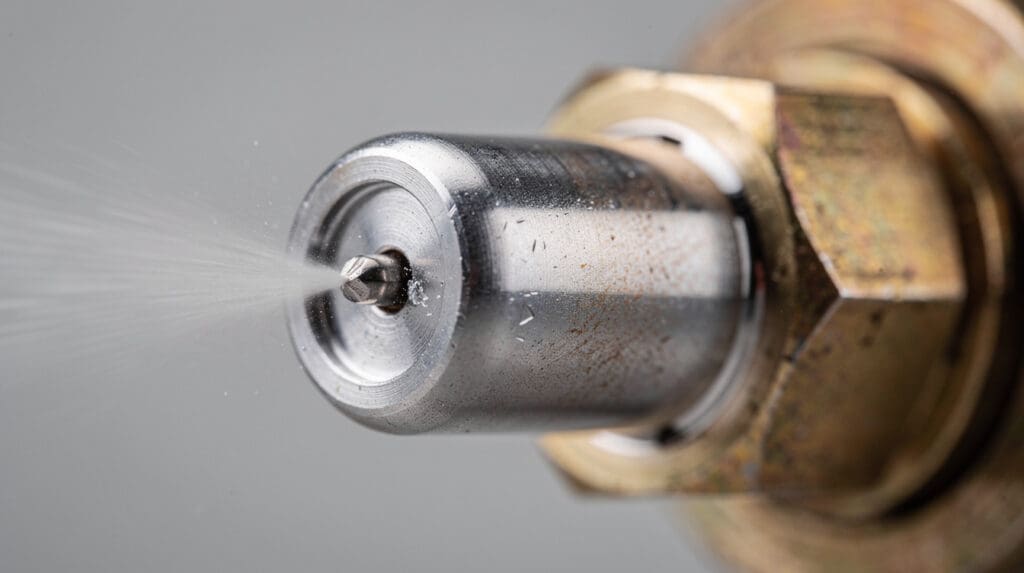
As fuel flows through the nozzle, it passes through a tight restriction (the Venturi), creating a localized pressure drop. This vacuum sucks air in through a tiny sensing port located at the tip of the nozzle spout. As long as air flows freely through that tip, the nozzle stays open. The moment diesel covers that sensing port (when the tank is full), the vacuum suddenly pulls on a diaphragm inside the nozzle handle instead of pulling air. This trips the latching mechanism, snapping the main poppet valve shut.
Common Nozzle Failures:
- Constant Premature Shut-off: The sensing port at the tip of the spout is blocked. Trust me, I see this all the time. In high-humidity monsoon conditions, mud, dust, and diesel film create a hard paste inside this port.
- Failure to Shut Off: The internal diaphragm has ruptured, or the vacuum tube inside the spout has a hairline crack, meaning the venturi vacuum never triggers the release mechanism.
- Leaking from the Spout: The main poppet O-ring is degraded. If you are pumping biodiesel (which is highly aggressive to standard Nitrile rubber) through a standard nozzle, the seals will swell and fail within weeks.
The Fix: Before writing off the unit, grab a compressed air gun and blow out the sensing port at the tip of the spout. Nine times out of ten, clearing this venturi pathway completely resolves the "fuel dispenser nozzle not working" complaint.
Tired of constant nozzle replacements and pump failures?
Chintan Engineers builds fuel dispenser systems specifically for harsh Indian factory environments, featuring heavy-duty rotary vane pumps and ambient-noise auto-shutoff nozzles.
Electronic Display Errors and PDP Meter Calibration Drift
Upgrading from rugged mechanical units (like our older CE-101) to digital systems requires a shift in mindset regarding power infrastructure. When I get a call about a scrambled display, it's rarely a fried CPU—it's almost always a symptom of terrible power quality.
Voltage Fluctuations and CPU Reboots
In rural industrial sectors, a heavy motor starting up on the same electrical panel can drop the line voltage from 220V AC down to 160V AC for a fraction of a second. This micro-brownout causes the dispenser's CPU to reboot mid-batch, freezing the display and wiping the current transaction data.
Positive Displacement (PDP) Meter Calibration Drift
If the display works but the dispensed volume doesn't match your dip-rod readings, you are facing calibration drift.
We spec our CE-204 model with a precision positive displacement (PDP) meter specifically to achieve a tight ±0.2% accuracy. But precision comes with a caveat: if micro-abrasives bypass your primary filtration, they will slowly score the inner walls of the measuring chamber. As the tolerance between the measuring gears and the chamber wall increases, fuel "slips" past the gears without being counted. The dispenser will deliver more fuel than the display indicates.
According to the Legal Metrology Act, measuring systems used for commercial transactions or strict auditing must maintain their certified accuracy. If your meter has suffered severe abrasive scoring, recalibration via the electronic K-factor will only act as a temporary band-aid. The meter block must be replaced.
For an in-depth understanding of how to properly set up piping to protect these sensitive meters, I highly recommend reading my Oil Flow Meter Installation: Expert Setup Guide.
Selection and Sizing: Upgrading Your Fuel Dispenser
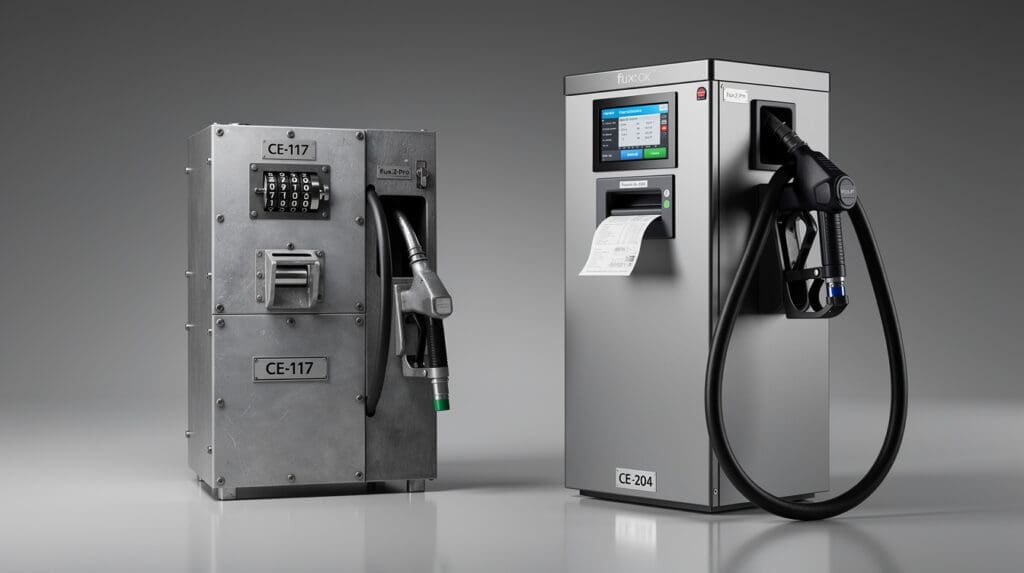
There comes a breaking point where constant fuel dispenser troubleshooting and piecemeal repairs cost more in downtime than a new unit. When internal wear compromises the PD meter, replacement is just good business.
When clients ask me what to upgrade to, here is the baseline I use to size our systems:
| Specification | CE-117 Entry-Level | CE-202 Mid-Range | CE-204 High Accuracy | CE-130 Mobile Mount |
| :— | :— | :— | :— | :— |
| Flow Rate | 40 – 60 L/min | 30 – 40 L/min | 20 – 80 L/min | 20 – 60 L/min |
| Accuracy | ±0.5 % | ±2.0 % | ±0.2 % | ±0.5 % |
| Meter Type | Standard Digital | Digital PDP | Legal Metrology Standard | Digital Preset |
| Best For | Farms, small factories | General fleet yards | Audit-ready fuel depots | Tanker-mounted fueling |
| Key Feature | Robust, simple operation | Compact workhorse | Receipt printer, 365-day log | CPU-based batching |
| Price (Ex-GST) | Starting ₹44,000 | Starting ₹55,000 | Starting ₹95,000 | Custom pricing |
The ROI of Upgrading to High Accuracy (CE-204)
Let's look at the actual engineering economics. Assume your plant dispenses 5,000 liters of diesel daily.
Using a standard dispenser with a degraded accuracy of ±0.5% (or worse, if uncalibrated), you have a daily error margin of 25 liters. Over a 30-day month, that is 750 liters of unaccounted fuel. At ₹90 per liter, your financial leak is ₹67,500 every single month.
Upgrading to the CE-204 High Accuracy Dispenser brings your error margin down to ±0.2%. Your monthly error drops to 300 liters (₹27,000). By investing ₹95,000 in the CE-204, your operation saves ₹40,500 monthly. The payback period on this equipment upgrade is a mere 2.3 months. After that, it is pure operational profit, backed by a printable receipt system for rigorous shift reconciliation.
If you are designing a mobile bowser for remote site fueling, the constraints are different. You need to focus on DC power stability and vibration resistance. I cover this exact engineering challenge in our Mobile Fuel Dispenser Engineering Specs & Sizing guide.
Ready to eliminate calibration drift and secure your fuel inventory?
The CE-204 Diesel Dispenser features a ±0.2% accuracy positive displacement meter, integrated printer, and secure 365-day data logging.
Preventative Fuel Dispenser Maintenance in India

European laboratory tests don't mean much in the real world. An OIML R117 compliant meter behaves very differently when subjected to the ambient heat, heavy monsoon moisture, and voltage unreliability of an Indian manufacturing zone.
Based on my 22 years of field service, here is my strict preventative maintenance protocol for industrial operations:
- Weekly Strainer Purge: Do not wait for cavitation. Open the primary suction strainer weekly and clean the stainless steel mesh.
- Water-Finding Paste Checks: Diesel storage tanks accumulate condensation. Use water-finding paste on your dip rod weekly. If water enters a rotary vane pump, it destroys the lubricity, causing the vanes to shatter.
- Grounding Verification: Static electricity builds up rapidly during high-speed fluid transfer. Ensure the dispenser grounding strap is securely fastened to a dedicated earth pit measuring less than 2 ohms resistance. This protects the motherboard from static spikes and prevents explosive ignition.
- Nozzle Swivel Lubrication: The 360-degree swivel on models like the CE-117 and CE-130 takes immense physical abuse. A drop of light machine oil on the swivel bearing monthly prevents the hose from binding and tearing.
Water in diesel is the silent killer of fuel dispensers. Modern ultra-low sulfur diesel (ULSD) is highly hydroscopic. In monsoon season, ambient humidity condenses inside bulk tanks. When this water hits the tight tolerances of a positive displacement meter, it causes instantaneous micro-corrosion, ruining the ±0.5% accuracy within days.
Frequently Asked Questions
Why does my fuel dispenser pump run but no fuel comes out?
This is classic suction loss. It is usually caused by a completely blocked suction strainer, an air leak in the suction piping (loose flange or union), or a stuck internal bypass valve inside the rotary vane pump. Check the strainer first.
How often should an industrial fuel dispenser be calibrated?
Under Indian operating conditions, I recommend a mechanical calibration check every 3 months using a certified 20-liter proving measure. If the dispenser is used for commercial billing, the Legal Metrology Act requires annual verification and sealing by a government inspector.
Why does the auto shut-off nozzle keep clicking off immediately?
The Venturi sensing port at the tip of the nozzle spout is blocked by dirt, dried fuel film, or mud. The internal vacuum mechanism incorrectly senses that the tank is full. Use a compressed air line to blow the tip clear.
What causes a fuel dispenser display to show random characters or freeze?
In industrial environments, this is almost always caused by voltage spikes or frequency drops from heavy machinery operating on the same power grid. Ensure your dispenser is connected to an isolated power supply with a dedicated MCB, and check the unit's grounding.
Can I pump petrol or solvents through a diesel dispenser?
Absolutely not. Unless the unit is specifically engineered with flameproof enclosures and specialized seals (like our customized CE-215), you are asking for trouble. Diesel dispensers use standard Nitrile seals and non-flameproof enclosures. Pumping highly volatile fluids like petrol through them will degrade the seals instantly and presents an extreme explosion hazard due to static discharge.
Final Engineering Verdict
At the end of the day, troubleshooting fuel dispensers doesn't require guesswork—it just takes a systematic approach to fluid dynamics. Whether it's a clogged Venturi, a cavitating pump, or meter drift, the root cause usually points right back to site conditions and maintenance habits.
However, there comes a point where repairing a degraded positive displacement meter costs more in untracked fuel losses than replacing the unit entirely. If your plant is dispensing high volumes daily and you are still relying on a ±2% accuracy mechanical unit, you are actively losing money.
Based on field data across hundreds of Indian installations, my recommendation for high-duty factory environments is to upgrade to the CE-204 High Accuracy Dispenser. The ±0.2% accuracy, combined with voltage-stabilized CPU architecture and physical receipt logging, closes the loop on fuel theft and meter drift.
Stop losing ₹1.3 Lakhs a month to inaccurate fuel metering.
Partner with Chintan Engineers for industrial-grade fuel dispensers built for Indian factories. We provide site assessment, installation, calibration certificates, and pan-India spares support.
Need a meter or dispenser for a specific duty?
Tell us the fluid, flow range and site; we reply with a model and a quote within one working day.