
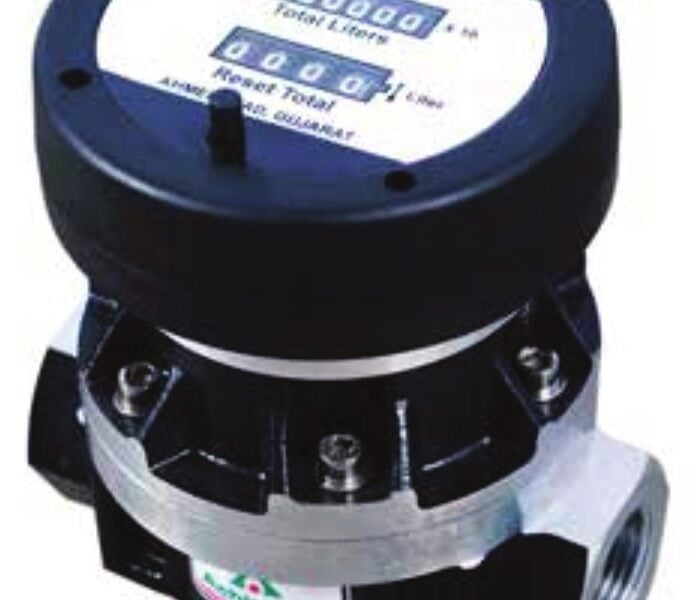
CE-118
CE-118 Oil Flow Meter
CE-118 oil flow meter with a flow range of 20-120lpm.
- Flow Range
- 20-120 lpm
- Accuracy
- +0.5 %
- Max Working Pressure
- 3.4 Mpa
Fuel monitoring
Pumps & nozzles
Batching
A 1% calibration drift on a 5,000 L/day furnace oil pipeline costs your operation roughly ₹1.3 lakh per month in untracked fuel. I've spent my career auditing plants in Ankleshwar, Vapi, and Baddi, watching production managers agonize over 0.5% boiler efficiency gains while remaining completely blind to the fact that their inlet measurement is feeding them garbage data.
I am Vikram Desai. Over the last 22 years at Chintan Engineers, I have designed, calibrated, and troubleshooted over 5,000 flow measurement systems. I can tell you unequivocally: an oil flow meter is only as accurate as its installation. You cannot simply bolt a high-precision positive displacement meter into a rusted carbon-steel pipeline, ignore air elimination, skip the steam tracing, and expect custody-transfer accuracy.
Here, I've documented the exact engineering protocols for oil flow meter installation, focusing on high-viscosity furnace oil flow meter setup, piping arrangements, and environmental protection in harsh Indian industrial conditions.
Why do we still see turbine meters on heavy fuel lines? Viscosity is the enemy of kinetic flow meters. I've calibrated enough of them to know they don't belong anywhere near viscous fuels like heavy fuel oil (HFO) or furnace oil (FO). Turbine rotors rely on the fluid's velocity profile, which distorts wildly as oil cools and thickens.
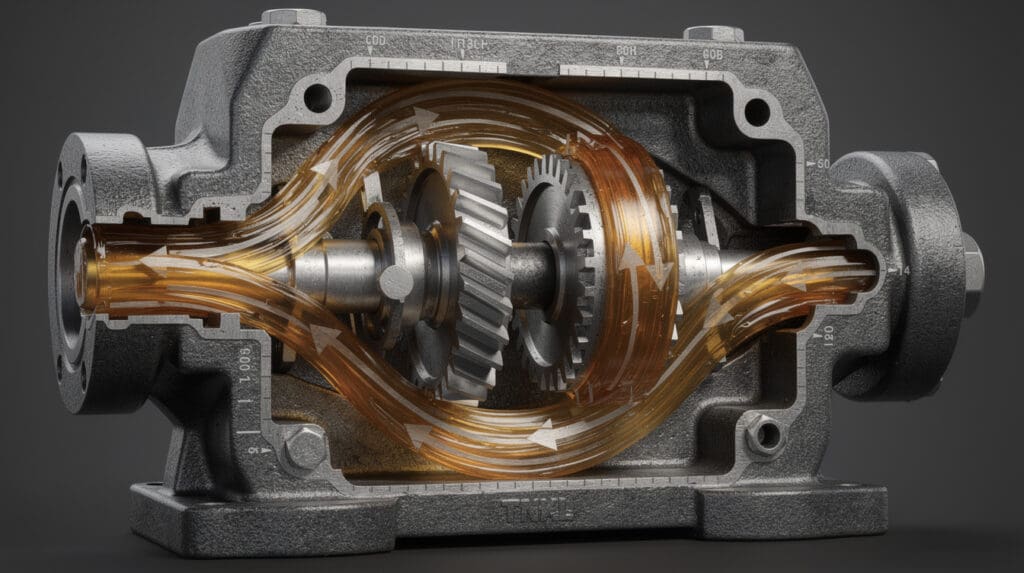
When you are pumping hydraulic oil, diesel, or furnace oil, you must use Positive Displacement (PD) or Oval Gear meters. These meters do not infer flow from velocity; they trap a fixed, discrete volume of fluid between interlocking gears or rotors and physically transfer it from inlet to outlet.
Because PD meters physically divide the fluid into volumetric compartments, they are immune to the Reynolds number variations that destroy turbine meter accuracy. They also eliminate the need for upstream straight pipe runs—saving critical footprint. (And if you've ever tried to pipe a retrofitted boiler room in a cramped GIDC plant, you know every square inch counts.)
If there is a golden rule in oil flow meter installation, it is this: Protect the rotors. Take our CE-107, for example. The clearances between the oval gears and the measuring chamber wall are machined to microscopic tolerances to achieve that 0.2% accuracy.
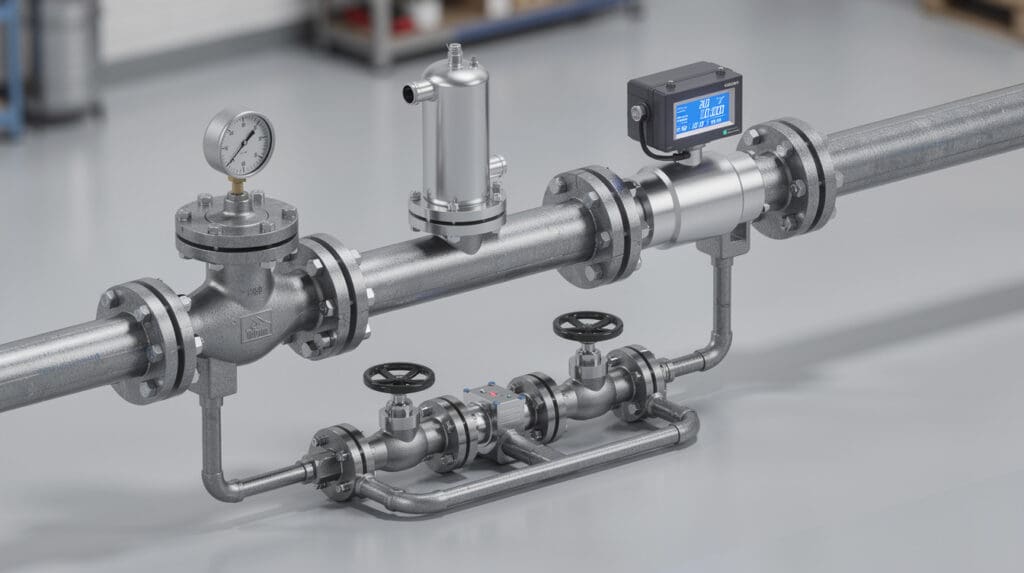
Industrial oils contain pipe scale, welding slag, and particulate contamination. A strainer must be installed immediately upstream of the flow meter. However, you cannot use a generic mesh size. Complying with IS 5765 standards for test sieves is a good baseline, but practically, sizing depends heavily on fluid viscosity.
Using a 100-mesh strainer on cold furnace oil will cause a massive pressure drop. I've seen maintenance teams strip their supply pump gears because they got the strainer mesh wrong and cavitated the pump.
Always install a pressure gauge directly before and after the upstream strainer. A differential pressure (ΔP) across the strainer exceeding 0.5 BAR indicates a clogged basket. I mandate this configuration on every system I commission.
Air in the pipeline is measured as oil. Positive displacement meters cannot distinguish between a trapped pocket of air and a trapped pocket of fuel. In systems where tanks run low, or where gravity feeds allow air ingress, an air eliminator is mandatory for compliance with OIML R117 and Legal Metrology Act guidelines.
The air eliminator must be installed at the highest elevation point in the pipeline system, strictly before the flow meter.
Paying for air instead of oil?
Our engineered positive displacement meters integrate seamlessly with heavy-duty air elimination systems to ensure custody-transfer accuracy.
North Indian winters in places like Baddi or Pantnagar turn furnace oil into a substance resembling road tar. Pumping cold FO through a high-precision meter will either stall the rotors or burst the housing due to extreme pressure spikes.
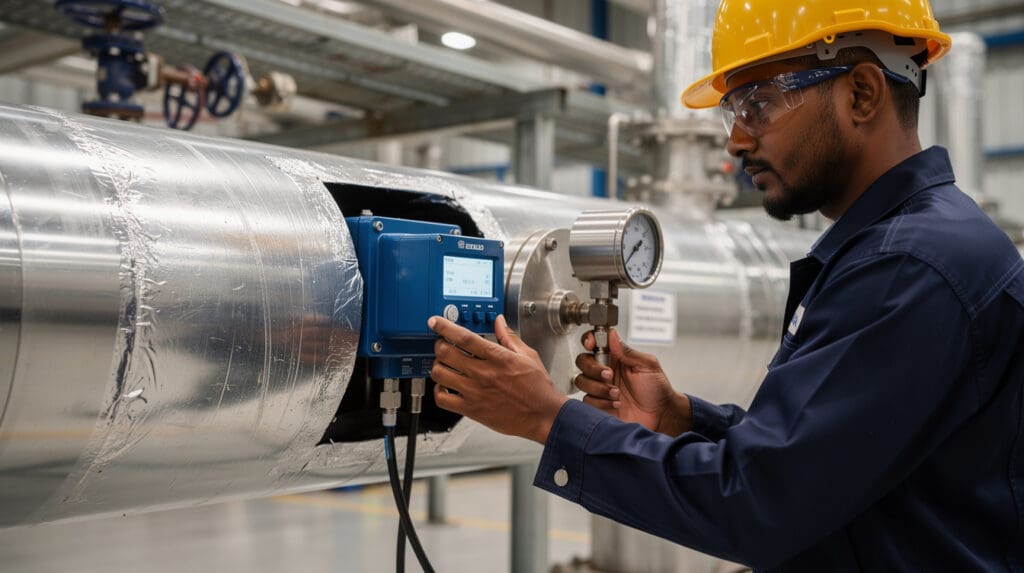
To maintain a pumpable viscosity (typically between 15 cSt and 40 cSt), furnace oil lines require steam tracing or electrical heat tracing. However, applying heat introduces a massive risk to the flow meter's electronics.
Never hit a cold positive displacement meter with full pump pressure. If the oil inside the meter has cooled and solidified overnight, a sudden 10 BAR pressure spike from a positive displacement gear pump will bend the rotor shafts instantly. Always use a slow-start bypass loop during morning commissioning.
Unlike magnetic or ultrasonic meters, PD and oval gear meters are highly forgiving of piping geometry.
If you are designing a skid-mounted system for fleet refueling rather than fixed plant boilers, your bypass and elimination setup will differ due to dynamic pressure scenarios. I recommend reviewing our Mobile Fuel Dispenser Technical & Sizing Guide for those specific applications.
Selecting the right meter isn't just pulling a model number from a catalog; it requires matching flow rates, pressures, and viscosity. Buying an oversized meter means the rotors will barely turn at low flows, drastically increasing measurement error. Buying an undersized meter creates an unacceptable pressure drop.
Here is how I specify meters for Indian industrial plants:
| Feature/Spec | High Accuracy CE-107 | Heavy Duty CE-118 | Preset Flow Meter |
| :— | :— | :— | :— |
| Accuracy | 0.2% (Custody Transfer) | 0.5% (Process Control) | 0.5% (Batching) |
| Mechanism | Positive Displacement | Positive Displacement | Oval Gear PD |
| Flow Range | Dependent on line size | 20 – 120 LPM | Variable |
| Max Pressure | 10 BAR | 3.4 MPA (34 BAR) | Standard Operating |
| Max Temp | 80°C | Dependent on seals | Standard Operating |
| Materials | Aluminium, Viton Seals | Corrosion Resistant | Cast Iron/Aluminium |
| Best For | Fuel consumption monitoring | Diesel transfer, rough environments | Precise batching / dispensing |
The CE-107 is my engineer's choice for measuring boiler fuel consumption. The 0.2% accuracy allows you to tighten your mass-balance calculations. Constructed with Aluminium and Viton seals, it easily handles the corrosive nature of sulfur-heavy industrial oils up to 80°C.
The CE-118 is what I spec for rugged transfer applications—like unloading tankers into underground storage. It handles pressures up to 3.4 MPA (roughly 34 BAR), meaning it won't fail when unloading pumps inevitably surge.
For dispensing specific quantities to day-tanks or machinery, the Preset Flow Meter is ideal. It works seamlessly with 0.37-1.5 KW pumps, allowing the operator to preset the exact volume required and eliminating messy tank overfills.
Need to hit 0.2% custody-transfer accuracy?
Explore our engineered flow solutions designed specifically to withstand Indian industrial voltage drops and extreme temperatures.
In industrial estates across India, the most common failure point I see in digital oil flow meters isn't mechanical—it's electrical. Plants suffer from severe voltage fluctuations and harmonic noise from heavy VFD (Variable Frequency Drive) operations nearby.
If you are using our CE-124-FM, which features an LCD display and a pulse output via reed switch, electrical isolation is critical.
Integrating these pulse outputs securely is a core requirement when building mobile skids as well. You can see how we apply these electrical principles in our Mobile Fuel Dispenser Engineering Specs & Sizing documentation.
A reed switch pulse output (like the one on the CE-124) is a mechanical contact. At very high flow rates, contact bounce can cause a PLC to over-count the pulses. Always implement a debounce filter in your PLC logic, typically set between 5ms and 15ms depending on the maximum pulse frequency.
If you take away nothing else from this article: Do not just open the valves and walk away. Follow this standard commissioning procedure:
Zero. Unlike turbine or ultrasonic meters, positive displacement meters trap and measure discrete volumes of fluid. They do not rely on flow profile, meaning elbows or valves can be installed immediately adjacent to the meter flanges.
No. Furnace oil is highly viscous. A 100-mesh strainer will cause a severe pressure drop and clog rapidly, potentially starving and cavitating your pump. Use a 20 to 40 mesh strainer for heavy fuel oils.
This is almost always due to entrained air. Positive displacement meters will measure air bubbles just as they measure oil. If your meter is over-reading, you must install an air eliminator upstream of the meter at the highest point in the pipeline.
The high-accuracy CE-107 meter, equipped with an Aluminium body and Viton seals, has a maximum operating temperature of 80°C. If your steam-traced furnace oil lines exceed this, you must adjust your thermostatic controls or physically isolate the meter from direct heat contact.
Under the Legal Metrology Act in India, custody transfer meters should be calibrated annually. However, for internal process control on heavy, abrasive oils, I recommend checking calibration every 6 months to account for rotor wear. Don't skip this—a worn rotor easily drifts 2-3% out of spec, quietly draining your fuel budget.
Horizontal mounting with the rotor shafts in the horizontal plane is the optimal orientation. Vertical mounting is possible but places the weight of the rotors on the bottom thrust bearing, which can accelerate wear over time.
Based on 22 years of field data, failure to accurately measure oil flow is almost never the fault of the meter's engineering—it is the fault of the installation. Dropping an unprotected meter into a harsh GIDC environment with no strainer, no air elimination, and improper steam tracing is burning money.
If you want true custody-transfer reliability for boiler fuel consumption or tank unloading, my recommendation is the CE-107 High Accuracy Digital Flow Meter. Combined with a properly sized 40-mesh strainer and isolated from direct tracing heat, its 0.2% accuracy will pay for itself within the first 45 days of operation in a standard 5,000 L/day plant.
Build the piping right, protect the electronics, and the meter will do its job.
Ready to stop losing money to inaccurate flow measurement?
Let Chintan Engineers audit your requirements and supply a meter designed for Indian realities.
CE-118 oil flow meter with a flow range of 20-120lpm.
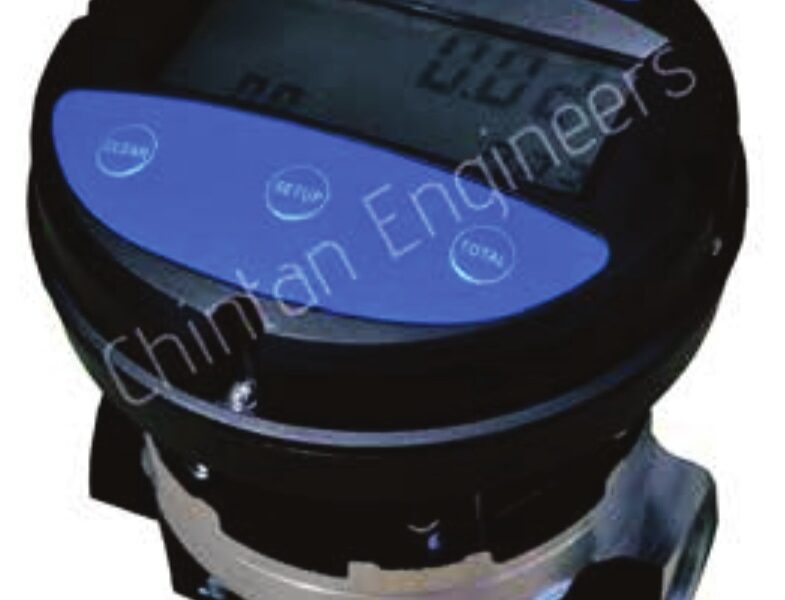
CE-119 oil flow meter with a flow range of 20-120lpm.
Tell us the fluid, flow range and site; we reply with a model and a quote within one working day.