
















A 1.5% discrepancy on a 20,000-litre bulk diesel delivery costs an Indian industrial plant roughly ₹27,000 per tanker. Multiply that by three deliveries a week, and your facility is bleeding ₹42 Lakhs annually into thin air—or more likely, into the black market. Over my 22 years calibrating measurement systems across ONGC refineries and rural GIDC estates, I have sat across from dozens of procurement managers who cannot understand why their monthly fuel reconciliations never balance, despite having a certified 60-ton weighbridge at the front gate.
The root of this financial hemorrhage is almost always a fundamental misunderstanding of measurement mechanics. When you receive bulk liquid hydrocarbons, you are purchasing energy density, not gross weight. Relying solely on a gravimetric weighbridge to measure volumetric fuel deliveries is a structural vulnerability in your supply chain.
Here, I'll walk you through the engineering realities of a fuel flow meter vs weighbridge setup, dissect the mechanics of fuel tanker reconciliation in India, and show exactly why positive displacement flow meter accuracy is the only mathematically sound way to secure your bulk diesel inventory.
In This Article
- The Illusion of Absolute Gravimetric Accuracy
- Volumetric Positive Displacement Flow Meters: Fluid-Level Truth
- Head-to-Head: Fuel Flow Meter vs Weighbridge
- Selecting the Right Fuel Management System
- Installation Realities in Indian Industrial Estates (GIDC)
- Proving and Calibration Lifecycle
- The Total Cost of Ownership (TCO)
- Frequently Asked Questions
- The Final Engineering Verdict
The Illusion of Absolute Gravimetric Accuracy
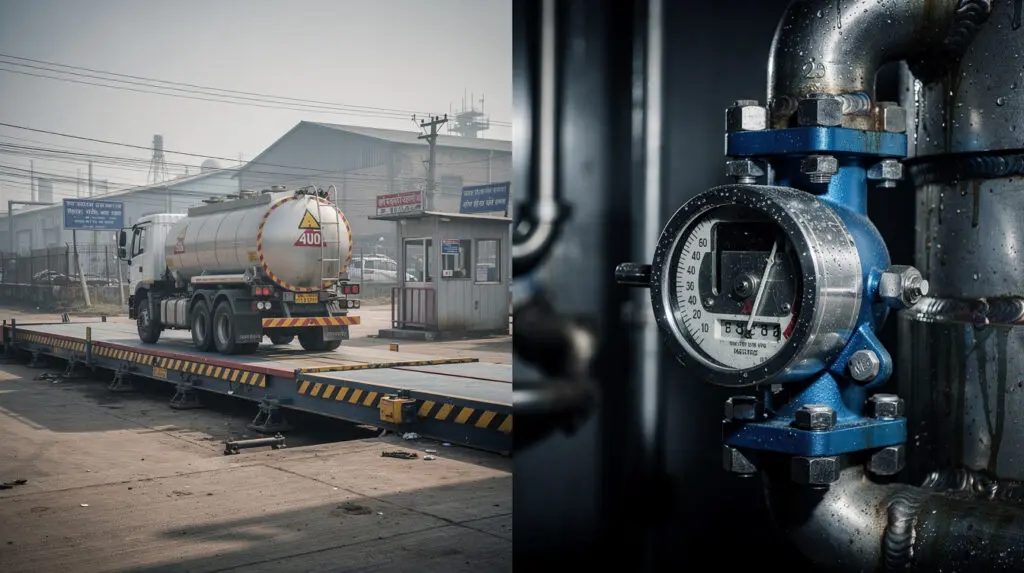
Weighbridges (truck scales) operate on a simple gravimetric principle: weigh the gross loaded vehicle upon entry, weigh the tare (empty) vehicle upon exit, and subtract the difference to find the net payload. The load cells under the bridge deck convert mechanical force into electrical signals, processed by a weight indicator compliant with BIS IS 14883 standards.
In theory, mass is constant. In practice, on a dusty Indian transport yard, vehicle mass is highly dynamic and aggressively manipulated.
When you use a weighbridge for bulk diesel measurement, you are not actually measuring the diesel. You are measuring the truck, the driver, the fuel in the truck's operational tank, the mud on the tires, and whatever physical objects are inside the cabin.
The "Tare Weight" Vulnerability
During fuel tanker reconciliation, drivers exploit the gap between gross and tare weight. The mechanics of this exploitation are well-documented in the field—I've personally caught drivers pulling these stunts from Surat to Chennai:
- The Auxiliary Tank Drain: A truck enters with a full 300-litre operational diesel tank (weighed in the gross). During decantation of the bulk payload, the driver transfers 100 litres from the operational tank into jerry cans hidden off-scale. Upon exit, the tare weight is lighter by 85 kg (approximate weight of 100L diesel). The weighbridge records this as decanted bulk payload. You just paid for 100 litres of fuel you did not receive.
- The Toolbox Trick: I've audited enough bulk receipts to know that a driver's "sudden weight gain" between the entry and exit gate is rarely due to a heavy lunch—it's the classic toolbox water-drain trick. The truck enters with heavy water bags hidden in toolboxes. During unloading, the water is dumped. The tare weight drops artificially, increasing the calculated net payload.
- Monsoon Variables: In coastal Gujarat or during the heavy Indian monsoon, a 12-wheel tanker can accumulate up to 60 kg of mud and standing water. If this dislodges during unloading, it skews the tare weight.
Warning: Legal Metrology Note: A standard 60-ton weighbridge has a graduation (e) of 10 kg. The permissible error margin under Legal Metrology Act rules for in-service weighbridges is often ±20 kg to ±30 kg. This alone allows for a 35 to 50-litre undocumented variance per truck, entirely within legal limits.
Volumetric Positive Displacement Flow Meters: Fluid-Level Truth
To eliminate the variables of truck mass, you must measure the fluid directly at the point of custody transfer. This is exactly where positive displacement (PD) flow meters prove their worth.
A positive displacement flow meter divides the fluid into discrete, fixed volumetric parcels. It mechanically counts these parcels as they pass through the measuring chamber. Unlike turbine meters, which infer volume from the velocity of the fluid spinning a rotor, a PD meter provides direct volumetric measurement.
Why Positive Displacement Flow Meter Accuracy Matters
When handling diesel (viscosity typically 2.0 to 4.5 mm²/s at 40°C), PD meters—specifically rotary vane, oval gear, or piston designs—are the gold standard.
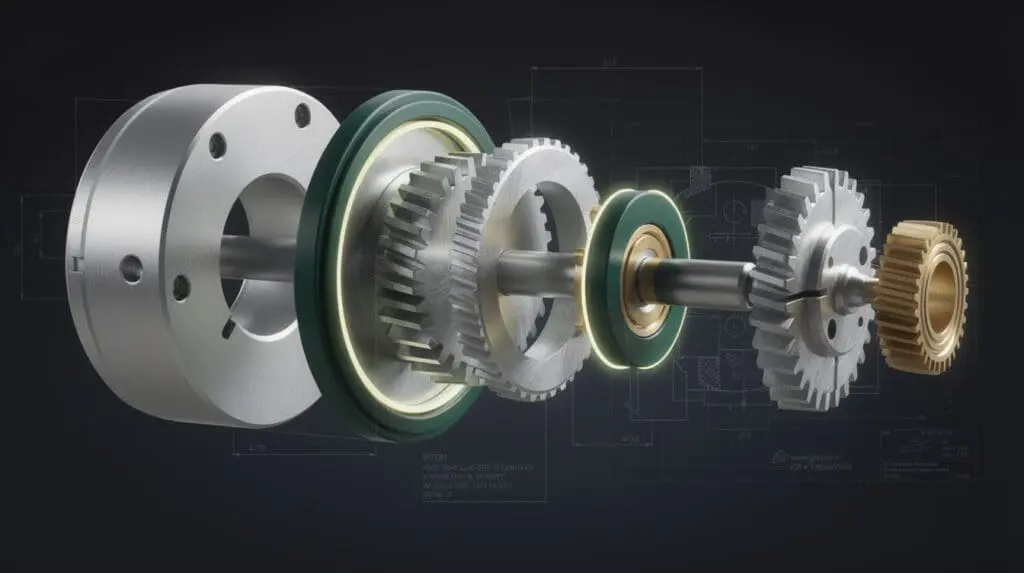
Consider a unit like our CE-113 High Accuracy Diesel Flow Meter. I use this specific model for heavy industrial sites because of its uncompromising positive displacement mechanics. As diesel enters the chamber, the pressure differential forces the internal components to rotate. Because the clearance between the rotating components and the chamber wall is machined to micrometer tolerances, fluid cannot bypass the measurement cycle (a phenomenon known as "slippage").
The CE-113 delivers an accuracy of ±0.2% with excellent repeatability. This is achieved through a calibrator mechanism that allows micro-adjustments to the gearing ratio before the output reaches the mechanical counter. When we talk about custody transfer, ±0.2% accuracy is the absolute minimum requirement under OIML R117 guidelines.
Pro Tip: Engineer's Advice: I've calibrated enough turbine meters to know they don't belong anywhere near highly viscous or aerated bulk fuel transfers. If there is air in the line, a turbine rotor will spin out of control, registering phantom thousands of litres. A PD meter equipped with an air eliminator physically blocks air from being metered.
Losing fuel between the front gate and the storage tank?
Upgrade your unloading gantry with a custody-transfer grade PD meter. Stop paying for air and truck mud.
Head-to-Head: Fuel Flow Meter vs Weighbridge
If you need to justify the shift to volumetric measurement to your plant's board of directors, look at this direct operational comparison between an industrial fuel management system using flow meters versus reliance on a gate weighbridge.
| Measurement Factor | 60-Ton Weighbridge (Gravimetric) | CE-113 PD Flow Meter (Volumetric) |
| :— | :— | :— |
| Core Principle | Gross Truck Mass minus Tare Mass | Direct fluid volume displacement |
| Base Accuracy | ± 20 to 30 kg (Legal limits) | ±0.2% (approx ±2 litres per 1000L) |
| Vulnerability to Theft | High (water draining, tank siphoning) | Zero (measures exact liquid received) |
| Aeration/Air Counting | N/A | Eliminated via integrated Air Eliminator |
| Capital Expenditure | ₹8 Lakhs – ₹12 Lakhs | ₹40,000 – ₹85,000 (Setup dependent) |
| Space Requirement | 18 x 3 Meters | 1 x 1 Meter (Pipeline mounted) |
| Density Calculation | Requires manual lab density testing | Measures exact volume directly |
The Temperature-Density Trap
One of the most maddening aspects of bulk diesel measurement is the density-temperature relationship. Diesel expands when heated and contracts when cooled. The standard reference temperature for petroleum products in India is 15°C (IS 1448).
When you weigh a tanker on a weighbridge, you get mass in kilograms. To convert this mass to the litres you are billed for, your receiving staff must use a hydrometer to check the density at the current ambient temperature, and then use ASTM Table 53B to find the density at 15°C.
In peak Indian summer, ambient temperatures hit 45°C. A manual error in reading the hydrometer, or a fabricated density figure entered by a compromised staff member, completely alters the mass-to-volume calculation.
When you install a CE-106 High Accuracy Digital Fuel Flow Meter, you bypass this mathematical trap entirely. The positive displacement digital design directly measures the physical volume decanted into your tanks. If the invoice says 20,000 Litres, the mechanical or digital register on your meter must read 20,000 Litres. There is no mathematical gymnastics required.
Selecting the Right Fuel Management System
Transitioning to volumetric accountability means matching the hardware to your operational flow rates. Over-sizing a meter results in low-flow slippage; under-sizing causes massive pressure drops and premature wear.
Here are the exact custody-transfer specifications I routinely deploy across Indian industrial setups:
1. High Accuracy Mechanical Systems (The CE-113 & CE-115)
For bulk loading gantries and primary decantation headers, the CE-113 and CE-115 High Accuracy Diesel Flow Meters are the industry workhorses.
- Method: Positive displacement.
- Accuracy: ±0.2%, adjustable via mechanical calibrator.
- Materials: Aluminium body, Viton seals (crucial for surviving aggressive Indian biodiesel blends).
- Operating Window: Up to 10 BAR pressure, 80°C maximum temperature.
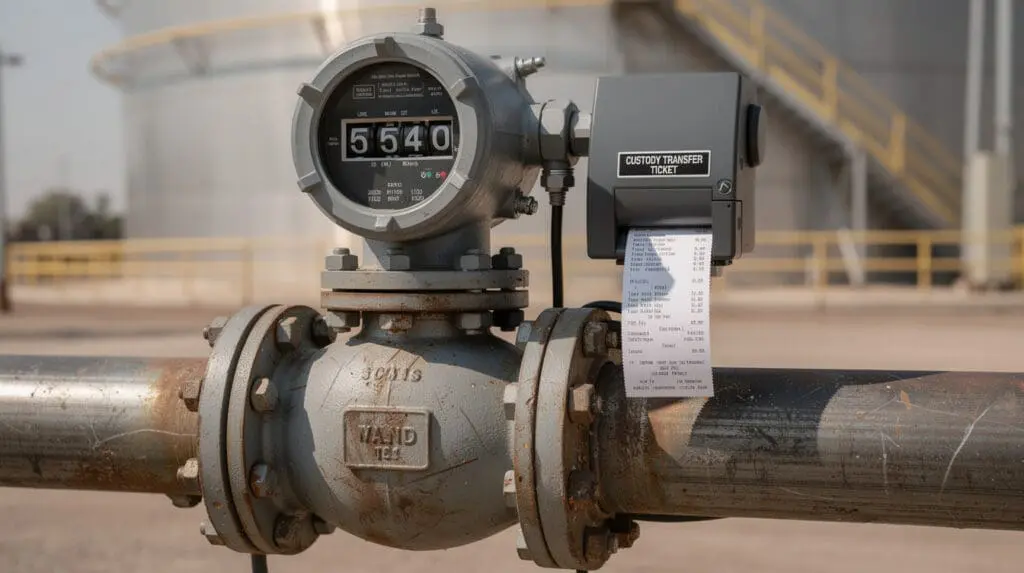
- Outputs: Mechanical register with optional ticket printer.
The ticket printer is a vital component for fuel tanker reconciliation in India. When decantation finishes, the system prints a stamped receipt showing the exact volume. The driver signs it, your engineer signs it, and there is zero ambiguity.
2. High Accuracy Digital Systems (The CE-105 & CE-106)
For facilities integrating directly into SCADA systems, PLCs, or remote telemetry dashboards, the CE-105 and CE-106 series are optimal.
- Accuracy: ±0.2% custody accuracy.
- Features: Low pressure loss, robust digital design.
- Integration: Pulse outputs available to feed directly into your industrial fuel management system.
If you're building a skidded transfer station to move diesel from underground tanks to daily service tanks, digital pulse outputs aren't just nice to have; they are essential for automating pump shutdowns when the batch is complete.
Did You Know: Industry Context: Many fleet operators attempt to use low-cost turbine meters (like our CE-210) for bulk unloading. While the CE-210 is an excellent meter for low-viscosity, steady-state flows with ±0.5% accuracy, bulk decantation from a truck involves severe pressure pulsations and air pockets. For truck unloading, always stick to Positive Displacement (CE-113/CE-105/CE-106).
Installation Realities in Indian Industrial Estates (GIDC)
Procuring the right meter is only 50% of the battle. The other 50% is how you pipe it. Honestly, I have seen highly precise CE-115 meters destroyed in three months simply because a rushed contractor bolted them directly to a pump discharge without protective accessories.
Operating in environments like the Gujarat Industrial Development Corporation (GIDC) estates means dealing with heavy airborne dust, unpredictable voltage fluctuations, and monsoon humidity.
The Mandatory Accessories for Bulk Diesel
If you want your positive displacement flow meter accuracy to hold at ±0.2% year after year, your installation skid must include:
- Y-Strainer or Basket Filter (Minimum 40 Micron): Bulk tankers carry rust, scale, and occasionally physical debris from poorly maintained depot loading arms. A positive displacement meter has micro-tolerances between its gears. If a 2mm piece of welding slag enters the chamber, it will lock the rotors and blow the internal seals. Always install a strainer upstream.
- Air Eliminator Tank: This is non-negotiable for bulk unloading. When a tanker empties, the pump sucks in a massive slug of air. Without an air eliminator, the flow meter will measure that air as diesel. An air eliminator tank sits before the meter, lowering fluid velocity, allowing air bubbles to rise and vent out through a float-actuated reed valve, ensuring only solid liquid hits the measuring chamber.
- Straight Pipe Runs: While PD meters are less sensitive to flow profile turbulence than turbine meters, installing isolation valves and providing adequate support prevents pipe strain from warping the meter's aluminium housing.
For facilities utilizing smaller transfer setups or mobile bowsers, understanding sizing and protective circuitry is equally critical. I highly recommend reviewing our engineering standards on Mobile Fuel Dispensers: Engineering & Sizing to see how these meters are integrated into portable units.
Need a bulletproof fuel unloading skid?
We design complete decantation skids featuring CE-113 meters, air eliminators, basket strainers, and ticket printers.
Proving and Calibration Lifecycle
A mechanical calibrator is a beautiful piece of engineering, but it is not "set and forget." Wear and tear on the Viton seals and aluminium measuring chamber over millions of litres will cause calibration drift.
A 1% calibration drift on a 5,000L/day throughput costs your operation ₹1.3 Lakh per month in untracked fuel.
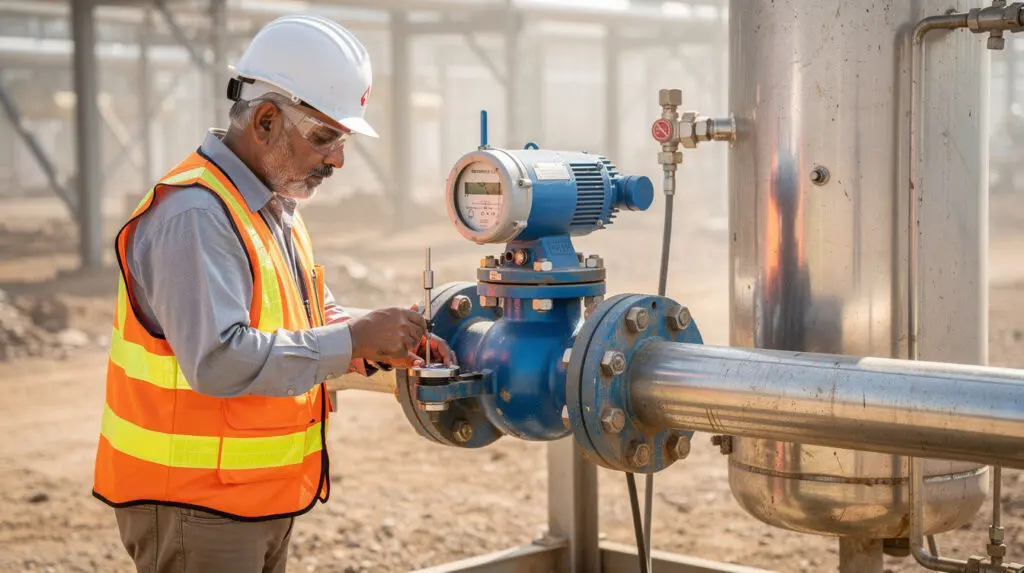
I strictly advise field-proving bulk flow meters every 6 to 12 months, depending on throughput. This involves running fuel through the meter into a Legal Metrology certified Prover Can (typically 50L or 100L) or using a Master Meter method. If the meter reads 1000L but the master prover shows 998L, we open the calibration wheel housing, adjust the stepless gear mechanism, and re-seal the unit with a wire-lead seal to prevent tampering.
If you are experiencing sudden, drastic jumps in flow readings, the issue is rarely calibration drift and more likely an electrical pulse issue or a blown seal. You can troubleshoot these specific symptoms using our Fuel Dispenser Troubleshooting Guide & Fixes.
The Total Cost of Ownership (TCO)
Let's circle back to that board presentation.
Installing a dedicated, high-accuracy decantation skid (Flow meter, Air Eliminator, Strainer, Ticket Printer, Valves) typically requires a capital expenditure of ₹1.5 Lakhs to ₹3 Lakhs, depending on line size.
If your facility consumes 1,00,000 Litres of diesel monthly, and your current weighbridge-based reconciliation is allowing a conservative 1% loss through driver manipulation or density errors, you are losing 1,000 Litres a month. At ₹90/Litre, that is ₹90,000 lost every single month.
The ROI on a certified volumetric flow measurement skid is typically achieved in under 3.5 months.
Proper setup is the key to achieving this ROI. To understand the mechanical requirements of marrying piping to metering hardware, our technical team has documented best practices in our Oil Flow Meter Installation: Expert Setup Guide.
Frequently Asked Questions
Why can't I just rely on the fuel supplier's loading depot slip?
The loading slip only tells you what was pumped into the truck at the refinery depot, not what actually arrived at your gate. During transit, siphoning, seal tampering, or operational fuel transfers can occur. You must measure exactly what crosses your gate.
Do positive displacement meters require electricity?
Mechanical registers like those on the CE-113 and CE-115 do not require external power to measure flow or display totals. However, if you opt for pulse outputs, 4-20mA signals, or digital models like the CE-105/CE-106, a 12V/24V DC or 220V AC supply is required.
Can the CE-113 handle biodiesel blends?
Yes. Biodiesel has a higher viscosity and requires specific seal materials to prevent degradation. Our high-accuracy meters utilize Viton seals and robust aluminium bodies that handle standard industrial diesel and biodiesel blends effortlessly.
What is the maximum pressure a diesel flow meter can withstand?
The CE-105, CE-106, CE-113, and CE-115 are all rated for a maximum operating pressure of 10 BAR (approx 145 PSI), which is more than sufficient for standard centrifugal or gear pump unloading pressures.
How does an air eliminator stop fuel theft?
When a truck compartment runs dry, the pump pulls air. If a driver intentionally restricts flow to suck air, a flow meter without an eliminator will spin and count that air as diesel. The air eliminator physically vents this air to the atmosphere and prevents it from entering the measurement chamber, ensuring you only pay for liquid.
Can I bypass the weighbridge entirely?
For fuel, yes. The weighbridge should be used for solid bulk materials (coal, steel, aggregate) where volume measurement is impossible. For liquid hydrocarbons, volumetric measurement via a proved flow meter is the legally and financially sound method.
The Final Engineering Verdict
After twenty-two years of tearing apart failed fuel management systems, my conclusion is absolute: using a gravimetric weighbridge for bulk diesel measurement is an invitation to continuous, systemic theft and accounting errors. The weighbridge measures truck mass; it does not secure your fuel inventory.
Based on field data, here is what I recommend for your operation: Do not attempt to fix weighbridge procedures. Move the point of custody transfer to the exact moment the fluid enters your storage tanks.
Install a CE-113 High Accuracy Diesel Flow Meter with an integrated air eliminator and ticket printer on your unloading header. This guarantees ±0.2% positive displacement flow meter accuracy, removes density-calculation errors, ignores tare-weight manipulations, and forces absolute accountability onto the transport contractor via printed receipts.
Stop weighing your fuel and start measuring it.
Ready to close the "Weighbridge Gap" in your fuel accounting?
Contact Chintan Engineers to spec out a custody-transfer flow meter system customized for your exact unloading rates and pump pressures.
