
Mobile Fuel Dispenser Technical & Sizing Guide
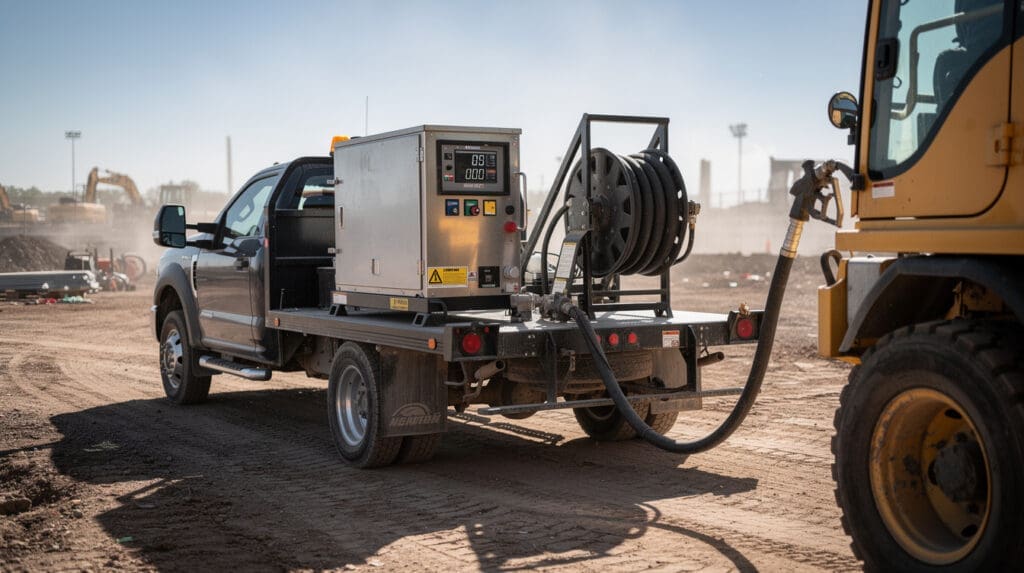
A 1% calibration drift on a 5,000-liter per day throughput costs your operation ₹1.35 lakh per month in untracked diesel. If your mobile bowsers are relying on basic transfer pumps and uncalibrated analog counters, you are not just losing fuel to pilferage—you are hemorrhaging capital through inaccurate batching and unrecorded dispensing.
In my 22 years as a flow measurement engineer at Chintan Engineers, I have climbed atop more diesel bowsers across India than I care to count. From mining sites in Odisha to remote agricultural tracts in Gujarat, the story is exactly the same: procurement managers invest millions in heavy machinery but treat the mobile fueling supply chain as an afterthought.
They mount a cheap pump on a Tata truck bed, attach a gravity hose, and wonder why their monthly diesel reconciliation is chronically short by 3 to 5 percent. (Spoiler: It isn't evaporating).
You cannot manage what you cannot measure. Upgrading a bare-bones bowser into a certified, auditable fueling station requires a precisely engineered mobile fuel dispenser skid. This is not about bolting on a meter; it is about integrating positive displacement measurement, ruggedized rotary vane pumping, micron-level filtration, and digital preset control into a single DC-powered or AC-powered unit capable of surviving violent vehicle vibrations and extreme Indian field conditions.
Here is the unvarnished engineering truth about what it takes to specify, size, and deploy mobile fuel dispensers effectively, along with the OIML R117 and IS 14883 compliances you simply cannot afford to ignore.
The Physics and Failures of Basic Transfer Pumps
Why do standard transfer pumps fail so miserably at metrology? A standard transfer pump merely moves fluid from point A to point B. If you attach an inline turbine meter to a basic pump, you are subjecting the meter to turbulent flow, entrained air, and pressure spikes. Because diesel viscosity changes with ambient temperature—shifting from 2.5 cSt in the afternoon sun to over 4 cSt during a cold desert night—turbine meters lose their K-factor linearity. You end up with a system that under-reads during cold mornings and over-reads in the afternoon heat. Good luck explaining that variance to your finance department.
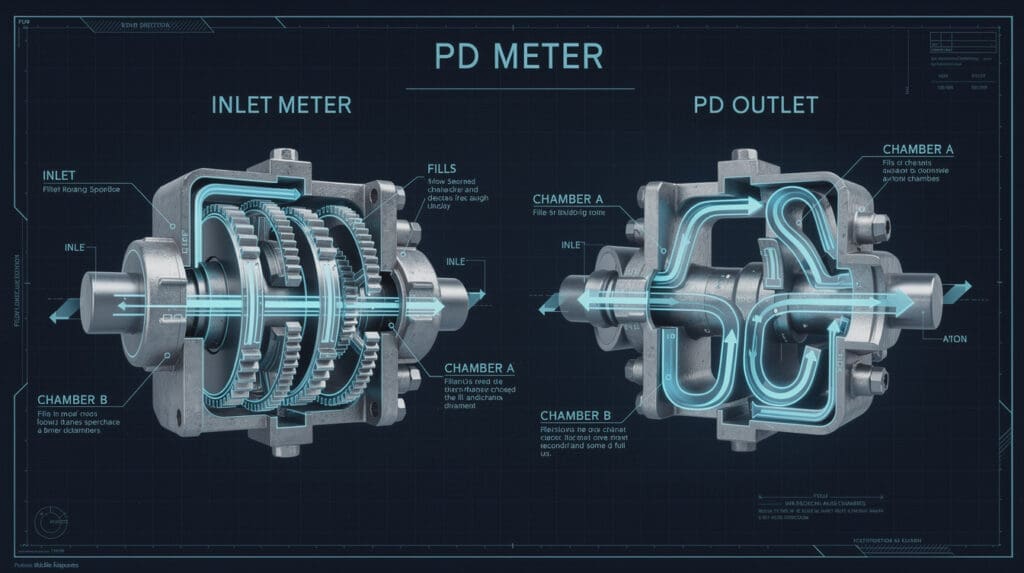
True mobile fuel dispensers rely exclusively on Positive Displacement (PD) technology. Instead of inferring flow from fluid velocity, a PD meter captures precise, discrete volumes of diesel in mechanical measuring chambers (such as oval gears or rotary vanes) and counts these packets.
I've calibrated enough inline turbine meters to know they do not belong anywhere near commercial fuel transfers. If transaction accuracy is your goal, mandate Positive Displacement mechanics. A PD meter physically cannot pass liquid without registering it, making it inherently resistant to flow-profile disturbances.
For the exact physics of why I specify PD over other types for diesel transfer, review my previous analysis on PD vs Coriolis Flow Meter for Diesel Transfer.
Anatomy of a Commercial-Grade Mobile Dispenser Skid
Converting a tank into an auditable fueling asset requires a complete skid integration. At Chintan Engineers, we built our CE-Series mobile kits (such as the CE-204 and CE-206) precisely to solve four critical failure points:
1. The Pumping and Prime System
We utilize positive displacement rotary vane pumps equipped with internal bypass valves. Operating predominantly on 12V or 24V DC from the vehicle's alternator, these pumps provide self-priming lift from the bowser belly. The internal bypass is crucial; when the operator releases the auto-shutoff nozzle, the pump continues to run briefly. The bypass valve opens to recirculate the fuel internally at a maximum pressure of 0.3 MPa (3 Bar), preventing deadheading and motor burnout.
2. Air Elimination and Filtration
Mobile tanks slosh. Sloshing introduces entrained air. If air passes through the meter, you are literally paying for bubbles. Our mobile dispensers incorporate pre-meter air separators and wire-mesh strainers. The filters—typically 10 to 30 microns—protect the machined tolerances of the oval gears from rust flakes, tank scale, and the inevitable dust ingress found in construction and mining environments.
3. The Metrology Engine (Positive Displacement Meter)
Whether mechanical or digital, the core is a brass or aluminum PD meter. The CE-101 relies on a mechanical counter, whereas units like the CE-206 use digital pulse transmitters. For high-throughput applications, mechanical oval gears easily handle the torque, but for data tracking, we step up to CPU-based digital controllers.
4. Controller, Presets, and Telemetry
This is where pilferage goes to die. A digital controller allows the operator to input a preset batch (e.g., exactly 150 liters). The controller actuates a solenoid valve. As the dispensed volume approaches 149.5 liters, the solenoid partially closes to prevent hydraulic shock, and shuts completely at exactly 150.0 liters. Systems like the CE-204 and CE-206 also store daily transaction logs for 365 days, ensuring every drop is accounted for.
Losing track of diesel consumed on remote construction sites?
Upgrade your existing service trucks with our ruggedized, DC-powered mobile dispenser skids featuring 365-day transaction memory.
Specification Breakdown: Sizing the Right Unit for Your Fleet
Selecting a mobile dispenser isn't guesswork; it requires matching the pump’s duty cycle and flow rate to the receiving equipment. You do not use a 110 L/min pump to fill a 50-liter pickup truck tank (you will cause severe foaming and backsplash), and you do not use a 40 L/min unit to fill a 1,000-liter earthmover (your operator will be standing there for 25 minutes, risking pump overheating).
Below is field-tested data comparing our primary mobile dispenser configurations based on Indian industrial requirements.
| Model Specification | CE-206 Digital Dispenser | CE-204 High Accuracy | CE-117 Digital Dispenser | CE-201 Heavy Duty Skid |
| :— | :— | :— | :— | :— |
| Flow Range | 20 – 80 L/min | 20 – 80 L/min | 40 – 60 L/min | Up to 110 L/min |
| Accuracy Rating | ±0.5 % | ±0.2 % (Achievable) | ±0.5 % | ±0.5 % |
| Metering Tech | Digital CPU / Pulse | Digital Preset | Digital CPU / Brass PD | Mechanical Oval Gear |
| Power Supply | 12V / 24V DC | 12V / 24V DC or AC | DC / AC Options | 220V / 440V AC (Gen-set) |
| Data Logging | 365 Days Daily / 12 Mo. | Printer-ready, 365-day log | Real-time batch display | Mechanical totalizer |
| Ideal Application | Remote Fleet Fueling | Auditable Bowser Fleets | Service Pickups | Tanker Trucks / High-Volume |
The CE-206: The Data-Driven Fleet Workhorse
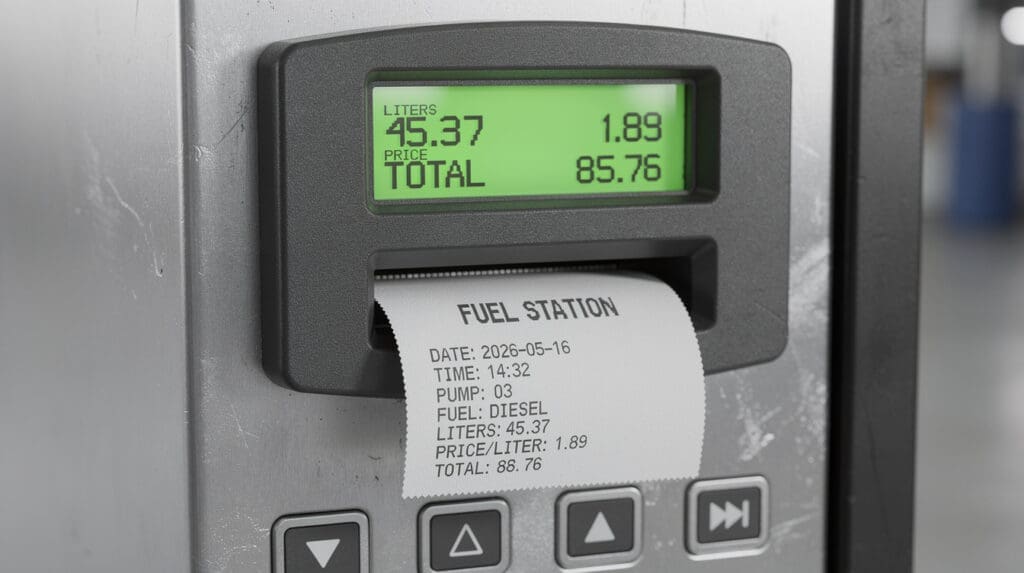
The CE-206 is engineered for managers who demand strict accountability. Running off DC12V or DC24V, it is entirely self-sufficient on a truck bed. It boasts a 0.5% accuracy rating over a 20-80 L/min flow range. Most importantly, it retains daily data for the last 365 days and monthly cumulative data for the last 12 months. If an operator claims a discrepancy in the logs, you simply print the receipt directly from the unit's optional on-demand printer.
The CE-117 and CE-101: Robust Basics
For smaller agricultural fueling or factory fuel management, the CE-117 (Digital) and CE-101 (Mechanical) models offer heavy-duty brass construction with 25mm connection sizes. Delivering a steady 40-60 L/min at up to 3 Bar of pressure, they ship with 4-meter rubber hoses and ambient noise automatic shutoff nozzles. They represent the baseline upgrade from manual transfer pumps to true metrology.
Surviving the Indian Operational Environment
I see it all the time: companies import generic, off-the-shelf fuel transfer kits into India and expect them to survive. It's a costly mistake. The environmental variables here actively work to destroy flow measurement equipment.
1. Voltage Drops and Alternator Noise
Running off a 24V commercial vehicle battery sounds simple, but in reality, voltage drops significantly over long wiring runs from the truck cabin to the rear bowser skid. Furthermore, vehicle alternators create electrical noise. (If you've ever had a radio buzz in an older truck, you know exactly what I mean). Our CE-Series DC motors are wound to handle voltage fluctuations, and the digital CPU boards in the CE-204 and CE-206 are shielded against electromagnetic interference (EMI) that would otherwise reset batch counters mid-delivery.
2. Monsoon Humidity and PCB Corrosion
In coastal Gujarat or during the monsoon in Maharashtra, high humidity infiltrates electronic housings. If the PCB is not conformally coated, condensation will short the digital display or pulse transmitter. We specify IP65 or higher rated enclosures for the preset controllers to ensure moisture does not corrupt the 365-day transaction memory.
3. Dust Ingress in Mining and GIDC Estates
Fine particulate dust acts as a lapping compound on internal pump vanes and meter gears. While our inline 30-micron strainers catch the bulk debris, the external enclosure must also be tightly sealed. Hose reels must feature heavy-duty swivels that do not jam when caked in mud.
A standard rotary vane pump spinning at 1440 RPM passing unfiltered, dust-contaminated diesel can lose 15% of its pumping efficiency in just three months due to internal scoring of the stator housing.
Calibration, Compliance, and Installation Best Practices
Let's be clear: no dispenser is inherently accurate forever without proper field calibration and rigorous installation standards. Under the Legal Metrology Act and relevant BIS standards (like IS 14883 for fuel dispensers), mobile units used for commercial transactions or strict internal auditing must undergo periodic volumetric proving.
Volumetric Proving in the Field
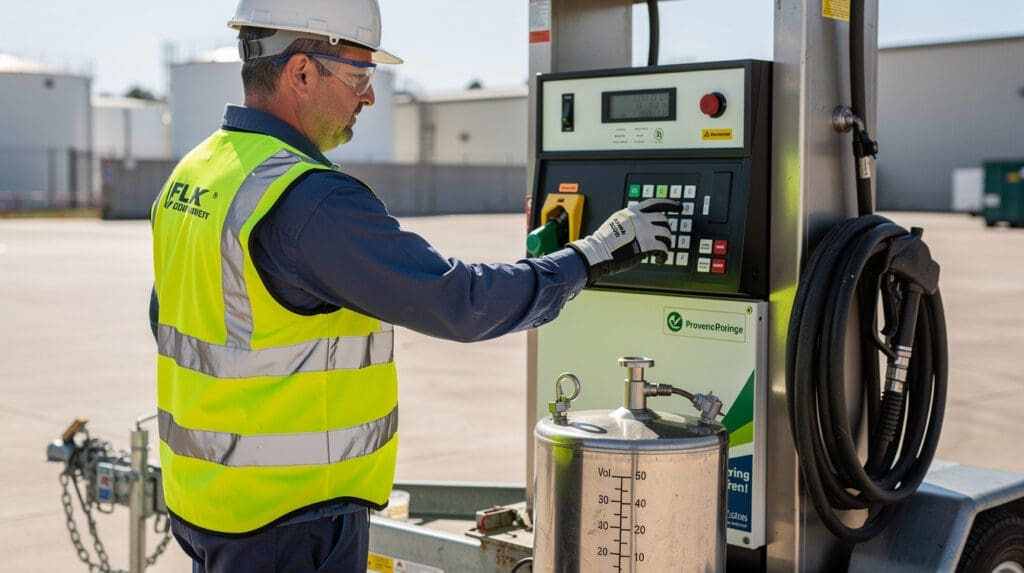
You do not calibrate a mobile dispenser in a lab; you calibrate it on the vehicle, exactly as it will operate. Why? Because the vehicle's electrical load, piping restrictions, and vibration profile all matter. We utilize certified 20-liter or 50-liter proving measures.
- We prime the system to eliminate air.
- We dispense precisely 50 liters according to the CE-206 digital display into the proving measure.
- We read the meniscus level on the graduated neck of the proving can.
- If the physical volume is 49.8 liters, we adjust the electronic K-factor in the CPU to correct the -0.4% error.
We repeat this at fast flow (80 L/min) and slow flow (20 L/min) to ensure linearity across the operating range, achieving the tight ±0.2% accuracy specified on models like the CE-204.
Piping and Suction Lines
The most common installation mistake I see on mobile bowsers is an undersized or highly restrictive suction line. If your CE-201 skid is rated for 110 L/min, but you install a 1-inch corrugated suction hose with multiple 90-degree elbows leading to the pump, you will induce cavitation. Cavitation causes vapor bubbles in the diesel. When these bubbles hit the PD meter, they are registered as liquid volume, destroying your accuracy.
Always ensure the suction line diameter matches or exceeds the pump inlet diameter (typically 25mm to 40mm), keep it as short as possible, and use rigid piping or steel-reinforced non-collapsible suction hoses.
Never ignore grounding on mobile installations.
Diesel flowing through rubber hoses generates static electricity. If the dispenser skid, tank, and receiving vehicle are not electrically bonded, a static discharge at the nozzle can ignite fuel vapors. Always ensure your mobile dispenser kit includes a proper grounding reel and bonding straps.
If you're pulling your hair out over calibration drift or pressure loss in your fuel systems, review my comprehensive Oil Flow Meter Troubleshooting Guide.
Advanced Configurations: Automotive Assembly & AdBlue
While diesel is the primary application, mobile dispensing technology extends further. Many automotive manufacturing plants require mobile, high-precision liquid batching on the assembly floor. For these highly specific applications, the engineering principles remain the same, but the wetted materials change (e.g., stainless steel chambers, specific elastomer seals).
If you are handling DEF (Diesel Exhaust Fluid) alongside diesel, you cannot use brass or standard aluminum components, as DEF is highly corrosive. For these setups, we deploy specialized systems like the CE-130 Small Adblue Dispenser, which features a digital LCD display and 0.5% accuracy using materials strictly compatible with urea solutions.
If you need to batch liquids directly into vehicles on an assembly line, you can read our breakdown on Liquid Batching Systems for Automotive Assembly.
Require multi-fluid dispensing on your service trucks?
We manufacture custom skids combining diesel, oil, and AdBlue dispensing modules on a single footprint.
Frequently Asked Questions
Can I run the dispenser entirely on vehicle battery power?
Yes, and this is highly common. Both the CE-204 and CE-206 models feature 12V or 24V DC motors engineered to run directly off a standard commercial vehicle battery or alternator. They power the pump, the metrology CPU, and the optional receipt printer. We do recommend keeping the vehicle engine running during prolonged dispensing to prevent battery drain.
How does the CE-206 prevent pilferage on remote sites?
The CE-206 uses an integrated CPU that records every single transaction, including volume, date, and time. It stores the last 365 days of daily data and 12 months of monthly cumulative data. Coupled with preset batching (where the pump automatically stops at the requested volume), drivers cannot over-dispense or skim fuel without leaving an auditable digital footprint.
Is hose management included with the skid kits?
Yes, our mobile fuel dispenser kits can be specified with heavy-duty hose reels accommodating 3 to 6 meters of delivery hose. These setups include heavy-duty swivels to prevent kinking and ambient noise automatic shutoff nozzles to prevent overfilling.
What happens if air gets into the suction line?
Unfiltered air destroys metrology accuracy. Our dispensers utilize pre-meter air separators. If the pump runs dry or draws air from a sloshing tank, the separator vents the air before it reaches the positive displacement measuring chamber, ensuring the meter only counts liquid volume.
Do you offer flameproof versions for hazardous zones?
Yes, and it is a mandatory requirement for explosive environments. If your bowser is operating in hazardous zones (such as refineries or chemical plants), we upgrade the system with EX/FLP (Flameproof) motors and enclosures, adhering to strict explosion-proof certification standards.
Final Verdict: Stop Guessing, Start Measuring
Running a commercial fleet or a remote industrial site without accurate mobile fuel metrology is a gamble you lose every single day. The mechanical counters and standard transfer pumps of the past simply lack the precision, data logging, and environmental resilience required to manage modern fuel costs.
Based on 22 years of field data, here is what I recommend for your operation:
- For standard construction and service pickups: Deploy the CE-117 or CE-101. They provide rugged, brass-machined positive displacement metering at 40-60 L/min, acting as an indestructible baseline for accurate transfers.
- For heavy-duty bowsers requiring strict audits: Upgrade to the CE-206 Digital Dispenser. Its ability to run on DC voltage, maintain 0.5% accuracy, and log 365 days of transaction data completely removes the human element from your fuel reconciliation process.
Diesel is liquid cash. It is time you engineered a system that treats it that way.
Ready to plug the leaks in your mobile fueling operations?
Provide us with your tank size, required flow rate, and power availability, and our engineers will size the perfect dispenser skid for your fleet.
Need a meter or dispenser for a specific duty?
Tell us the fluid, flow range and site; we reply with a model and a quote within one working day.