
Mobile Fuel Dispenser Price in India & 5-Year TCO
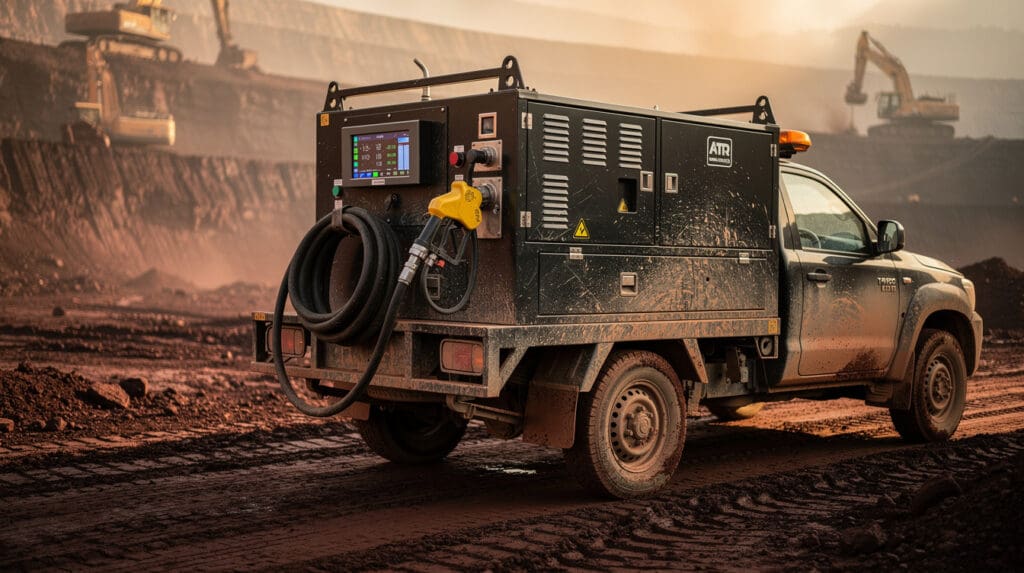
A 1% calibration drift on a standard 5,000 L/day mining bowser costs your operation ₹1.35 lakh per month in untracked diesel. Over a year, that is ₹16.2 lakhs bleeding out of your operational budget because a procurement team saved ₹20,000 by specifying an agricultural-grade flow meter instead of a metrologically certified positive displacement system.
I am Vikram Desai. For 22 years, I have designed, calibrated, and troubleshooted flow measurement systems across India at Chintan Engineers. I have crawled under Tata 407s in the heavy rains of coastal Gujarat and calibrated skids in the 48°C dust storms of Rajasthan mines. When corporate procurement asks me for the "lowest mobile fuel dispenser price in india," I tell them they are asking the wrong question.
The right question is: What is the 5-year Total Cost of Ownership (TCO) to move Class B petroleum products accurately across an unpaved industrial site?
This article is an uncompromising, engineering-led breakdown of mobile refuelling cost analysis. I'll break down the components of diesel bowser kits, explain exactly why cheap DC motors burn out in six months, and prove how high-accuracy metering (±0.2%) pays for the entire skid in less than one financial quarter.
The Deceptive Economics of the "Cheapest" Diesel Bowser Kit
The market is saturated with imported, low-grade 12V transfer pumps masquerading as industrial fuel dispensers. These units pair a brushed DC motor with a cheap turbine flow meter.
I've calibrated enough turbine meters to know they don't belong anywhere near unrefined, variable-viscosity fuels bouncing around on a truck chassis. Turbines calculate volume based on fluid velocity. When diesel heats up in the afternoon sun, its viscosity drops. When it cools at night, it thickens. This alters the slippage past the turbine blades, shifting your calibration curve entirely. You might dispense 100 liters, but the meter registers 96. Who pays for the missing 4 liters? You do. And trust me, the fleet operators notice.
Before you sign a PO based purely on the lowest diesel bowser kit price, you must calculate the 5-Year TCO. This includes:
- Initial CAPEX: The skid, pump, meter, hose reel, and controller.
- Calibration Maintenance (OPEX): Costs to re-prove and certify the meter annually.
- Downtime Costs: What happens when an excavator sits idle for 3 hours because the bowser's rotary vane pump sheared its carbon vanes?
- Metrological Losses: The cost of untracked fuel due to meter drift.
Never accept a "factory calibrated" certificate for a mobile dispenser if it was calibrated using water. Diesel has a kinematic viscosity of 2.0 to 4.5 cSt at 40°C. Water is 0.65 cSt. A meter calibrated on water will systematically over-register when dispensing diesel.
Quantifying Mobile Refuelling Cost Analysis: The 5-Year Model
Here is a real-world mobile refuelling cost analysis based on data I pulled from a mid-sized civil contracting firm in Pune operating three mobile bowsers.
The Operational Baseline:
- Fleet Fueling Demand: 3,000 Liters per day per bowser.
- Operating Days: 300 days/year.
- Total Annual Volume: 900,000 Liters/year.
- Average Diesel Price: ₹90/Liter.
Scenario A: Low-Cost Assembly (±1.5% accuracy drift over time)
- Initial Hardware Cost: ₹45,000
- Annual Untracked Fuel (1.5% of 900k): 13,500 Liters
- Cost of Untracked Fuel: ₹1,215,000/year
- 5-Year Hardware Replacement: ₹90,000 (replaced twice—because they will burn out)
- 5-Year TCO: ₹6,210,000
Scenario B: Chintan Engineers CE-204 High Accuracy Mobile Dispenser (±0.2% accuracy)
- Initial Hardware Cost: ₹1,10,000 (Approximate, configuration dependent)
- Annual Untracked Fuel (0.2% of 900k): 1,800 Liters
- Cost of Untracked Fuel: ₹162,000/year
- 5-Year Hardware Replacement: ₹0 (designed for a 10-year lifecycle)
- 5-Year TCO: ₹920,000
The math is unarguable. Spending an additional ₹65,000 upfront on a metrologically sound system saves over ₹52 Lakhs across a five-year horizon.
Stop losing lakhs to inaccurate mobile fueling.
Upgrade your fleet with our OIML-compliant, high-accuracy mobile dispenser skids designed for extreme Indian conditions.
Hardware Breakdown: Where Procurement Teams Get It Wrong
You don't get ±0.2% accuracy and a decade of reliability by accident. Every component on the skid must be specifically engineered for the harmonic vibrations and electrical anomalies of vehicle-mounted operation.
1. The Metering Unit: Positive Displacement vs. The Rest
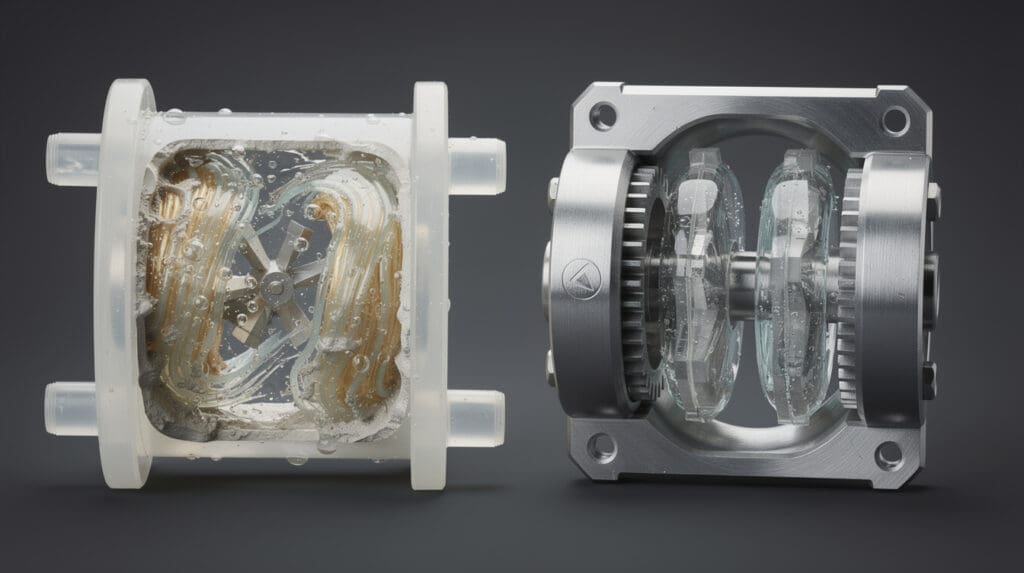
As I mentioned earlier, turbines are completely unacceptable for accurate fleet inventory. I ban them from my sites. At Chintan Engineers, we utilize Positive Displacement (PD) meters—specifically oval gear or rotary piston designs.
In our CE-204 and CE-201 units, the measuring chamber entraps a precise, fixed volume of fluid with every rotation. Because the tolerances between the gears and the chamber wall are machined to microscopic precision, fluid "slip" is virtually eliminated, regardless of diesel temperature or pump backpressure. These meters comfortably meet Legal Metrology Act standards and OIML R117 guidelines for custody transfer.
2. DC Power Dynamics and Motor Burnout
When fueling in remote areas, you rely on the host vehicle's battery. Standard mobile dispensers run on 12V or 24V DC. Here is the dirty secret of 12V pumps: drawing 40-60 Amps from a vehicle battery creates severe voltage drop if the cabling is inadequate.
If you run 5 meters of standard 10 AWG wire from the battery to a 12V pump, voltage at the motor terminals might drop to 9.5V under load. To maintain power (P=VI), the motor draws significantly more current. This excessive current creates severe thermal loading in the motor windings, melting the insulation and causing premature failure.
We engineered our CE-130 and CE-202 systems with oversized armatures, high-temperature copper windings, and strict wire gauge specifications to handle the variable power curves of heavy commercial vehicle alternators without thermal breakdown.
Never wire a 24V DC mobile dispenser directly to a single 12V battery in a series bank, and never under-size your cables. We mandate minimum 6 AWG (16 sq mm) marine-grade tinned wire for runs exceeding 3 meters to prevent catastrophic thermal failure.
3. Filtration: The Silent Killer of Accuracy
Indian diesel, especially when transported in secondary bowsers, is notoriously contaminated with silica dust, rust flakes, and water. If a 50-micron rust flake enters a tight-tolerance oval gear meter, it will scar the measuring chamber, permanently destroying its accuracy.
This is why industrial fuel dispenser maintenance starts before the fuel ever reaches the meter. Our skids incorporate heavy-duty inline filtration—typically 10-micron particulate filters with water-absorbing media—as a non-negotiable standard.
Selecting the Right Mobile Dispenser Kit for Your Fleet
Don't over-spec if you don't need to. Not every operation needs a high-flow 110 L/min skid. Sizing the system correctly is critical to maintaining volumetric efficiency. Pushing 20 L/min through a 100 L/min meter will drop you out of the meter's linear accuracy range.
Here is a breakdown of our core configurations based on 22 years of deployment data:
| Model | Flow Range | Meter Type | Accuracy | Power | Ideal Indian Use Case |
| :— | :— | :— | :— | :— | :— |
| CE-130 Mobile Preset | 20 – 60 L/min | Digital Preset | ±0.5% | 12/24V DC | Rental fleets, agricultural fueling. Can store last 99 transactions. |
| CE-202 Compact | 20 – 60 L/min | Digital PDP | ±0.5% | 12/24V DC | On-site maintenance pickups, lightweight service rigs. |
| CE-204 High Accuracy | 20 – 80 L/min | Digital Preset | ±0.2% | 12/24V DC | Bowser fleets requiring high accuracy, printer-ready for audit trails. |
| CE-206 Data Logger | 20 – 80 L/min | High-Acc PDP | ±0.5% | 12/24V DC | Factory fuel management, stores 365 days of daily data. |
| CE-201 Heavy Duty | Up to 110 L/min | Mech. Oval Gear | ±0.5% | 220/440V AC | Tanker trucks, high-volume mining equipment (excavators/dumpers). |
If you are sizing a system for a specific tanker chassis, consult our Mobile Fuel Dispenser Engineering & Sizing Guide to match tank capacities with optimal pump flow rates.
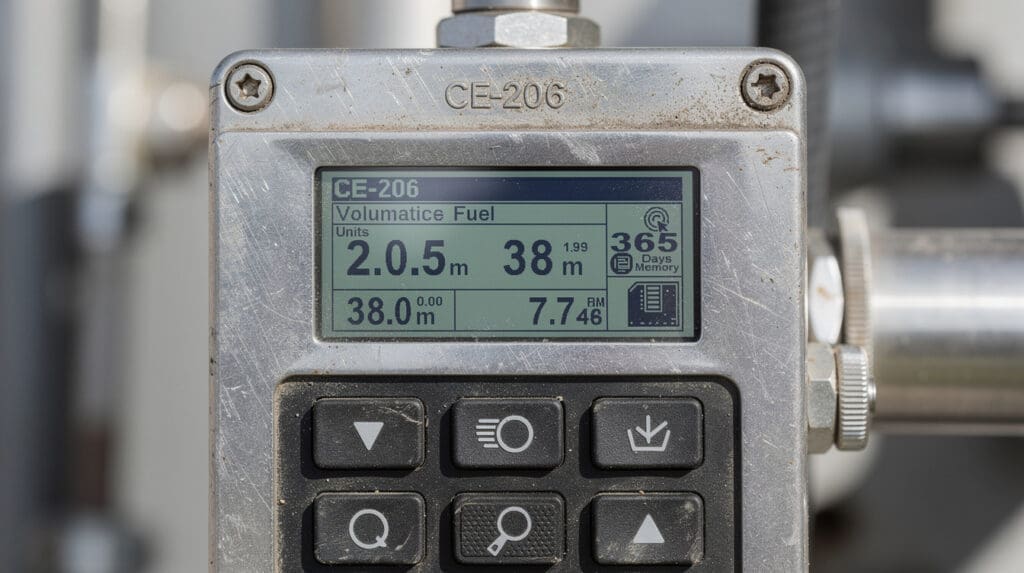
The CE-206 model's ability to store daily data for 365 days and monthly data for the last 12 months completely eliminates the need for manual logbooks, which are highly susceptible to "operator rounding" and deliberate misreporting.
Indian Industrial Context: Surviving GIDC Dust and Mining Vibrations
Any spec sheet looks impressive on a PDF. But put that equipment in a Kutch dust storm, and you find out what it’s really made of. Let me give you a recent example from an infrastructure project.
The contractor bought cheap bowser kits. Within three months, the fine saline dust from the Rann had bypassed the cheap plastic enclosures, coating the PCBs. Combined with high coastal humidity, the circuit boards shorted out. At the same time, the continuous vibration from driving over unpaved access roads cracked the cast-aluminum pump housings.
When we build a mobile fuel dispenser at Chintan, we design it for this exact brutality:
- Vibration Isolation: The pump and meter assembly on models like the CE-204 are mounted on elastomeric damping pads within the primary skid frame. This isolates the sensitive metrology equipment from chassis torsion and high-frequency road vibrations.
- Ingress Protection: We utilize IP65 and IP66 rated enclosures for all electronic components, including the CPU-based preset controllers.
- Environmental Sealing: All cable entries use metallic cable glands with neoprene seals, preventing both dust and moisture ingress.
For procurement teams weighing the structural differences between stationary depot setups and these ruggedized mobile units, I strongly recommend reviewing my Engineer's Guide to Mobile Fuel Dispensers.
Industrial Fuel Dispenser Maintenance and Calibration
Even the finest positive displacement meter will experience mechanical wear over millions of liters. A robust industrial fuel dispenser maintenance protocol is your only defense against metrological drift.
1. Volumetric Proving (Calibration)
Per BIS standards (IS 14883) and legal metrology guidelines, mobile dispensers used for custody transfer or precise internal accounting must be calibrated regularly.
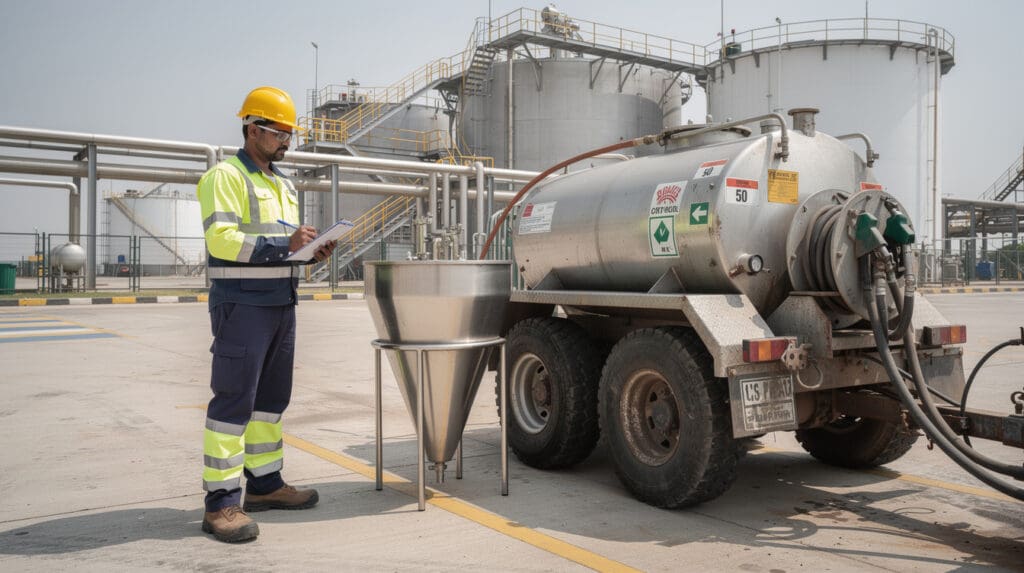
We utilize certified 20-liter or 50-liter conical field provers. The test is run at high flow, medium flow, and low flow. If the meter registers 50.00 liters but the prover sight glass shows 49.80 liters, we calculate the percentage error and mechanically or electronically adjust the meter's K-factor.
Calibration Frequency Recommendation:
- Standard construction fleet: Every 6 months.
- High-throughput mining: Every 3 months or 500,000 liters, whichever comes first.
2. Bypass Valve Calibration
Every rotary vane pump has an internal bypass (relief) valve. When the operator releases the auto-shutoff nozzle, the pump is still spinning. The bypass valve opens to recirculate the fuel within the pump head, preventing catastrophic pressure spikes.
If this valve gets stuck due to particulate buildup, the pump will deadhead, blowing the mechanical seal or stalling the DC motor. I've seen this happen far too many times in the field. Monthly maintenance must include checking the bypass valve spring tension and clearing any debris.
Need expert calibration for your mobile bowsers?
Chintan Engineers provides nationwide field proving, AMC support, and spare kits to keep your fleet OIML-compliant and highly accurate.
3. Critical Application Standards
While construction fleets have specific ruggedness needs, other mobile applications demand extreme precision. If your bowser is utilized for topping up critical infrastructure, such as banking data centers or hospital backup power, the standards shift entirely toward 100% uptime and micro-accuracy. For a deep dive into those specific metrological demands, read my notes on Data Center Generator Fuel Flow Meters & Auditing.
Final Engineering Verdict
After 22 years of analyzing flow data, I can definitively state that treating a mobile fuel dispenser as a low-priority, low-cost accessory is a massive financial error. You are effectively putting a cheap, unverified cash register on the back of a truck and allowing anyone to withdraw liquid money.
If you want my direct recommendation, backed by thousands of field data points across India:
If you operate a fleet of service pickups or small bowsers (under 2,000L capacity) and need economical, trackable dispensing, specify the CE-130 Mobile Preset Dispenser. The CPU-based preset allows you to input exact batch volumes (e.g., "dispense exactly 150 liters"), eliminating operator over-fueling, while storing the last 99 transactions for auditing.
If you operate heavy mining bowsers or high-volume civil construction tankers, do not compromise. Specify the CE-204 High Accuracy Mobile Dispenser. The ±0.2% accuracy achieved by its precision meter will pay for the entire skid in saved fuel within the first three months. The ability to integrate a receipt printer provides immediate, hard-copy custody transfer records right in the field.
Stop budgeting based on the initial "diesel bowser kit price." Budget for accuracy, budget for ruggedness, and budget for the 5-year TCO.
Frequently Asked Questions
What is the average mobile fuel dispenser price in India?
The price varies heavily based on technology. A low-grade turbine pump kit might cost ₹35,000, while a high-accuracy (±0.2%), OIML-compliant positive displacement skid like the CE-204 with preset electronics and a printer can range from ₹85,000 to ₹1,40,000 depending on exact configurations and flow rates.
Can I run the dispenser entirely on the host vehicle's battery?
Yes. Our CE-130, CE-202, and CE-204 systems are engineered with 12V or 24V DC motors. However, to prevent draining the vehicle, the host engine should typically be running during high-volume dispensing to allow the alternator to support the electrical load.
How does a digital preset controller prevent pilferage?
Models like the CE-130 and CE-204 feature CPU-based preset controllers. Management can mandate that operators punch in the exact volume required for a specific machine. Once that volume is reached, a solenoid valve automatically shuts off the flow. Combined with transaction memory (up to 365 days on the CE-206), you have a complete digital audit trail.
What is the recommended industrial fuel dispenser maintenance schedule for bowsers?
Clean the inline Y-strainer or 10-micron particulate filter every two weeks. Inspect the DC motor wiring for heat damage monthly. Perform a volumetric proving (calibration) test every 3 to 6 months depending on throughput volume. Inspect the auto-shutoff nozzle swivel for leaks daily.
Do you offer flameproof versions for hazardous zones?
Yes. If you are fueling in petroleum refineries, underground coal mines, or ATEX/PESO classified hazardous zones, we can engineer the skid with flameproof (FLP) motors, EX-rated enclosures, and static grounding reels to ensure absolute compliance with safety standards.
How long is the standard delivery hose included in the kit?
Standard diesel bowser kits from Chintan Engineers ship with a 4-meter anti-static rubber delivery hose. However, we frequently custom-build skids with spring-rewind hose reels carrying 10 to 15 meters of hose for reaching difficult access points on heavy earth-moving machinery.
Ready to deploy a metrologically accurate mobile bowser?
Stop relying on uncalibrated transfer pumps. Request a custom configuration specifying your tank size, required flow rate, and control needs.
Need a meter or dispenser for a specific duty?
Tell us the fluid, flow range and site; we reply with a model and a quote within one working day.