















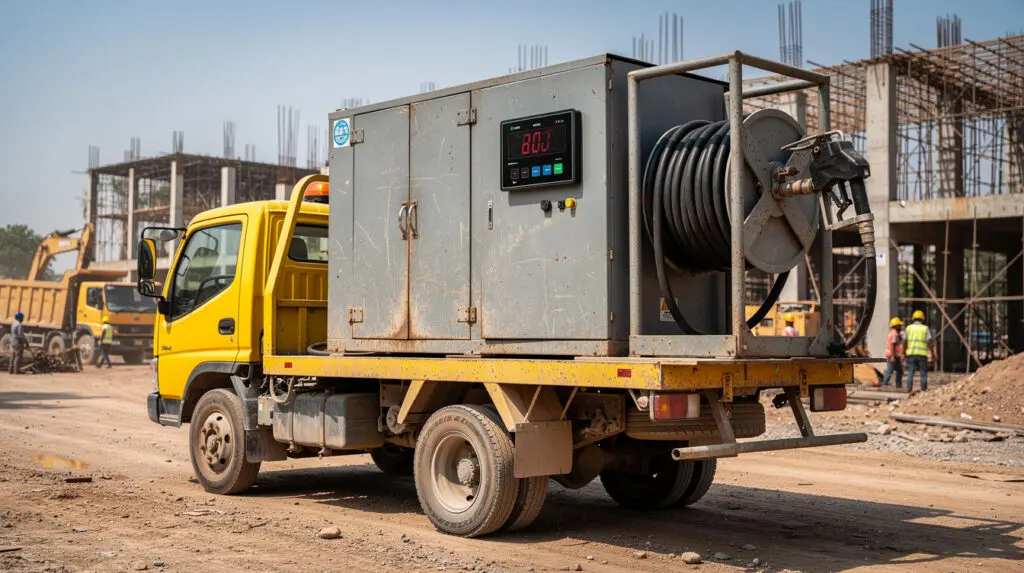
A 1% calibration drift on a 5,000 L/day diesel throughput costs your operation ₹1.35 lakh per month in untracked fuel. Over a year, that is ₹16.2 lakh simply vanishing into the dust of your work sites. If you are dispatching service trucks or bowsers to refuel excavators, DG sets, or transport fleets without certified mobile dispensing kits, you are operating a charity, not a business.
I'm Vikram Desai, Senior Flow Measurement Engineer at Chintan Engineers. Over the last 22 years, I have designed, installed, and calibrated over 5,000 flow measurement systems. From the humid, corrosive environments of ONGC coastal refineries to the voltage-starved stone quarries of rural Gujarat, I have seen exactly what happens when procurement teams buy cheap, uncalibrated transfer pumps instead of engineered mobile fuel dispensers.
Here is the reality of fluid dynamics and compliance you need to understand before slapping a pump onto a fleet vehicle. We'll look at the exact specifications, IS standards, and why the total cost of ownership matters more than the initial invoice.
In This Article
- The Physics of Mobile Fuel Delivery
- Metering Technologies: Why Turbine Meters Fail in Mobile Diesel Service
- Selecting the Right Dispenser Configuration
- Electrical Architecture: DC Power Constraints
- Surviving the Indian Industrial Context
- Installation, Calibration, and Standard Operating Procedures
- Calculating the ROI of Upgrading to a Digital Bowser Skid
- Final Engineering Recommendation
The Physics of Mobile Fuel Delivery
Transferring diesel from an underground storage tank (UST) at a fixed retail outlet is relatively straightforward. The environment is controlled, the power supply is regulated (mostly), and vibration is minimal.
I've seen so-called 'engineers' treat mobile bowsers like stationary tanks. But mounting a dispenser on a 4,000-liter bowser tank traversing unpaved mining roads is an entirely different mechanical beast. You are introducing three major variables that destroy measurement accuracy:
- Mechanical Vibration: Continuous harmonic resonance from the vehicle chassis can misalign poorly machined meter internals.
- Voltage Fluctuations: Running a 12V or 24V DC pump directly off a vehicle battery/alternator means dealing with severe voltage drops, especially when the truck is idling.
- Fluid Aeration: The sloshing of fuel in a mobile tank introduces micro-bubbles into the suction line, which standard meters will happily read as liquid volume.
This is why strapping a domestic water pump and a flow switch to a tank is an operational disaster. And frankly, I see it far too often. To achieve acceptable commercial accuracy—and comply with Legal Metrology Act requirements—a mobile fuel dispenser must employ positive displacement metering, air elimination, and ruggedized electrical controls.
If you want the exact metrology regulations covering these systems, read my previous breakdown of OIML R 117 Compliance for Liquid Batching Skids. But let's stay focused on the mechanics here.
Metering Technologies: Why Turbine Meters Fail in Mobile Diesel Service
I have calibrated enough turbine meters to know they do not belong anywhere near viscous fuels in a variable-flow mobile setting. I will explain exactly why.
A turbine meter relies on fluid velocity to spin a rotor. Diesel has a kinematic viscosity of roughly 2.5 to 4.0 cSt at 40°C. When a DC battery-powered pump starts, the initial flow rate is low. A turbine meter suffers from severe 'slip' at these low flow rates because the viscous fuel bypasses the rotor blades instead of turning them. The result? You under-register the volume delivered, giving away free fuel.
The Positive Displacement Advantage
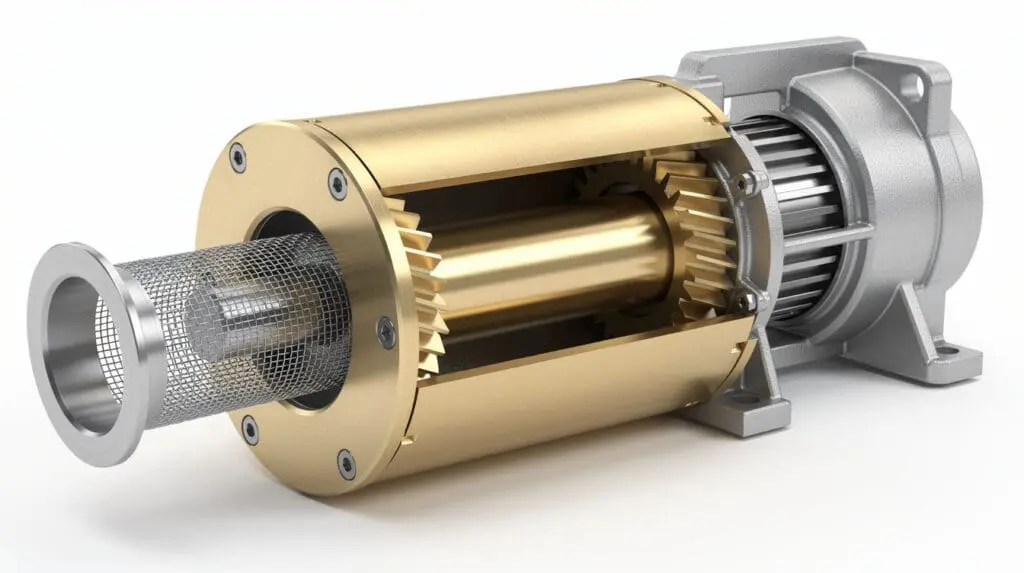
For mobile fuel dispensers, Positive Displacement (PD) meters are non-negotiable. Whether it is an oval gear or a rotary piston mechanism, a PD meter divides the fluid into fixed volumetric discrete parcels.
Take our CE-200 series (like the CE-204 and CE-206) for example. The meter mechanically traps the fluid, meaning viscosity actually improves accuracy by sealing the microscopic clearances between the gears and the measuring chamber. This is how we consistently achieve ±0.5% standard accuracy, and can tune the CE-204 down to an impressive ±0.2% accuracy during field calibration. (Try getting those numbers out of a cheap paddlewheel meter—it's mathematically impossible.)
Pro Tip: Always install a 10-micron to 30-micron inline particulate filter on the suction side of any PD meter. A rotary vane pump or oval gear meter chewing on rust flakes from a 10-year-old mild steel bowser tank will destroy your accuracy in a matter of weeks.
Losing diesel to inaccurate site transfers?
Upgrade your bowsers with Chintan Engineers' positive displacement mobile dispensers, featuring ±0.2% achievable accuracy and 365-day digital logging.
Selecting the Right Dispenser Configuration
Procurement often asks me, "Vikram, which mobile dispenser is the best?" The answer is always dictated by your throughput, your power availability, and your audit requirements.
Below is the selection matrix I use when sizing systems for clients ranging from construction firms to agricultural cooperatives.
| Model | Meter Technology | Flow Range | Accuracy | Power Input | Best Field Application |
| :— | :— | :— | :— | :— | :— |
| CE-204 | Digital PD w/ Preset | 20 – 80 L/min | ±0.2% (achievable) | 12/24V DC, 220V AC | Bowser fleets needing strict audit trails, 365-day memory, and receipt printing. |
| CE-206 | Digital PD | 20 – 80 L/min | ±0.5% standard | 12/24V DC | Standard fleet fueling; offers daily data storage and on-demand printing. |
| CE-117 | Digital (Brass internal) | 40 – 60 L/min | ±0.5% | DC / AC | Lightweight service pickups requiring versatile power and rugged 4m rubber hoses. |
| CE-101 | Mechanical (Brass) | 40 – 60 L/min | ±0.5% | DC / AC | Remote sites where digital screens may face damage; basic reliable transfer. |
| CE-201 | Mechanical Oval Gear | Up to 110 L/min | ±0.5% | 220/440V AC (Gen) | Heavy-duty tanker trucks and high-volume refueling (requires onboard generator). |
The Case for the CE-204 High Accuracy System
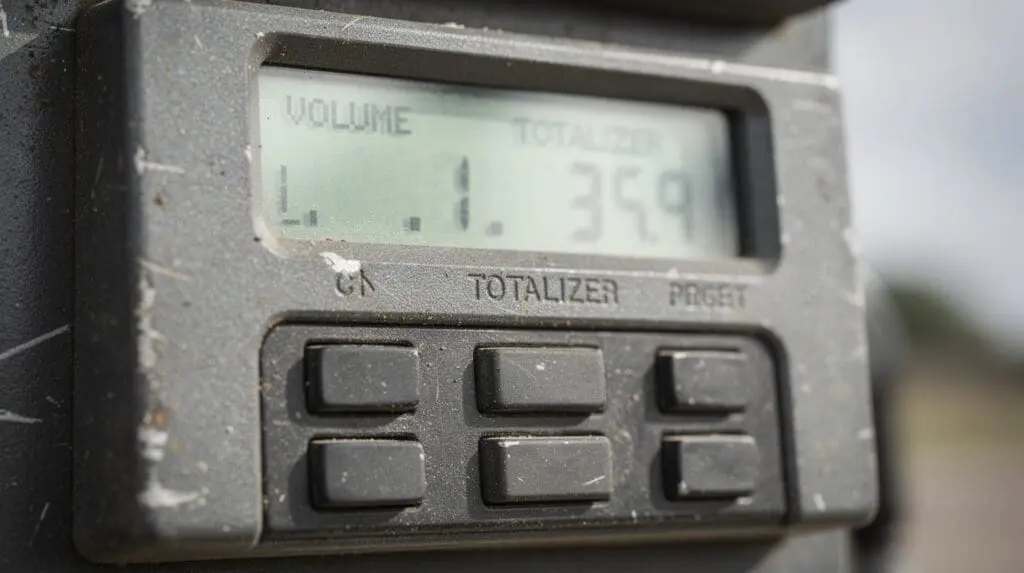
If you are managing a fleet of heavy earth-moving equipment (HEMM), the CE-204 is the engineering standard I specify. With a flow rate of up to 80 L/min, it minimizes the downtime of the receiving vehicle. More importantly, its CPU-based preset controller stores 365 days of daily data and 12 months of monthly data.
When a driver dispenses fuel, the batch is recorded, a receipt can be printed directly on site, and there is zero ambiguity about where the diesel went. This level of traceability is similar to the debates we see in factory environments when comparing Liquid Batching vs Load Cells—you need immutable digital records to stop pilferage.
Electrical Architecture: DC Power Constraints
Running a heavy-duty rotary vane pump off a 12V or 24V vehicle battery requires careful electrical engineering. The starting torque of these pumps is high, pulling significant inrush current.
If you under-size the DC supply cables, the voltage drop over a 5-meter run from the battery to the rear-mounted skid will starve the motor. A starved DC motor runs hot, fails prematurely, and fails to deliver the rated 60-80 L/min flow.
My field rules for 12/24V DC Mobile Dispensers:
- Use marine-grade, multi-strand copper cables sized appropriately for the ampere draw (typically 4-6 sq mm minimum for standard runs).
- Always install a dedicated heavy-duty isolator switch and an inline fuse right at the battery terminal.
- Ensure the vehicle engine is running during heavy dispensing operations to allow the alternator to support the load, rather than deep-cycling the starter battery.
Warning: Flameproof Compliance (IS 2148 / PESO): Standard 12/24V DC brush motors create sparks. If you are dispensing Class A or Class B petroleum products (like Petrol/Gasoline), or operating within a hazardous zone defined by the Petroleum Act, you MUST specify an EX/FLP (Flameproof) motor and enclosure. Diesel (Class C) is safer, but site-specific PESO regulations still dictate enclosure ratings.
Surviving the Indian Industrial Context
Let's talk about the harsh reality on the ground. A mobile dispenser deployed in a coastal area like Dahej or Hazira faces relentless monsoon humidity and saline air. A unit deployed in the iron ore mines of Odisha will be coated in abrasive dust within hours.
You can't use off-the-shelf commercial electronics here. We build our skids with powder-coated enclosures and IP55/IP65 rated internals because anything less will short out within a season.
The mechanical components inside models like the CE-117 and CE-101 utilize brass internals specifically to prevent internal corrosion when water inevitably condenses inside the bowser tank and is pulled through the pump. Water in diesel is a reality of the Indian fuel supply chain, and while your filters should catch the bulk of it, the meter internals must be able to withstand occasional moisture without seizing.
Did You Know: A standard 4-meter rubber hose full of diesel holds roughly 2 to 3 liters of fluid. High-quality ambient noise automatic shut-off nozzles (included with the CE-101/117) are critical not just for preventing overfills, but for maintaining the line pressure so the meter doesn't drain out and measure air on the next start-up.
Installation, Calibration, and Standard Operating Procedures
A mobile dispenser is only as accurate as its last calibration. Even the highly accurate CE-204 requires baseline proving once integrated into your vehicle's specific piping geometry. Why? Because every plumbing setup creates unique friction losses.
Step 1: Vehicle Assessment and Integration
When mounting a CE-202 compact kit or a full CE-201 skid, bolting it to the chassis is not enough. You must account for chassis flex. We recommend using heavy-duty vibration dampeners between the skid frame and the vehicle bed. The suction line from the tank should utilize a flexible, reinforced petroleum hose rather than rigid steel piping to prevent stress fractures.
Step 2: Proving and Calibration
Once wired and plumbed, do not just start dispensing. We use certified 20-liter or 50-liter volumetric provers.
- Prime the system to ensure all air is purged from the hose and meter.
- Dispense at the maximum flow rate (e.g., 60 L/min) into the prover.
- Note the mechanical or digital reading against the prover's graduated neck.
- Adjust the electronic K-factor (on digital models like CE-204/130) or the mechanical calibrator wheel until the error is well within the ±0.5% threshold.
Step 3: Implementing Driver SOPs
The best engineering in the world can't fix human negligence. Your drivers must understand how to handle the equipment. The hose reel must be retracted properly—dragging a delivery hose across gravel will wear through the nitrile rubber jacket in months, leading to leaks and pressure drops that affect meter accuracy.
Need expert installation for your mobile fueling project?
Chintan Engineers provides nationwide installation, calibration proving, and AMC support to ensure your bowsers stay legally compliant.
Calculating the ROI of Upgrading to a Digital Bowser Skid
Let's bring this back to the balance sheet. Suppose you upgrade a 5,000 L/day truck from a cheap transfer pump to a CE-206 Digital Dispenser.
- Capital Cost: Let us assume an estimated investment of ₹60,000 – ₹85,000 depending on accessories (hose reels, printers).
- Fuel Saved: By eliminating a 1% dispensing error (50 Liters/day at ₹90/L), you save ₹4,500 daily.
- Payback Period: Your investment pays for itself in less than 20 working days. It's simple math.
After month one, the dispenser is actively adding to your bottom line by eliminating shrinkage, preventing unauthorized drops, and saving the massive administrative headache of manual logbooks.
Frequently Asked Questions
Can I run the dispenser entirely on vehicle battery power?
Yes. Our 12V and 24V DC motors are specifically designed to power the rotary vane pump, digital meter, and controller directly from the vehicle's battery. An AC backup or AC-only configuration (220V) is optional for depot-based trollies.
How does the CE-204 prevent fuel pilferage on the road?
The CE-204 features a CPU-based preset controller. It requires specific input to dispense, logs the exact volume delivered, and stores daily transaction data for up to 365 days. Combined with optional receipt printers and telemetry pulse outputs, it makes unauthorized, unrecorded fuel drops virtually impossible.
Does the flow rate drop when using longer delivery hoses?
Yes, due to friction loss. Our standard kits are rated for 20-80 L/min at the meter. Pushing diesel through a standard 4-meter hose will maintain high flow, but if you request a 15-meter hose reel, the increased backpressure will slightly reduce the maximum achievable flow rate. The meter's accuracy, however, remains unaffected.
Are these dispensers suitable for AdBlue / DEF transfer?
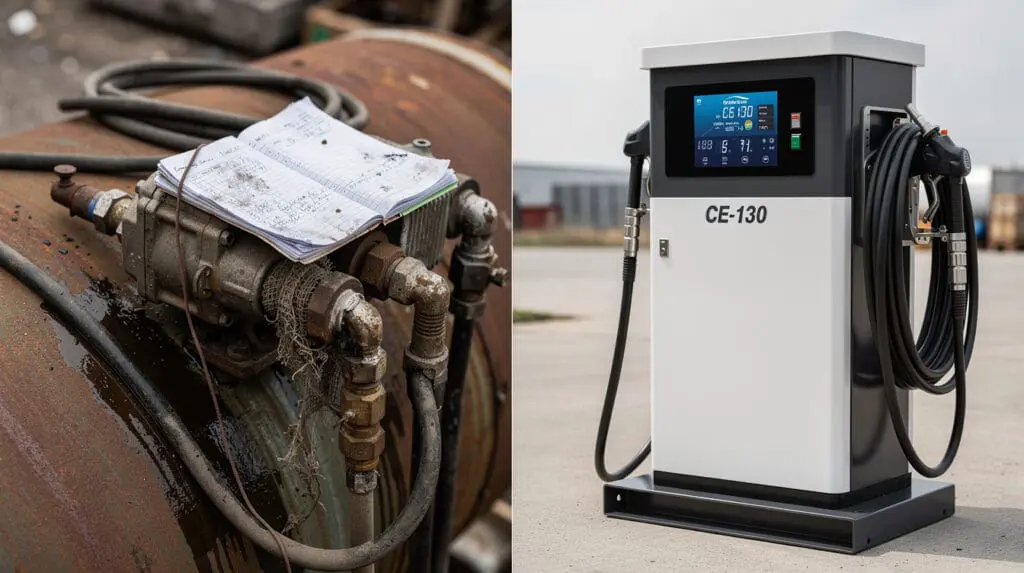
Standard cast iron or brass diesel dispensers will corrode rapidly if used for AdBlue. For AdBlue/DEF, you must specify our CE-130 Small AdBlue Dispenser, which utilizes urea-compatible polymers, stainless steel components, and a specialized digital LCD display engineered for aggressive fluids.
What maintenance is required for the rotary vane pump?
The primary maintenance is keeping the fluid clean. You must regularly inspect and clean the inline suction strainer. If flow rates begin to drop while the motor sounds healthy, the internal carbon or polymer vanes may need replacement—a simple, low-cost field service procedure we cover under our AMC support.
Do you provide Legal Metrology documentation?
Yes. Every mobile dispenser installation we execute can be supplied with initial calibration proving certificates, wiring diagrams, and the necessary technical documentation required for site compliance and audits.
Final Engineering Recommendation
Stop trusting millions of rupees of diesel to uncalibrated pumps and hand-written logbooks. Mobile fuel delivery is a precise fluid transfer operation and requires proper metrology equipment.
Based on two decades of field data, here is my direct recommendation for your operation:
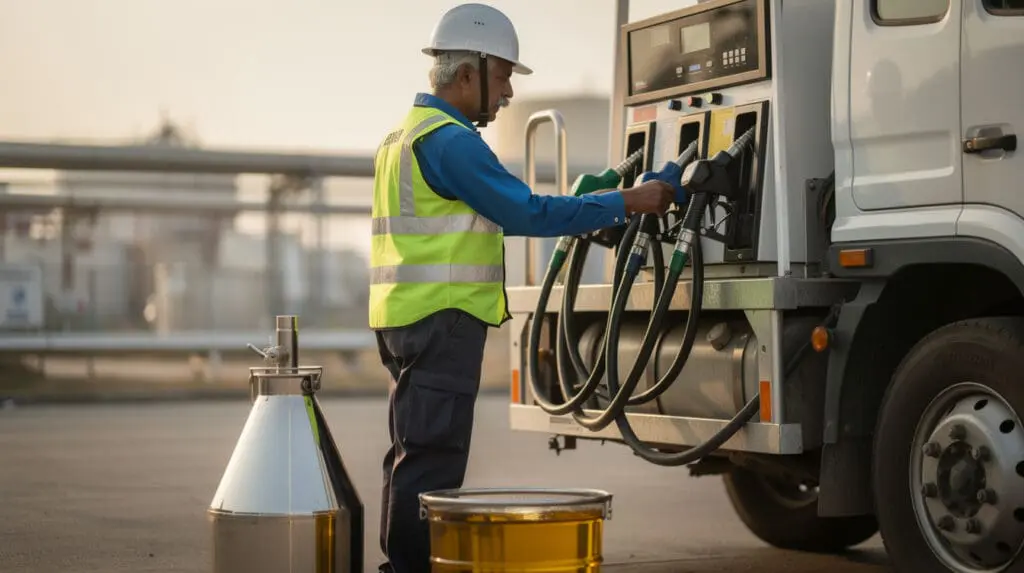
If you operate a commercial bowser fleet dispatching fuel to multiple assets, specify the CE-204 High Accuracy Mobile Dispenser. With achievable ±0.2% accuracy, robust 12/24V DC compatibility, and a 365-day transaction log, it closes the loop on your fuel inventory. For smaller service pickups running maintenance loops, the CE-117 offers a bulletproof brass-internals alternative.
Engineering isn't about buying the cheapest part; it is about buying the right tool to eliminate systemic losses.
Ready to turn your service truck into a certified mobile fueling station?
Contact Chintan Engineers to configure a self-contained dispenser skid matched exactly to your tank size, flow requirements, and power availability.
