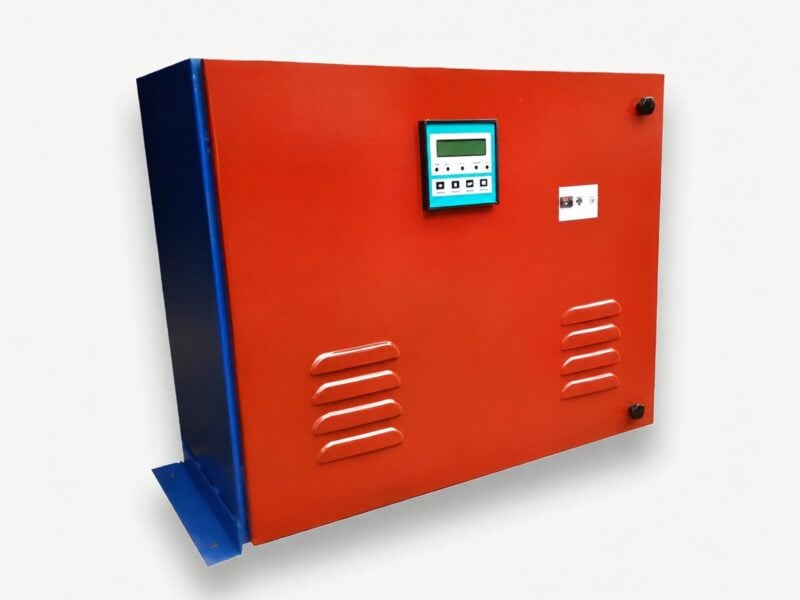
₹4.8 Lakhs/year€” Average raw material waste per stream from just a 1% valve overshoot in a standard two-shift 50 L/min chemical batching operation.
A 1% calibration drift or valve overshoot on a 50 L/min fluid line running two shifts costs your operation around ₹4.8 lakh annually in untracked product. Over my 22 years designing flow measurement systems at Chintan Engineers in Ahmedabad, I've seen plant managers spend heavy capital on top-tier PLCs, only to throttle their entire system's accuracy with sluggish valves, inadequate air elimination, or fundamentally incorrect meter selection.
Let's be clear: when evaluating a liquid batching system, your objective isn't just moving fluid from tank A to vessel B. You need to achieve repeatable ±0.5% to ±0.2% volumetric accuracy—complying with OIML R117 and IS 14883 standards—regardless of whether your fluid is diesel, high-viscosity gear oil, or an aggressive specialty chemical.
Instead of relying on trial and error, I'll walk you through the core engineering principles, component specs, and automation architectures needed to build a flow control batching skid that delivers exact volumes, shift after shift.
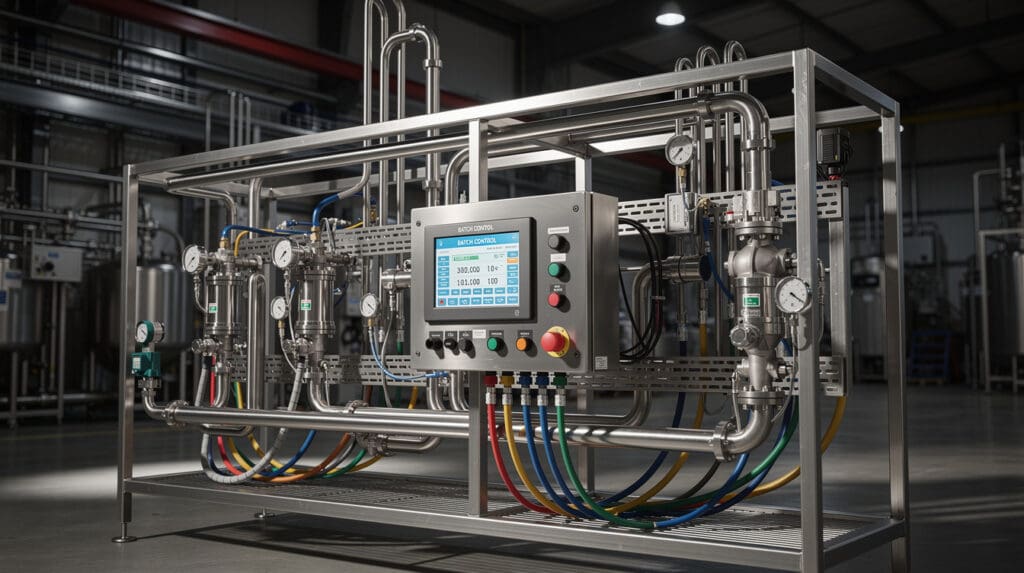
The Physics of Flow Control Batching
An automatic batching system operates on a simple control loop: measure fluid volume, compare it to a preset target, and actuate valves to start, trim, and stop the flow. Sounds simple enough, right? But the actual execution is entirely at the mercy of fluid dynamics.
Volumetric Metering Technologies
Your choice of flow sensor dictates the entire system's baseline accuracy. For liquid batching, we primarily rely on two proven technologies:
Positive Displacement (PD) Meters:
Systems utilizing meters like our CE-110/111 series physically divide the fluid into fixed, measurable increments. Because they measure discrete volumes rather than fluid velocity, PD meters offer ±0.5% accuracy (or ±0.2% on CE-113-based custody transfer skids) that is largely unaffected by viscosity changes.
Turbine Flow Meters:
Sensors like our CE-210 turbine rely on fluid velocity to spin a helical rotor. They are exceptional for low-viscosity, high-volume batching (like water or light solvents).
I've calibrated enough turbine meters to know they don't belong anywhere near highly viscous fluids. Once your media crosses 50 mPa·s, the slip factor on a turbine rotor destroys your linearity. If your fluid viscosity fluctuates with morning temperatures, stick to Positive Displacement meters.
Two-Stage Valve Actuation & Pre-Act Logic
Stopping flow precisely is actually harder than measuring it. A standard motorized ball valve takes 3 to 5 seconds to close. At 120 L/min, a 3-second delay translates to a 6-litre overshoot.
If you want precision, proper batching skids must utilize two-stage pneumatically actuated valves controlled by a PLC or a CE-Setstop preset counter. The logic employs a "fast-fill / trim" sequence. For a 500-litre batch, the valve opens 100% until 485 litres. It then drops to a 15% trim flow rate for the remaining 15 litres. Combined with algorithmic "pre-act" (which signals the final closure fractions of a second before the target volume is hit to account for mechanical lag), this eliminates water hammer and essentially guarantees zero overshoot.
Struggling with batch overshoot?
Our CE-136 Preset Batching System integrates dual-speed valve control to guarantee ±0.5% accuracy with automatic cutoff.
Selection & Sizing Guide
Sizing a liquid batching system requires matching the mechanical and electronic specifications directly to your specific throughput limits.
Core Skid Specifications
When engineering a custom skid, these are the baseline parameters we configure:
| Parameter | Specification Standard | High-Performance Option |
| :— | :— | :— |
| Flow Capacity | 5 – 120 L/min per stream | Custom manifolds for higher flows |
| System Accuracy | ±0.5% (Standard Industrial) | ±0.2% (Custody Transfer class) |
| Fluid Viscosity Limit | Up to 100 mPa·s | Up to 5,000 mPa·s (PD Meter based) |
| Power Infrastructure | 220 V AC single-phase | 24V DC / Flameproof configurations |
| Pumping Capability | Built-in matched pump | Liquid Transfer Pump up to 200°C |
Evaluating Automation and Connectivity
The "brains" behind the hardware—such as our CE-215 Custom Liquid Dispenser—must integrate seamlessly with your plant's existing SCADA or ERP architecture.
Modern controllers offer pulse outputs, 4–20 mA analog signals, and Ethernet/Modbus connectivity. For operations under the purview of the Legal Metrology Act, local ticket printing capabilities and secure batch logging are non-negotiable. If you're running multi-stage recipe blending, your PLC must handle formula selection via an HMI while simultaneously managing inline flush protocols between product changeovers.
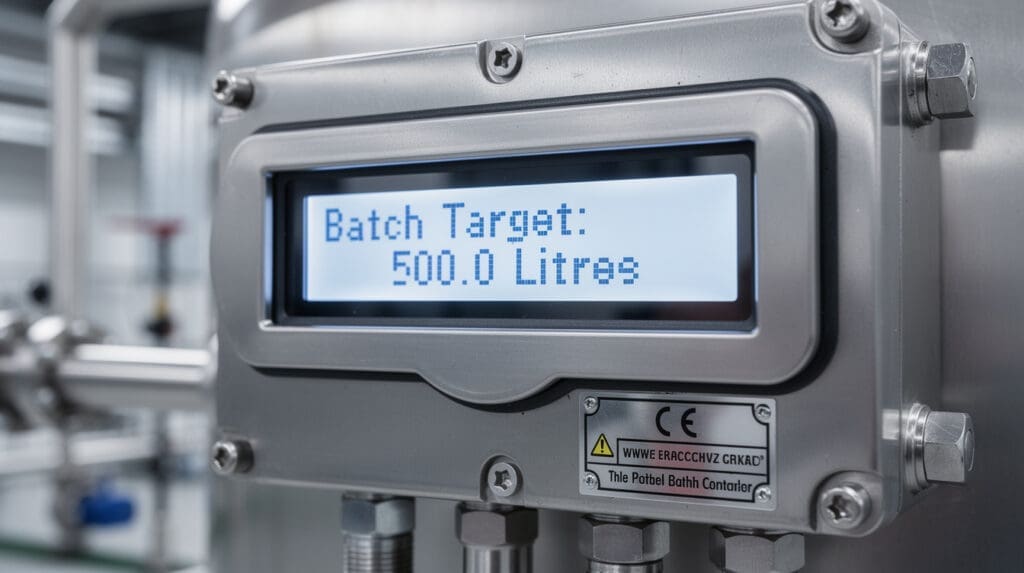
Applications & Indian Industrial Context
I always remind clients that designing a chemical batching system for Indian facilities requires specific environmental foresight. An off-the-shelf European skid often struggles with our aggressive voltage fluctuations, heavy dust ingress in industrial estates, and extreme monsoon humidity.
Chemical Mixing & Reactor Vessel Filling
In chemical manufacturing hubs like Ankleshwar GIDC, plant engineers require highly repeatable ratio dosing for reactor vessels. Manual drum dumping? It's hazardous, slow, and horribly inconsistent. An automated skid meters precise fluid quantities directly into the reactor. For highly aggressive or corrosive chemicals, we upgrade meter components to SS-316 (like our CE-143 SS Flow Meter) and utilize PTFE seals.
If you are sizing systems specifically for corrosive textile dyeing processes, you should review our engineering notes on PP Pumps for Textile Dyeing.
Lube Blending and Automotive Assembly
Assembly lines require exact volumes of gearbox oil, coolant, and brake fluid. A customized multi-stream CE-136 setup allows operators to select the specific fluid recipe for the vehicle model currently on the line. Because lubricants are highly temperature-dependent (viscosity drops dramatically on a 42°C May afternoon compared to a January morning), the system must utilize positive displacement technology to ensure the volumetric count remains perfectly linear across shifts.
High-temperature processes, such as furnace oil batching or bitumen blending, require specialized transfer equipment. We regularly integrate our Liquid Transfer Pump—capable of handling fluid temperatures up to 200°C—directly onto the metering skid, saving plant managers the headache of engineering custom pump-to-meter integration onsite.
Depot Operations & Mobile Skids
For fleet refueling and rental yard genset operations, batching systems essentially act as local custody transfer units. Every preset batch must trigger a printed ticket for audit trails. This kind of setup overlaps heavily with bulk fuel dispensing applications. For more on sizing mobile variants of these systems, consult my guide on Mobile Fuel Dispenser Specs.
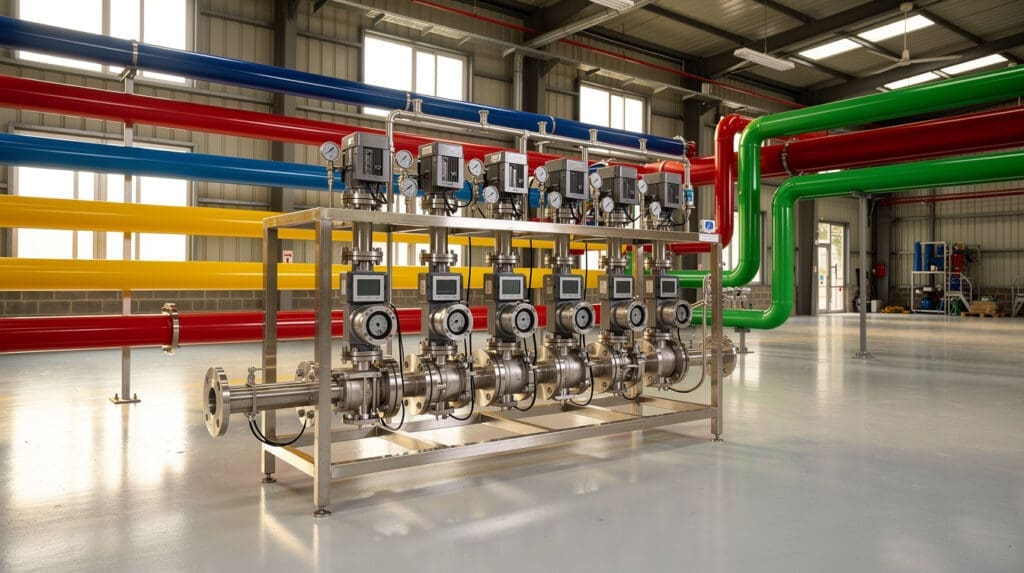
Need a customized multi-fluid manifold?
We design specialized manifolds with dedicated meters and flush cycles to prevent cross-contamination in batch reactors.
Installation & Maintenance Protocols
I can design the perfect skid, but it will still drift if installed poorly.
1. Upstream Filtration (The 40-Micron Rule)
More than 80% of PD meter failures I see in the field are due to particulate ingress. A Y-strainer with an appropriate mesh (typically 40 to 80 microns depending on fluid viscosity) must be installed upstream of the pump and meter.
2. Air Elimination
Flow meters measure volume, not state. If air enters your line during a tank switch, the meter will happily count the air bubbles as fluid, shorting your final batch. Industrial liquid batching skids must include an air eliminator vessel installed at the highest point before the meter.
3. Static Grounding
Particularly for petrochemicals and fuels like diesel, high-velocity transfer generates static electricity. Skids must be hard-grounded to the plant grid, and if operating in Zone 1 or Zone 2 hazardous areas, flameproof motors and intrinsically safe zener barriers are mandatory.
Never run a newly installed batching system line without first flushing the pipes with a dummy spool piece in place of the meter. Welding slag and pipe scale from installation will immediately jam a precision PD meter rotor.
Frequently Asked Questions
What batch sizes can these systems actually handle?
Our standard liquid batching systems efficiently cover 5 to 1,000 litres per batch. By utilizing multi-stage pneumatic valve logic and precise pre-act calculations, the controller keeps volume overshoot strictly below ±0.5% across this entire range.
Can a single batching system handle multiple fluids?
Yes. We design custom manifolds that can feature either dedicated meters and valves for each individual fluid stream, or shared headers with automated PLC-controlled flushing cycles to prevent cross-contamination.
Do you support installations in hazardous locations?
Yes. For petrochemical sites, refineries, and solvent blending areas, we build systems utilizing flameproof (Ex-d) motors, intrinsically safe (Ex-i) barriers for instrumentation, and fully stainless steel wetted components.
Can batch data be logged to an ERP or MES system?
Yes. The automation architecture includes pulse and 4–20 mA analog outputs, as well as Ethernet, RS485/Modbus communications to feed your central PLC, SCADA, or ERP systems. We also provide local ticket printers for physical batch receipts.
Do you supply the pumps as part of the skid package?
Yes, our systems are turnkey. Each skid is engineered and shipped with a correctly matched pump (such as our 200°C rated Rotary Gear Liquid Transfer Pump), inline strainers, air eliminators, and all necessary piping. It drops right into your process line requiring minimal onsite fabrication.
What is the advantage of the CE-136 Preset Batching System?
The CE-136 provides highly reliable preset quantity dispensing with an automatic electronic cutoff. It completely eliminates human error in drum filling and reactor dosing, achieving 0.5% accuracy using electrically activated two-stage valve control.
Final Engineering Thoughts
At the end of the day, your automatic batching system dictates the material efficiency and regulatory compliance of your entire fluid operation. Whether you're dealing with water-thin solvents or 5,000 mPa·s industrial lubricants, success lies in pairing the correct volumetric metering technology with rigid, two-stage valve automation and intelligent PLC logic.
Take it from my 22 years of field troubleshooting: avoid loosely assembled, mixed-brand components. A pre-engineered, factory-calibrated skid minimizes installation downtime, guarantees system integration, and ensures you hit your ±0.5% accuracy target from day one.
Ready to build a precision liquid batching system?
Share your fluid specs, line pressure, and batch volumes with us for a detailed process assessment and engineered skid design.