
SS Centrifugal Pump Specs & Mechanical Seal Selection
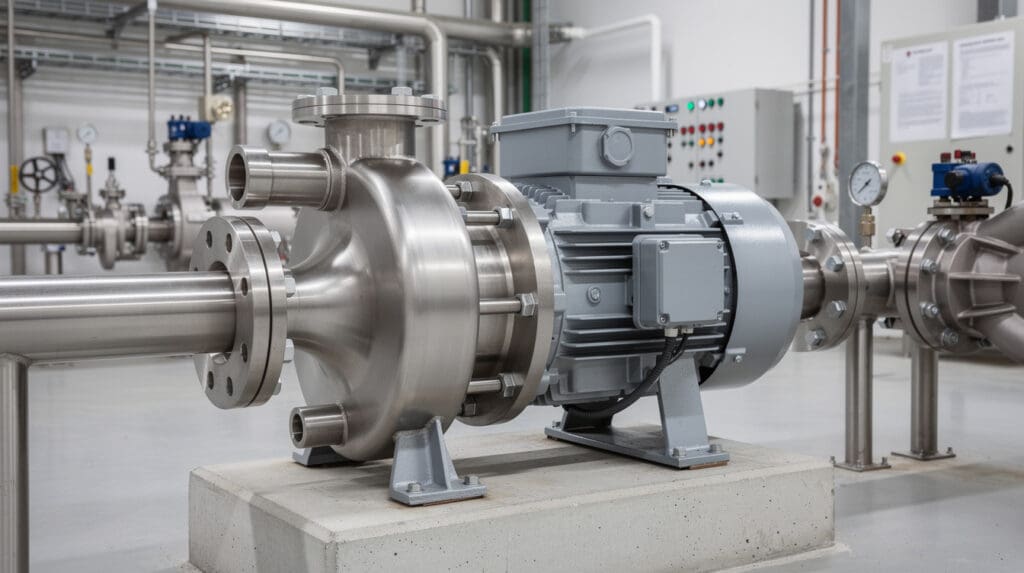
A recurring mechanical seal failure on a 20 HP transfer pump moving corrosive solvents isn't just an Rs 8,500 replacement part. Factor in the four hours of line downtime, production loss, and hazardous cleanup, and that single failure easily costs an average chemical plant in Vatva or Ankleshwar upwards of Rs 1.8 Lakhs per incident.
I am Vikram Desai, and over the last 22 years at Chintan Engineers, I've overseen the sizing, installation, and troubleshooting of thousands of fluid transfer systems. I regularly walk into plants where maintenance teams are replacing gland packings every three weeks on aggressive chemical lines simply because procurement bought a generic cast iron pump instead of specifying the right metallurgy and seal arrangements.
Instead of generic advice, I want to walk through the exact SS centrifugal pump specifications, fluid dynamics, and internal versus external industrial SS pump mechanical seals you need to keep harsh chemical lines operational.
The Realities of Metallurgy: Why Rolled Stainless Steel Outperforms Cast
When specifying a stainless steel monoblock pump India relies heavily on for dairy, pharmaceutical, and chemical applications, the manufacturing process of the casing and impeller is just as critical as the grade of the steel.
Many budget pumps utilize cast stainless steel. I strictly avoid cast SS for highly corrosive or hygienic applications. Why? The casting process inherently leaves a micro-porous surface. In chemical lines, these microscopic pits act as initiation sites for chloride-induced stress corrosion cracking. I've seen cast casings look like Swiss cheese after just six months of duty. In dairy or pharma setups, those same pits harbor bacterial colonies.
This is exactly why our CE Series at Chintan Engineers utilizes rolled stainless steel construction.
Always demand a pore-free, non-pitting surface finish for applications involving food-grade liquids or aggressive solvents. Rolled SS-304 or SS-316 prevents fluid stagnation at the microscopic level, drastically extending the pump's lifecycle.
The difference is measurable on the gauges. A rolled SS-316 pump casing will maintain hydraulic efficiency longer because the volute walls remain hydrodynamically smooth, reducing friction losses. When handling fluids with viscosities up to 1500 centipoise (cp)—like industrial resins or heavy dairy creams—minimizing internal surface friction is paramount to maintaining your Net Positive Suction Head Required (NPSHr).
The Operational Value of Back Pull-Out (BPO) Designs
If I can push plant managers toward one specific structural upgrade for their heavy process lines, it is the Back Pull-Out (BPO) design.
Think about standard monoblock maintenance. Reaching a damaged impeller or a blown mechanical seal requires disconnecting the suction and discharge piping. You have to wait for pipe-fitters, break the flange seals, wrestle with heavy piping, and essentially dismantle your entire fluid pathway.
The BPO Engineering Advantage
Our CE Backpullout Pump BPO Series eliminates this bottleneck. The design features a spacer coupling between the pump shaft and the motor shaft.
Pump back pull out design benefits include:
- Zero Piping Disturbance: The volute casing remains bolted securely to the suction and discharge lines.
- Rapid Maintenance: By removing the spacer coupling, the entire rotating assembly (impeller, shaft, mechanical seal, and bearing housing) can be withdrawn from the back.
- Precision Alignment Maintenance: Because the pump casing and motor base remain fixed, you don't have to perform a costly laser alignment of the massive pipeways after reassembly.
For plants adhering to DIN 24255 / ISO 2858 standards, standardizing on a BPO chassis means your mechanics can swap rotating assemblies in under 45 minutes, keeping downtime to an absolute minimum.
Is pump maintenance causing unacceptable plant downtime?
Standardize your process lines with Chintan's BPO Series. True back pull-out construction designed for 16-bar working pressure.
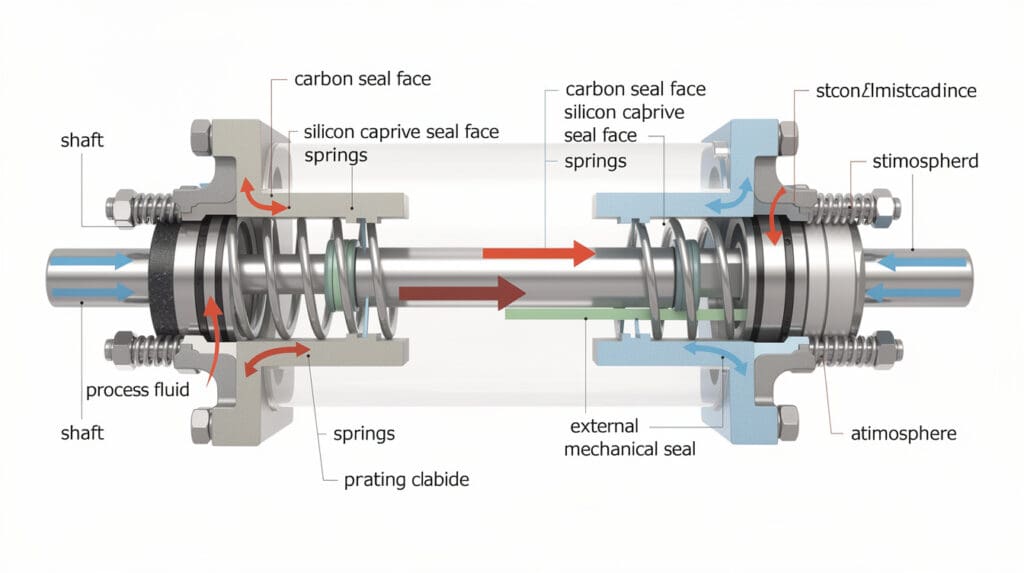
Internal vs. External Industrial SS Pump Mechanical Seals
Process uptime usually comes down to the sealing mechanism. The choice between gland packing and mechanical seals is largely settled—for hazardous or high-value fluids, mechanical seals are mandatory to meet fugitive emission standards.
However, the choice between internal and external mechanical seals dictates whether your pump runs for five years or five weeks.
Internal Mechanical Seals
An internal mechanical seal sits inside the pump's stuffing box, submerged in the pumped fluid.
- The Physics: The hydraulic pressure of the fluid inside the pump actually helps keep the seal faces pushed together.
- Cooling: The pumped fluid provides continuous lubrication and cooling to the seal faces (typically Carbon vs. Ceramic or Silicon Carbide vs. Silicon Carbide).
- Ideal For: Clean chemicals, RO water systems, dairy, and pharmaceutical transfer where the fluid is clean and non-abrasive.
External Mechanical Seals
An external seal sits on the outside of the stuffing box. The rotating face points outward, away from the fluid.
- The Physics: Centrifugal forces throw particles away from the seal faces, rather than grinding them into the gap.
- Corrosion Defense: The metallic springs and components of the seal are located outside the fluid zone. Why submerge a vital mechanical spring in aggressive process fluid if you don't have to?
- Ideal For: Highly corrosive fluids (like strong acids) where the metal components of an internal seal would dissolve, or fluids with abrasive suspended solids that would chew up internal seal faces.
Never use an internal mechanical seal with a standard 304SS spring for pumping high-concentration hydrochloric or sulfuric acids. The spring will embrittle and snap within days. If you are pumping extremely aggressive chemicals, you must look beyond SS. I highly recommend reading our engineering guide on PP Pumps for Electroplating & Metal Finishing for dealing with highly corrosive, chloride-rich environments.
Impeller Geometries for Corrosive and Viscous Fluid Handling
The impeller is where motor torque converts to fluid velocity. In our CE Series SS pumps, we pair different impeller geometries to the process fluid to prevent cavitation and clogging.
Closed Impellers
Closed impellers feature shrouds on both sides of the vanes.
- Performance: They provide the highest hydraulic efficiency and head generation. Our BPO series with closed dynamically balanced impellers can push heads up to 120 meters and capacities up to 990 m3/hr.
- Drawback: They have tight clearances. Closed impellers are great on paper, but if you're pulling from a dirty sump with suspended solids, you'll be tearing the pump down weekly to clear clogs.
- Best Application: Clean water, RO systems, solvents, and refined fuels. (Note: If you are moving refined fuels, accurately tracking that transfer is critical. See my breakdown on PD vs Ultrasonic Flow Meters to ensure you aren't losing product downstream).
Semi-Open Impellers
Semi-open impellers have a back shroud but no front shroud.
- Performance: They are slightly less efficient but highly tolerant of suspended solids and higher viscosities (up to 1500 cp).
- Maintenance: The clearance between the impeller vanes and the pump casing can be adjusted to compensate for wear, significantly extending the pump's useful life in mildly abrasive applications.
Selection and Sizing Guide: CE Monoblock vs. BPO Series
Here is how we translate these specifications into actual procurement decisions at Chintan Engineers:
| Specification Parameter | CE Series SS Monoblock | BPO Series Back Pull-Out |
| :— | :— | :— |
| Ideal Application | Hygienic, Food Grade, Solvents | Heavy Industrial, Process Lines |
| Max Capacity | Up to 120 m³/hr | Up to 990 m³/hr |
| Max Head | Up to 60 Meters | Up to 120 Meters |
| Max Viscosity | 1500 Centipoise | Process Dependent |
| Operating Speed | Up to 2880 RPM | 500 to 3600 RPM |
| Power Rating | 1.0 HP to 20 HP (3-Phase) | Customized (Heavy Duty) |
| Flange Standards | Standard | DIN 24255 / ISO 2858 |
| Design Pressure | Standard | 16 Bar (Optional 20 Bar) |
The 3mm Rule: Our Cast Iron variants of the BPO series include a >3mm corrosion allowance on the casing. This over-engineering ensures that even under aggressive chemical erosion, the casing integrity holds for years before requiring a swap.
Installation Realities in the Indian Industrial Context
Designing a pump on a CAD screen in a climate-controlled office is one thing; installing it in a humid GIDC estate where the incoming grid voltage frequently drops in the summer is entirely another.
1. Combating Voltage Fluctuations
Our SS Monoblock pumps are wound specifically to handle Indian industrial power realities. The 3-phase motors operate comfortably within a 380 V to 415 V range, and the single-phase units handle 200 V to 240 V. Operating outside these ranges spikes amperage, generating heat that travels straight down the shaft and bakes the mechanical seal elastomers.
2. Piping Strain and Baseplate Grouting
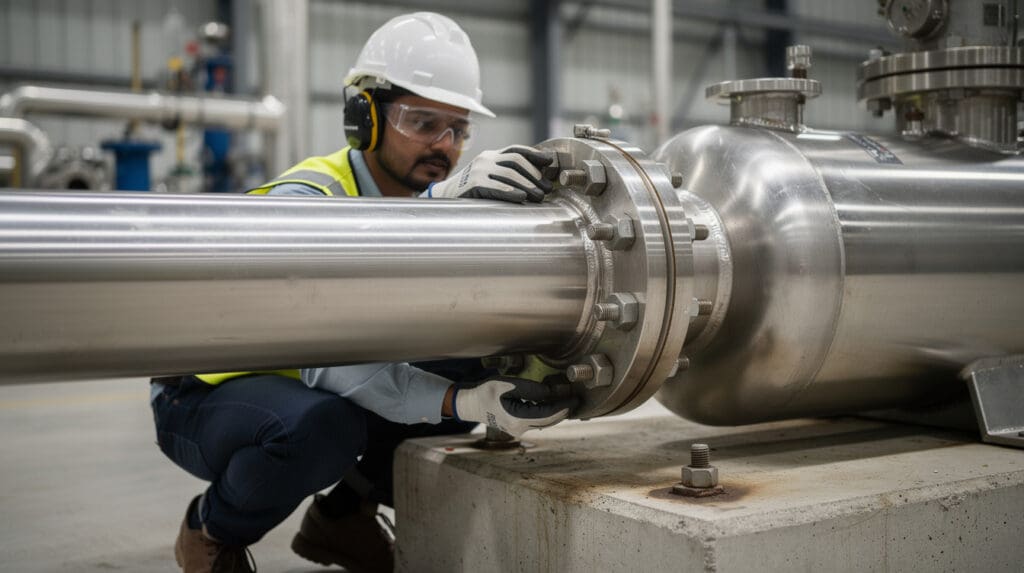
A pump is not a pipe support. I see this installation violation constantly: a 100mm discharge pipe is slightly misaligned, so the installation crew uses the flange bolts to forcefully "pull" the pipe into place.
In our BPO series installations, we mandate heavy-duty baseplates properly grouted into concrete, with piping independently supported. Piping strain distorts the volute casing by fractions of a millimeter—just enough to cause the mechanical seal faces to separate, resulting in immediate, unexplainable leaks.
Need a pump engineered for harsh industrial realities?
Chintan Engineers manufactures robust SS centrifugal pumps designed to withstand voltage fluctuations and heavy continuous duty.
3. Monsoon Humidity and Motor Enclosures
In coastal Gujarat or during the heavy monsoons, ambient humidity destroys motor terminal boxes. We specify highly rated IP enclosures and recommend anti-condensation heaters for pumps that sit idle for long periods. (If you manage remote or mobile assets exposed to these elements, you'll find similar ruggedization strategies in my Mobile Fuel Dispenser Engineering Guide).
Frequently Asked Questions
Why is rolled stainless steel better than cast for food-grade pumps?
Rolled stainless steel provides a pore-free, non-pitting surface finish. Cast metals have microscopic pores that harbor bacteria or serve as initiation points for chemical corrosion. Rolled SS ensures a strictly hygienic surface compliant with dairy and pharma standards.
What is the maximum viscosity a standard SS centrifugal pump can handle?
Our CE Series SS pumps efficiently handle viscosities up to 1500 centipoise (cp) when fitted with the appropriate semi-open impeller and motor sizing. Pumping fluids thicker than this usually requires shifting to a Positive Displacement pump, like a Rotary Lobe or Gear pump.
How does a back pull-out (BPO) design save money?
It eliminates the need to disconnect suction and delivery piping during maintenance. You remove a spacer coupling and pull out the entire rotating assembly. This cuts maintenance downtime by over 60% and removes the need for costly pipe re-alignment.
When should I specify an external mechanical seal over an internal one?
You must specify an external mechanical seal when handling highly abrasive fluids (slurries) or extremely aggressive chemicals that would corrode the metallic springs and components of an internal seal.
What are the standard voltage requirements for industrial SS monoblock pumps?
Our heavy-duty industrial units operate on Three Phase power ranging from 380 V to 415 V (1.0 HP to 20 HP). For smaller utility applications, Single Phase units are available operating from 200 V to 240 V (0.5 HP to 2.0 HP).
Final Thoughts on Pump Specification
Pump specification goes far beyond flow and head curves. It is an engineering calculus involving fluid viscosity, chloride levels, vapor pressure, and maintenance accessibility.
If you are pumping clean, high-value liquids like dairy, RO water, or fine solvents, a rolled SS-316 pump from our CE Series with an internal mechanical seal and a closed impeller is your most efficient choice.
However, if you are operating a continuous process line where downtime costs thousands of rupees a minute, and you need to conform to ISO 2858 standards, you should seriously look at the BPO Series. The initial capital expenditure for a true back pull-out design pays for itself the very first time you need to replace a seal without tearing down your pipework.
Stop paying the hidden costs of poor pump specification. Analyze your fluid, measure your NPSH, and install the right metallurgy for the job.
Ready to specify the right pump for your process line?
Send us your fluid parameters (viscosity, specific gravity, flow rate, and head), and our engineers will size the perfect SS pump for your plant.
Need a meter or dispenser for a specific duty?
Tell us the fluid, flow range and site; we reply with a model and a quote within one working day.