
















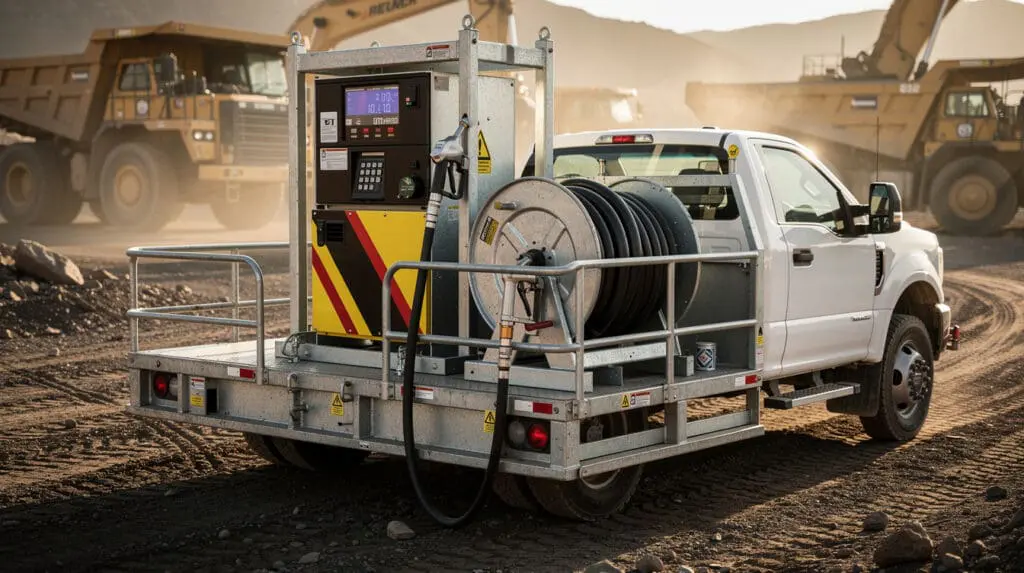
I've spent 22 years auditing fleet fuel systems across India, from the ONGC refineries in Hazira to isolated mining camps in rural Odisha. Procurement managers constantly ask me why their diesel consumption data never matches their operational output. How is fuel vanishing? The answer is almost always sitting in the back of their service truck: an uncalibrated, loosely assembled utility pump pretending to be a mobile fueling station.
Let me be clear: bolting a cheap pump to a drum does not make a fuel dispenser. A true mobile fuel dispenser is an engineered skid incorporating positive displacement measurement, air elimination, inline filtration, and traceable preset controls. If your bowser cannot meet OIML R117 standards for dynamic measuring systems, you aren't dispensing diesel—you are hemorrhaging operating capital.
In This Article
The Physics of Mobile Fuel Measurement
Mobile dispensation is arguably the harshest environment for flow measurement. Stationary depot dispensers enjoy stable power, vibration-free mounts, and highly filtered product. A mobile dispenser mounted on a pickup bed traversing kacha roads faces constant high-frequency vibration, 12V/24V DC power fluctuations from the vehicle alternator, and severe sloshing that introduces entrained air into the suction line.
I've calibrated enough turbine meters to know they don't belong anywhere near viscous fuels on a moving vehicle. Turbine rotors suffer from bearing wear under vibration and completely lose their K-factor linearity when subjected to the fluctuating backpressure of a manually operated hose nozzle.
This is exactly why industrial mobile fuel dispensers rely exclusively on positive displacement (PD) technology—specifically rotary vane or oval gear mechanisms. A PD meter traps a finite volume of fluid between its mechanical clearances and physically sweeps it from inlet to outlet. Engineered builds like our CE-204 and CE-206 series utilize precision-machined volumetric chambers. This allows them to maintain mechanical accuracy independent of flow profile disturbances or viscosity changes caused by ambient temperature swings.
Did You Know: Per Indian Standard IS 14883 (Requirements for Volumetric Meters), commercial fuel transactions demand specific accuracy classes. While depot operations aim for ±0.1%, robust mobile systems must legally maintain ±0.5% in the field, with units like the CE-204 capable of sustaining ±0.2% even under DC power fluctuations.
Core Components of a Bowser Skid
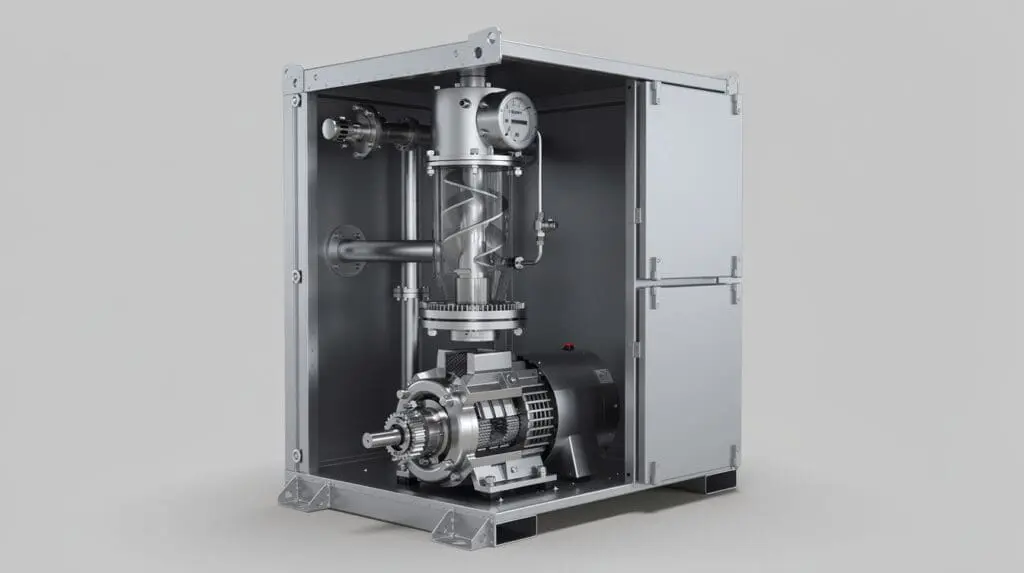
To turn a standard tank into a certified mobile fueling station, the skid must integrate several discrete technologies into a single continuous sequence. Cheap kits often skip steps 1 and 3, which is a guaranteed recipe for failure:
- Suction Filtration (Y-Strainer): Protects the pump vanes from tank scale and rust.
- Rotary Vane Pump: We specify these for 12V/24V DC operations because they are self-priming and maintain high suction lift (up to 3 meters) even when internal vanes wear over time.
- Air Elimination: Critical for accuracy. Without a centrifugal air separator before the meter, you aren't just pumping diesel—you're pumping froth, and charging your own fleet for tank slosh.
- Positive Displacement Flow Meter: Mechanical (like the CE-101) or Digital (like the CE-206) with pulse outputs.
- Delivery Hardware: Auto shut-off nozzle and a heavy-duty hose reel (typically 3–6 meters of reinforced rubber).
Warning: Static Electricity Hazard: Diesel flow through a rubber hose generates static electricity. If you are mounting a 220V AC dispenser (like the CE-201) to a trailer, ensure you utilize grounding kits. If operating in hazardous zones, the motor and electrical enclosure must be EX/FLP (flameproof) certified.
Building a mobile fueling fleet?
Don't piece together incompatible parts. Our self-contained dispenser skids drop directly onto bowsers and service trucks.
Specification and Selection Guide
Selecting the correct model dictates the long-term reliability of your refueling operation. Sizing primarily depends on vehicle battery capacity (or onboard AC generator), required flow rate, and the level of data logging required for your ERP system. If you want to run the exact hydraulic equations, pull up our Mobile Fuel Dispensers: Engineering & Sizing reference.
Stop guessing with product catalogs. Here is the actual field data driving my recommendations for specific fleet profiles:
| Model | Flow Range | Accuracy | Power Supply | Critical Feature | Ideal Application |
| :— | :— | :— | :— | :— | :— |
| CE-204 High Accuracy | 20 – 80 L/min | ±0.2% | 12/24V DC, 220V AC | 365-day transaction memory, Printer-ready | Large bowser fleets requiring total auditability and zero pilferage. |
| CE-206 Digital Dispenser | 20 – 80 L/min | ±0.5% | 12V/24V DC | Max pressure 0.3 MPA, Monthly data for last 12 months | Oil stations, agricultural fueling, and daily fleet top-offs. |
| CE-201 Heavy Duty Skid | Up to 110 L/min | ±0.5% | 220/440V AC | 1.2 kW pump, Mechanical Oval Gear | Tanker trucks refueling heavy earth-moving equipment (HEMM). |
| CE-130 Mobile Preset | 20 – 60 L/min | ±0.5% | 12/24V DC, 220V AC | CPU-based preset batching | Remote construction sites and rental equipment fleets. |
| CE-117 (Brass) | 40 – 60 L/min | ±0.5% | DC / AC | Max 3 BAR, 25mm connection | Service pickups dispensing lubricants or general diesel transfer. |
The ROI of Digital Preset and Data Logging
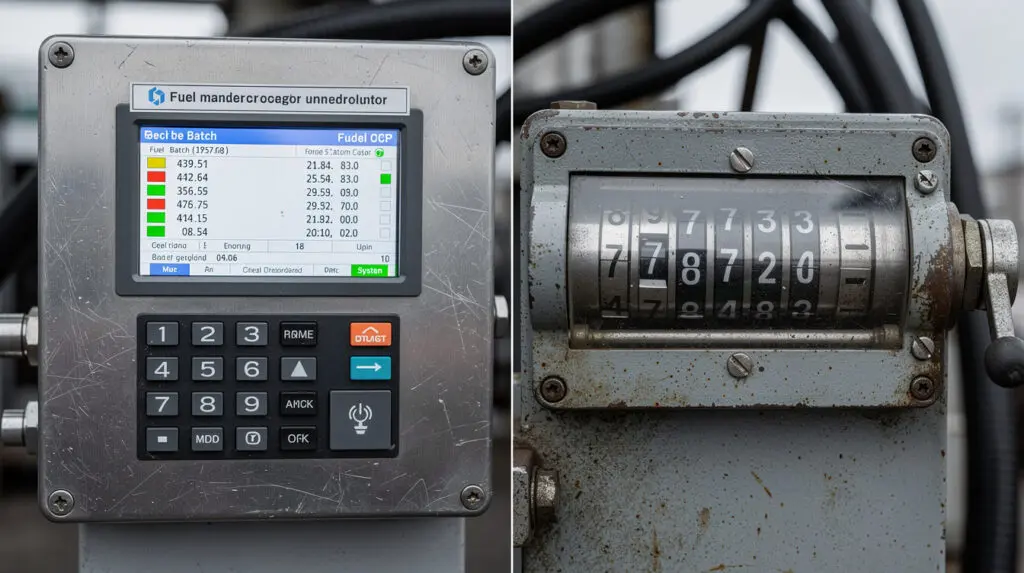
The CE-206 and CE-204 are fundamentally changing how fleet managers track fuel. When you rely on a basic mechanical counter (like the otherwise robust CE-101), the operator must manually record the transaction on a clipboard. This introduces "fat-finger" errors and provides highly convenient cover for skimming.
By deploying a digital CPU-based preset controller, the fleet manager sets a predetermined batch (e.g., exactly 200 liters for an excavator). The dispenser automatically shuts off via a solenoid valve when the batch is reached.
Furthermore, the CE-206 stores daily data for 365 days and monthly data for the last 12 months. If a discrepancy arises, you pull the receipt directly from the dispenser's memory. I constantly have to explain how field transactions reconcile with gross tank weights; if you're struggling with this at your site, grab our analysis on Fuel Flow Meter vs Weighbridge for Bulk Diesel.
Pro Tip: I see this mistake weekly: If your service truck uses a 12V battery, strictly limit your flow expectations to 40-60 L/min. Pushing an 80 L/min pump on a standard 12V vehicle alternator forces massive voltage drops that will cook the pump's DC motor stator within months. For 80+ L/min, upgrade to a 24V system or use an AC generator for the CE-201.
Surviving the Indian Industrial Context
Imported, lightweight plastic pumps look great in a catalog, but they simply do not survive in a GIDC industrial estate or a central Indian mining corridor. Here is what we actively engineer for when designing these kits:
- Monsoon Humidity & Ingress: The electronic enclosures on the CE-204 and CE-206 are hermetically sealed. IP55 is the absolute minimum, but we prefer potting the CPU boards to prevent condensation from shorting the digital preset circuits during heavy July monsoons.
- Dust Contamination: Laterite dust in mining zones is highly abrasive. We utilize heavy-duty powder-coated steel housings and oversized suction strainers. If abrasive dust enters the rotary vane pump, it scores the internal casing, immediately dropping suction lift and flow rate.
- Voltage Fluctuations: On-site AC generators rarely provide a clean 220V sine wave. Our AC power supply modules include robust rectification and surge protection to prevent motherboard burnout.
Stop losing diesel to inaccurate field transfers.
Upgrade your service trucks with 0.2% accurate, data-logging dispensers.
Installation and Volumetric Proving
Proper installation is more than bolting down the skid and connecting a battery. As per Legal Metrology rules (aligned with OIML R117), a dispenser is only as good as its field calibration.
- Suction Line Sizing: The line from the bottom of the bowser tank to the pump inlet must be short, rigid (or wire-reinforced suction hose), and strictly matched to the pump inlet size (typically 25mm / 1-inch for 60 L/min). Reducing the suction line size causes cavitation, which destroys the meter and registers false volumes.
- Bypass Valve Calibration: DC pumps feature internal bypass valves. If the nozzle is closed while the pump is running, the fuel loops internally. This bypass must be set to open at the correct pressure (usually around 1.5 to 2.5 BAR) to prevent motor stall.
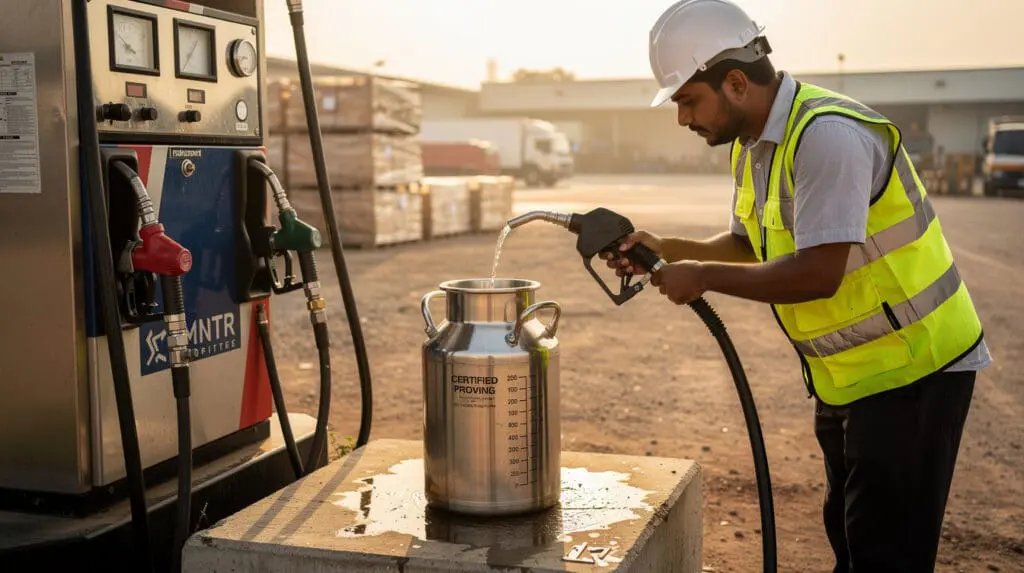
- Proving the Meter: We never deploy a skid without running a volumetric proving test using a certified 20L or 50L proving measure (IS 5765 standard). We run the fluid at fast flow, slow flow, and intermittent flow to establish the mechanical K-factor, adjusting the electronic calibration on the CE-206 until the deviation is locked well within ±0.5%.
Frequently Asked Questions
Can I run the dispenser entirely on vehicle battery power?
Yes. Both 12V and 24V DC motors are available specifically to power the pump, meter, and controller directly from the service vehicle's electrical system without requiring an external AC generator. The CE-206 and CE-130 are ideal for this application.
How do I prevent pilferage on the road?
Deploy a digital dispenser like the CE-204 or CE-206. These utilize password-locked preset controllers, store transaction data for up to 365 days, and can connect to receipt printers. This ensures every drop pumped is mathematically logged to a specific transaction, eliminating manual "clipboard" errors.
Is hose management included?
Our engineered skids can be configured with 3 to 6-meter reinforced rubber delivery hoses. For heavy-duty applications (like the CE-201), we integrate spring-rewind hose reels with heavy-duty swivels to prevent kinking and premature hose failure.
Do you offer flameproof versions for hazardous zones?
Yes. If your bowser is operating in a designated hazardous area (such as near aviation fuel or chemical plants), we supply the system with EX/FLP certified motors and explosion-proof electrical enclosures to maintain compliance with stringent site safety standards.
What documentation is required for a commercial mobile dispenser?
Every mobile fuel dispenser should be supplied with a factory calibration certificate, electrical wiring diagrams, and Standard Operating Procedures (SOPs) for hose grounding and batch recording. If the dispenser is used for commercial custody transfer, it must be periodically stamped by Legal Metrology authorities.
Final Engineering Verdict
Let me save you some trial and error. Based on two decades of field data, here is my direct recommendation for your operation:
If you are operating a standard maintenance pickup dispensing 40-60 L/min primarily to top off generators or small equipment, the CE-117 Brass Digital Dispenser provides rugged, no-nonsense reliability.
However, if you are running a dedicated 5,000 to 10,000-liter diesel bowser supplying a mining fleet or construction site, do not compromise. Specify the CE-204 High Accuracy Mobile Dispenser or the CE-206 Digital Dispenser. The ability to lock batch quantities via a CPU preset, coupled with 365-day transaction memory and ±0.2% to ±0.5% PD meter accuracy, will pay for the entire skid in recovered fuel costs within the first four months of deployment.
Stop guessing how much diesel your bowsers are delivering. Engineer the measurement.
Ready to modernize your bowser fleet?
Request a mobile dispenser configuration matched to your tank size, flow requirements, and telemetry needs.
