
















In This Article:
- The Mechanics of Mobile Dispensing: Why Simple Pumps Fail
- Power Dynamics in Off-Grid Metrology
- Mobile Dispenser Configuration Guide
- TCO and ROI: The Economics of Traceability
- Indian Field Realities: Installation & Maintenance Defenses
- Dispensing AdBlue on Mobile Platforms
- Frequently Asked Questions
- Final Engineering Verdict
A 1% calibration drift on a 5,000L/day mobile bowser throughput costs your operation Rs 1.3 lakh per month in untracked fuel. Most fleet managers write this off as unavoidable “transit loss.” I write it off as engineering negligence. Are you really willing to bleed that kind of money just because your pump is vibrating on a dirt road?
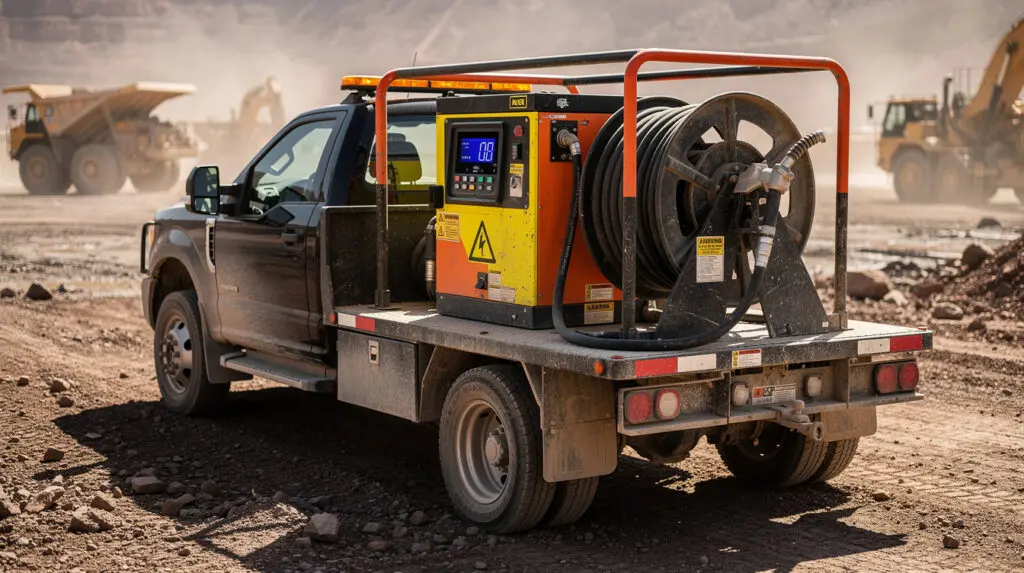
I have spent 22 years calibrating over 5,000 flow measurement systems at Chintan Engineers—from massive ONGC transfer lines to makeshift service rigs in rural Gujarat. The most common mistake I see in off-grid fueling is treating a mobile dispenser like a glorified water pump. A true mobile fuel dispenser is an integrated metrology instrument engineered to operate under severe vibration, fluctuating DC voltages, and harsh environmental conditions, all while maintaining Legal Metrology compliance.
When you mount a dispensing kit onto a flatbed, a trailer skid, or a tank-top frame, you are removing the stable infrastructure of a permanent depot. You lose grid power stabilization, thermal shielding, and vibration isolation. If your equipment is not specifically built for mobile duty—and compliant with OIML R117 and IS 14883—you are simply pumping fuel blind.
The Mechanics of Mobile Dispensing: Why Simple Pumps Fail
I’ve calibrated enough turbine meters to know they don’t belong anywhere near viscous fuels on a mobile platform—and I’ll explain exactly why.
When a bowser traverses unpaved roads in a mining corridor or a construction site, the diesel inside the tank sloshes violently. (If you’ve ever driven behind a fuel truck on a haul road, you know exactly what I mean.) This introduces microscopic air entrainment and causes erratic pressure spikes at the pump inlet. A standard turbine rotor relies on fluid velocity to calculate volume. If the fluid velocity surges due to a pressure spike from sloshing, the turbine over-spins, recording fuel that hasn’t actually been delivered.
The Positive Displacement Imperative
For mobile applications, a Positive Displacement (PD) meter is mathematically non-negotiable. PD meters physically isolate fixed volumes of fluid in sealed chambers. Whether the fuel is surging at 80 L/min or trickling at 20 L/min due to a dying 12V battery, the volume displaced remains mathematically constant.
If you want the exact mechanical breakdown, read my guide on PD vs Turbine fuel flow meter specifications.
Our mobile kits utilize heavy-duty rotary vane pumps coupled with mechanical oval gear or digital PD meters. The rotary vane pump design is self-priming, which is critical because mobile suction lines often lose prime due to vehicle tilt and constant vibration. A centrifugal transfer pump would cavitate and burn out under these conditions; a rotary vane pump pulls a strong vacuum and immediately resumes flow.
Need help selecting the right Mobile Fuel Dispenser?
Our engineering team can match the exact configuration to your operational requirements.
Power Dynamics in Off-Grid Metrology
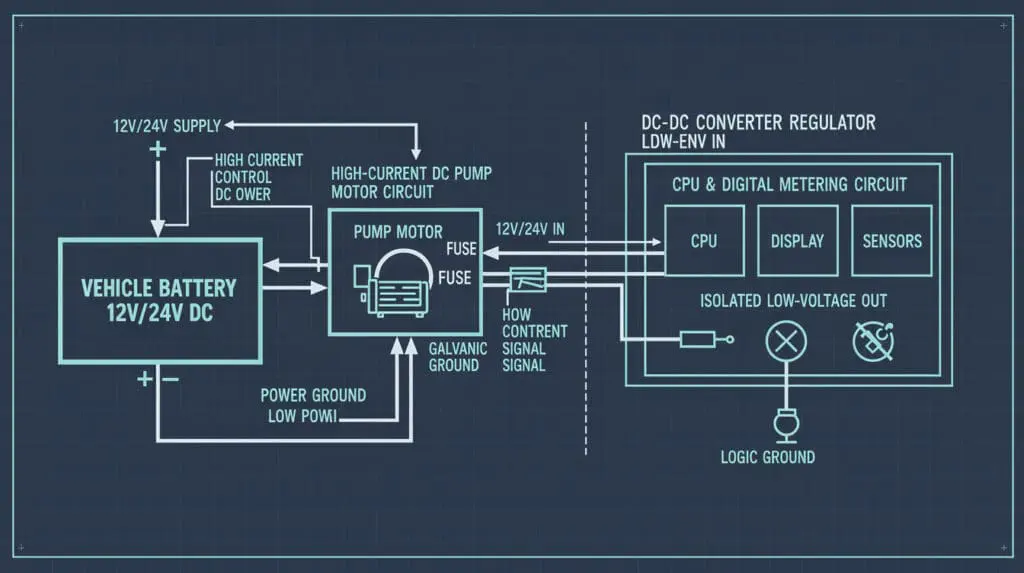
Power supply stabilization is where DIY mobile setups usually fail. Permanent depots operate on stable 220V/440V AC grids. A service pickup operates on a 12V or 24V DC alternator system that is already heavily loaded by the vehicle’s own electronics, lighting, and starter motor.
Voltage Drop and CPU Integrity
Hook up a cheap off-the-shelf digital dispenser to a truck’s 12V battery, and watch what happens when the DC pump motor engages. A 12V system can easily dip to 10.5V under the inrush current of a 60 L/min rotary vane pump.
If the CPU in your digital preset controller is not isolated from this voltage drop, the microprocessor will reset midway through a batch, erasing the transaction record and ruining your audit trail. (Trust me, there is nothing worse than an angry fleet manager calling at 2 AM because a voltage drop erased a 500-liter transfer record.)
The Chintan Engineers CE-204 and CE-206 architectures utilize robust DC-DC voltage regulators with capacitive buffering. This ensures the CPU maintains constant voltage, keeping the preset batching, digital display, and optional receipt printer perfectly operational even when the pump motor causes severe voltage sag.
Mobile Dispenser Configuration Guide
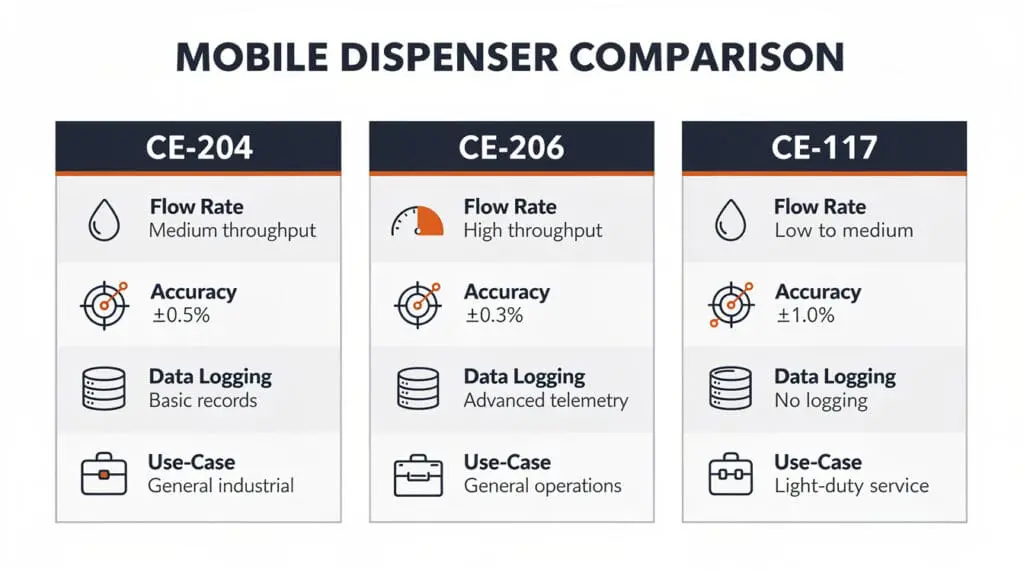
Specifying a mobile fuel dispenser requires mapping the system to your throughput, power availability, and necessary audit trail. I get asked daily how to spec a mobile kit. Here is exactly how I map our core configurations to field reality:
CE-204: High Accuracy Mobile Dispenser
This is the benchmark for auditable mobile refueling. Built for operations that require depot-level accuracy in the bare elements.
- Flow Range: 20 – 80 L/min
- Accuracy: ±0.2% achievable (exceeds standard ±0.5%)
- Power Supply: 12 / 24 V DC (Vehicle Battery) or 220 V AC
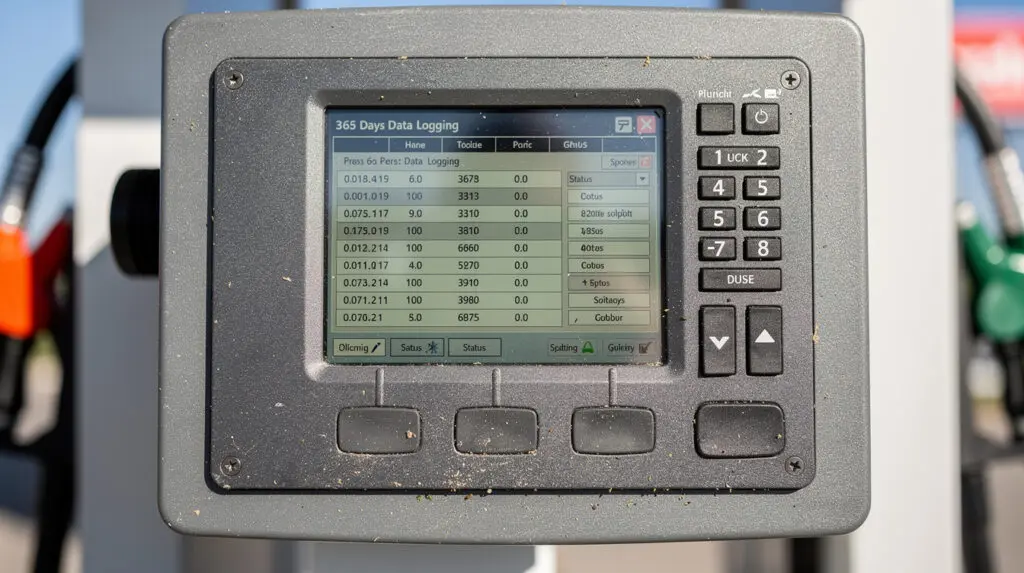
- Data Integrity: 365-day transaction log storage, printer-ready
- Engineering Note: The CE-204 is the system I mandate for large-scale earthmoving operations. The ±0.2% accuracy is achieved through a high-resolution pulse encoder and a CPU that actively compensates for minor temperature variations. If you need transaction memory to prevent pilferage on the road, this is the only logical choice.
CE-206: Digital Fuel Dispenser with Advanced Logging
Designed for heavy fleet usage where monthly reconciliations are critical to the accounting team.
- Flow Range: 20 – 80 L/min
- Max Pressure: 0.3 MPA
- Accuracy: 0.5%
- Data Integrity: Storage of daily data for last 365 days, and monthly data for the last 12 months.
- Application: Ideal for agricultural and factory fuel management where the bowser acts as the primary fueling node for an entire sprawling facility.
CE-117 & CE-101: Rugged Transfer Kits
For rugged, smaller-scale transfers where electronic batching is less critical than absolute mechanical durability.
- Flow Range: 40 – 60 L/min
- Max Pressure: 3 BAR
- Connection Size: 25MM
- Materials: Brass internals for extended functional life
- Difference: CE-117 utilizes a robust digital display, whereas CE-101 is purely mechanical. Both come with ambient noise automatic shutoff nozzles and 4m rubber hoses.
- Engineering Note: The use of brass components in the measuring chamber provides superior resistance to the abrasive micro-particulates often found in poorly filtered site diesel.
For a breakdown of how flow rates impact fueling times across different vehicle classes, consult my diesel dispenser specifications guide.
Need help selecting the right Mobile Fuel Dispenser?
Our engineering team can match the exact configuration to your operational requirements.
TCO and ROI: The Economics of Traceability
I hate theoretical ROI. Let’s look at the actual math from a recent site audit I conducted for a mid-sized road construction project in Rajasthan operating 15 heavy earthmovers.
- Daily Consumption: 250 liters per machine = 3,750 liters total per day.
- Cost of Fuel: Rs 90 per liter.
- Daily Fuel Cost: Rs 3,37,500.
The site was using a basic mechanical drum pump subject to a ±2.5% error due to internal wear and vibration. That means their daily measurement uncertainty was roughly 94 liters.
- Cost of Untracked Fuel: 94 liters * Rs 90 = Rs 8,460 per day.
- Monthly Loss: Rs 2,53,800.
By upgrading to a CE-204 mobile dispenser achieving ±0.2% accuracy, that uncertainty shrinks to just 7.5 liters per day.
- Daily Savings: Rs 7,785.
- Monthly Savings: Rs 2,33,550.
A fully equipped, printer-ready CE-204 mobile skid pays for itself in less than 15 operating days on a site of this scale. Beyond the raw fuel savings, the 365-day digital log provides immutable proof of delivery, eliminating the “ghost fueling” disputes that constantly plague mobile operations.
Indian Field Realities: Installation & Maintenance Defenses
Engineering a dispenser is only half the battle; installing it to survive the Indian industrial environment is the other half. I have overseen installations in the corrosive, high-humidity coastal zones of Dahej and the abrasive, dust-choked atmospheres of GIDC industrial estates in Ahmedabad. The textbook goes out the window here.
Suction Line Hydraulics and Filtration
The most common point of failure on a mobile bowser is the suction line between the tank and the dispenser pump. Fleet fabricators looking to cut corners often use ribbed, non-collapsible PVC hoses. (I’ve seen brand new PVC hoses crack in under three weeks of Gujarat heat). Under continuous vibration, PVC hardens, micro-cracks develop at the hose clamps, and the pump begins drawing air. This leads to cavitations and highly erratic meter readings.
I mandate the use of wire-braided nitrile rubber suction hoses, secured with heavy-duty T-bolt clamps. Furthermore, mobile tanks act as massive settling basins for rust and condensation. An inline 10-micron water-absorbing particulate filter must be installed before the positive displacement meter. The tight tolerances of an oval gear or rotary vane meter will heavily score and eventually jam if subjected to rust flakes.
Grounding and Flameproof Requirements
Mobile platforms build up severe static electricity due to fluid friction during transit and the sloshing of the diesel payload. Pumping diesel in the dry, low-humidity environments of central India without proper earthing is a critical safety violation.
All Chintan Engineers mobile skids include heavy-duty grounding cables and bonding points. The skid frame must be bonded directly to the vehicle chassis. If you are dispensing in hazardous zones—such as chemical plants or underground mining operations—you must specify an EX/FLP (Flameproof) motor and enclosure. Standard brushed DC motors can generate microscopic arcing during operation; EX enclosures ensure that any internal arc cannot ignite external atmospheric vapors.
Combating the Monsoon Element
In regions prone to heavy monsoons, water ingress into the control electronics is fatal. Our digital models (CE-130, CE-202, CE-204) are housed in powder-coated, weatherproof enclosures. However, why let a heavy downpour destroy your metrology gear? I always recommend integrating a simple, fabricated rain shield over the skid if it is permanently mounted on an open flatbed. A Rs 2,000 sheet metal canopy extends the life of a Rs 80,000 dispensing instrument by years.
Dispensing AdBlue on Mobile Platforms
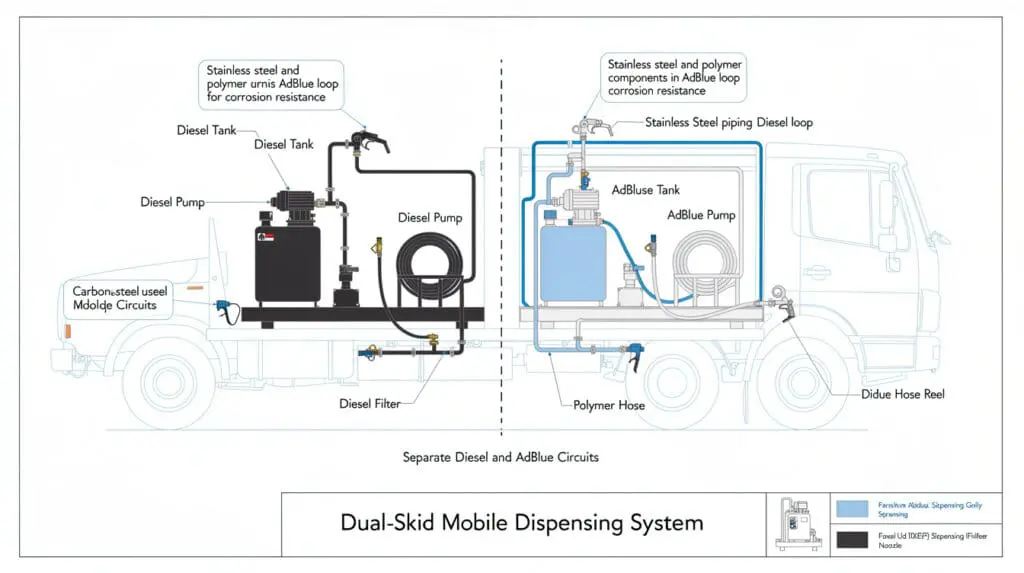
With the transition to BS-VI emissions standards across India, fleets are now required to manage AdBlue (Diesel Exhaust Fluid) alongside their diesel operations. AdBlue is highly corrosive to standard mild steel, aluminum, and brass components.
For mobile AdBlue dispensing, you cannot simply repurpose standard diesel equipment. We specify the CE-130 Small AdBlue Dispenser:
- Display: Digital LCD
- Accuracy: 0.5%
- Materials: Engineered polymers and stainless steel internals immune to urea corrosion.
Using a brass-component meter (like the CE-117) for AdBlue will result in rapid galvanic corrosion, ruining the meter and heavily contaminating the vehicle’s SCR (Selective Catalytic Reduction) system. That mistake leads directly to lakh-rupee engine repairs.
Frequently Asked Questions
Can I run the dispenser entirely on the vehicle’s battery power?
Yes. Our DC motors (12V/24V) are designed specifically to power the pump, meter, and controller directly from the vehicle’s electrical system. However, for continuous, high-volume operation (e.g., fueling 50 trucks back-to-back), keep the vehicle engine running to allow the alternator to maintain the battery charge.
How do I prevent fuel pilferage while the bowser is in transit?
Models like the CE-204 and CE-206 feature preset controllers with password locks. They lock out unauthorized dispensing and maintain a 365-day internal log of every liter pumped. Adding an optional receipt printer provides physical, auditable receipts to the equipment operator immediately upon delivery.
What flow rate should I specify for my mobile setup?
If you are fueling light commercial vehicles or performing top-offs, a 40 L/min system (like the CE-117) is sufficient. If you are fueling heavy earthmovers or 500+ liter tanks, specify a high-throughput system capable of 80 L/min (CE-204/206) to prevent excessive idle time for both the bowser and the receiving equipment.
Is hose management included with the skids?
Yes, standard kits ship with 4m rubber hoses and auto shut-off nozzles. For larger flatbed installations, we integrate heavy-duty hose reels accommodating up to 10m of hose, complete with swivel joints to prevent kinking and mechanical stress on the meter outlet.
How frequently does a mobile dispenser require calibration?
Due to the intense vibration of mobile applications, I recommend volume proving and calibration checks every 6 months. Standard static depot dispensers are checked annually, but the mechanical stress on mobile positive displacement meters necessitates a tighter calibration schedule to consistently maintain ±0.5% or ±0.2% accuracy.
Do you offer flameproof versions for hazardous zones?
Yes. If your mobile bowser operates inside refineries, chemical GIDCs, or specific mining sectors, you must specify EX/FLP motors and intrinsically safe wiring to comply with site safety mandates.
Final Engineering Verdict
Transforming a steel tank on a truck into a traceable, compliant mobile fueling station requires far more than just bolting on a pump. It demands metrology-grade equipment engineered to survive fluctuating voltages, extreme vibration, and abrasive environments.
Based on 22 years of field data, here is my recommendation for your operation:
If you are managing a small service rig where mechanical durability outweighs digital tracking, install the CE-117 Mechanical Kit. Its brass internals will survive heavy abuse and poor fuel quality.
However, if you are operating a commercial fleet, mining operation, or construction site where untracked fuel represents a massive financial leak, you must deploy the CE-204 High Accuracy Mobile Dispenser. The combination of ±0.2% accuracy, CPU-stabilized 12/24V operation, and immutable 365-day transaction memory transitions your mobile operation from a vulnerability into a highly controlled, auditable asset.
Stop writing off your profits as “transit loss.” Demand traceability.
Ready to engineer your mobile fueling operation? Request a mobile dispenser configuration outlining your tank size, required flow rate, and control needs. Our engineering team will size the exact skid required to secure your fluid assets.
Products Mentioned in This Article:
- Mobile Fuel Dispenser — View full specifications and request a quote
Ready to discuss your requirements?
Contact our engineering team with your specifications. We’ll provide a detailed configuration recommendation.
