
















My name is Vikram Desai, and over the past 22 years at Chintan Engineers, I have designed, installed, and calibrated over 5,000 flow measurement systems. From high-pressure ONGC refinery nodes to dusty fleet depots in rural Gujarat, I have seen exactly what happens when procurement decisions are made based on a superficial reading of an industrial oil flow meter datasheet.
Datasheets are engineering contracts, not marketing brochures. Yet, I routinely see plant engineers misinterpret critical parameters like turn-down ratios, pressure drops, and viscosity shifts. When you misunderstand these metrics, you don't just buy the wrong meter—you bleed operating capital through untracked inventory and process inefficiencies. I've lost count of how many times I've had to explain this to a frustrated plant manager.
I want to cut through the jargon and show you exactly how to evaluate oil flow meter specifications for real-world Indian industrial applications. We are going to look past the marketing and break down the mechanics, the standards (like OIML R117 and IS 14883), and the hard math of flow measurement.

In This Article
The Reality of Turn-Down Ratios and Repeatability
When a procurement manager looks at a datasheet, their eyes immediately dart to the "Accuracy" line (usually because they are trying to match a specific tender requirement). While a ±0.5% or ±0.2% accuracy rating is legally necessary—especially for custody transfer—it is only half the story.
The metric that actually dictates long-term performance is the turn-down ratio (or rangeability) coupled with repeatability.
Turn-down ratio is the operational range over which the meter maintains its stated accuracy. If a meter has a flow range of 20 to 120 LPM (like our CE-118 model), its turn-down ratio is 6:1. If your process drops to 10 LPM, that ±0.5% accuracy guarantee vanishes, and your measurement error could spike to 3% or more.
Pro Tip: I always tell junior engineers: Accuracy gets you the purchase order, but repeatability keeps you out of court. A meter that is consistently off by 1% can be mathematically calibrated via the register. A meter with poor repeatability that fluctuates between +0.5% and -1.2% is fundamentally useless.
For positive displacement (PD) meters, repeatability should be tightly bound. This is why we designed our CE-107 and CE-114 models with precision-machined measuring chambers that offer repeatability thresholds tight enough to meet Legal Metrology Act requirements for custody transfer.
Viscosity Shifts: The Silent Accuracy Killer
Viscosity limits are where I see the most expensive field mistakes. Fluid viscosity is not static; it changes violently with temperature. In a typical Gujarat industrial estate, morning temperatures in January might be 12°C, while afternoon equipment temperatures in May can exceed 45°C.
I have pulled enough turbine meters from lube oil plants to know they don't belong anywhere near viscous or temperature-variable fuels. (You'd be amazed how often I see this mismatch.) Turbine meters rely on the kinetic energy of the fluid to spin a rotor. As oil becomes colder and thicker, the fluid velocity profile changes (shifting from turbulent to laminar flow), causing massive calibration drift.
Did You Know: Positive Displacement (PD) meters actually become more efficient as viscosity increases. Thicker oils seal the microscopic clearances between the internal rotors and the measuring chamber walls, virtually eliminating "slip" (the fluid that bypasses the measurement mechanism).
When you review positive displacement oil flow meter specs, you are looking at technology that isolates discrete volumes of fluid. Whether the oil is 10 cSt at 40°C or spikes to 50 cSt overnight, the physical volume of the measuring chamber does not change. This renders PD meters practically immune to viscosity shifts within their operational envelope—a massive advantage for Indian seasonal extremes.
Tired of recalibrating your meters every season?
Our positive displacement meters provide ±0.2% accuracy independent of fluid viscosity or temperature fluctuations.
Sizing Guide: Comparing Core PD Meter Specifications
Selecting the right meter requires matching metallurgy, pressure ratings, and flow ranges to your specific process. When my team sits down to size a meter for a client, we look at raw engineering data. Here is how our core lineup handles the field:
| Specification | CE-107 High Accuracy Digital | CE-114 High Accuracy Mechanical | CE-118 Oil Flow Meter |
| :— | :— | :— | :— |
| Measuring Principle | Positive Displacement | Positive Displacement | Positive Displacement |
| Base Accuracy | 0.2% | 0.2% | 0.5% |
| Register Type | Digital (Pulse/Printer output) | Mechanical | Digital Totalizer (4-digit reset) |
| Flow Range | Scalable by line size | Scalable by line size | 20 – 120 LPM |
| Max Pressure | 10 BAR | 10 BAR | 3.4 MPA (34 BAR) |
| Max Temperature | 80°C | 80°C | Process Dependent |
| Wetted Materials | Aluminium, Viton seals | Aluminium, Viton seals | Corrosion-resistant alloy |
Application Matrix
Take the CE-107, for example. This is our primary custody transfer and process automation meter. With its 0.2% accuracy and pulse output capabilities, it integrates seamlessly into PLC setups. If you are designing automated dosing, I highly recommend reviewing our Liquid Batching System Selection Guide & Specs to see how this meter functions as the brain of the operation.
If you're dealing with explosive environments, the CE-114 is the mechanical twin to the 107. We use this heavily where electrical digital registers would require expensive ATEX-certified flameproof enclosures.
Then you have the CE-118 and CE-119—the workhorses. Rated up to 3.4 MPA, these handle high-pressure diesel transfer, heavy equipment refuelling, and bulk oil dispensing where a ±0.5% accuracy is sufficient but robust pressure handling is non-negotiable.
Field Applications and the Indian Industrial Context
Datasheets are printed on paper, but these meters operate in dirt, heat, and unpredictable power grids. Here is what that looks like in practice:
Fleet Operations and Depot Fueling
In rural mining depots—like a few sites I've commissioned in Odisha—voltage fluctuations can fry sensitive electronic instrumentation in seconds. In these harsh environments, we deploy the mechanical CE-114. It requires no external power, measures diesel with 0.2% accuracy, and utilizes Viton seals that resist the aggressive chemical additives often found in industrial diesel.
Textile Dyeing and Boiler Feed
In the Surat and Ahmedabad textile corridors, accurate measurement of Light Diesel Oil (LDO) or Furnace Oil for boilers is a massive OPEX factor. Facilities that upgrade their fluid handling by installing specialized PP Pumps for Textile Dyeing frequently pair them with our CE-107 meters on the boiler feed lines to tightly control combustion fuel consumption.
Heavy Machinery and Hydraulics
I routinely spec the CE-118 for hydraulic fluid lines in heavy presses and injection molding machines. Its high-pressure rating (34 BAR) easily handles the load, and its low pressure drop ensures it doesn't artificially tax the system pumps.
Installation & Maintenance Pragmatism
A 0.2% accurate meter will perform like a 5% accurate meter if installed improperly. Follow these non-negotiable field rules:
- Upstream Filtration is Mandatory:
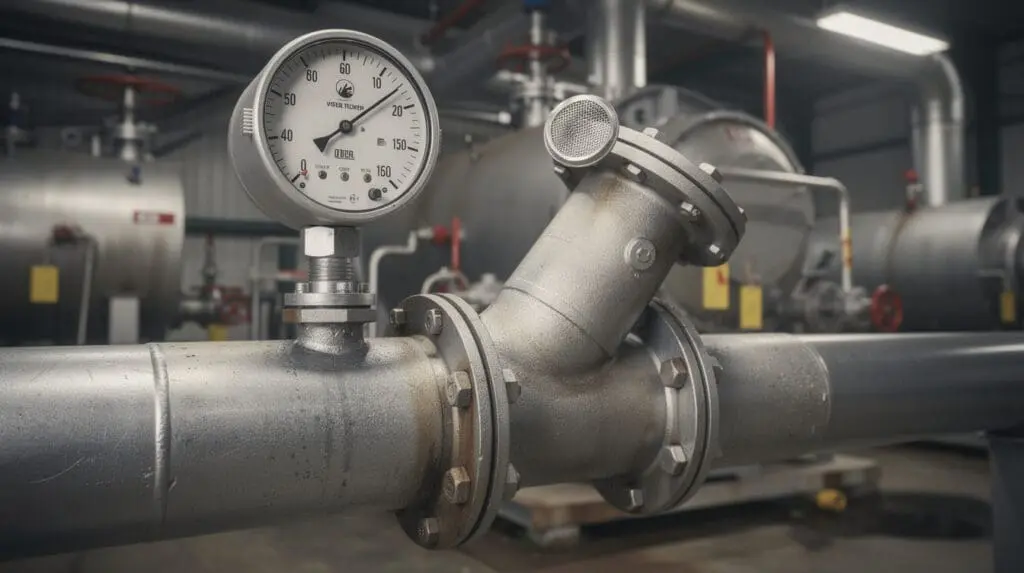
Warning: I reject warranty claims outright if a meter comes back seized without a Y-strainer installed upstream. A single 2mm weld slag particle or a flake of pipe rust will lock a precision aluminium rotor solid, potentially shearing the drive shaft and destroying the meter.
- Eliminate Air Pockets:
PD meters measure volume. They cannot distinguish between a liter of oil and a liter of air. Trust me, I've seen companies pay for thousands of liters of pumped air. If your transfer lines run dry or draw air from the pump cavitation, the meter will register that air as fluid. Install an air eliminator before the meter in bulk transfer setups.
- Manage Pressure Drops:
Every flow meter introduces a pressure drop (ΔP) into the system. As viscosity increases, the pressure drop across the meter increases. Ensure your supply pump has adequate head pressure to overcome this resistance without cavitating.
Building a new process line?
Don't guess the pressure drop calculations. Let our engineers size the exact meter for your fluid and flow rate.
Frequently Asked Questions
What is the difference between accuracy and repeatability in oil flow meters?
Accuracy dictates how close the meter's reading is to the absolute true volume (e.g., ±0.2% of true flow). Repeatability dictates how consistently the meter performs under identical conditions. A highly repeatable meter can be calibrated to high accuracy, but a non-repeatable meter can never be accurately calibrated.
Why do positive displacement oil flow meter specs highlight Viton seals?
Viton (Fluoroelastomer) provides superior chemical resistance to petroleum-based fluids, synthetic lubricants, and diesel additives compared to standard Nitrile (NBR) rubber. It also maintains its structural integrity at higher process temperatures (up to 80°C in our CE series), preventing internal fluid slip.
Can I use a CE-107 digital meter for high-viscosity furnace oil?
Yes, the positive displacement principle makes it ideal for viscous fluids. However, you must account for the increased pressure drop at higher viscosities and ensure your pump is sized correctly. The accuracy remains an exceptional 0.2% regardless of the viscosity shift.
How often should an industrial oil flow meter be calibrated?
In high-volume or custody transfer applications, we recommend a master-meter proving or volumetric calibration every 6 to 12 months. For internal process monitoring where ISO 9001 compliance is required, an annual calibration is standard practice.
Why is my flow meter registering volume when the nozzle is closed?
Nine times out of ten, this is caused by thermal expansion of the fluid trapped in the line between the meter and the closed valve, or by a sudden line pressure shock (water hammer) causing the rotors to pulse slightly. Installing a check valve immediately after the meter usually resolves this.
The Engineering Verdict
Ultimately, buying an oil flow meter isn't about ticking a box on a procurement list; it's about protecting your bottom line. You are safeguarding your inventory, optimizing your combustion ratios, and ensuring your process chemistry remains stable.
Based on over two decades of field data across India's harshest industrial environments, the math is clear: for viscous fluids and fuels, Positive Displacement technology is the most sound choice.
If your operation requires rigorous custody transfer accuracy and PLC integration, the CE-107 Digital Oil Flow Meter is the specified standard. If you are operating in remote depots with unstable power, the CE-114 Mechanical provides the exact same 0.2% accuracy without electrical dependencies. And for high-pressure transfer lines, the CE-118 delivers robust 3.4 MPA performance.
Stop losing money to calibration drift and viscosity shifts. Read your datasheets carefully, specify the right internal metallurgy, and demand verifiable accuracy.
Ready to lock in your fluid measurement accuracy?
Partner with Chintan Engineers for BIS-compliant, precision flow measurement systems backed by 22 years of industrial expertise.
