
















I have walked through hundreds of pharmaceutical plants in Vapi and dairy clusters in Mehsana over my 22 years at Chintan Engineers. One of the most expensive engineering mistakes I consistently see is the misapplication of fluid transfer pumps. Procurement managers often buy Air-Operated Double Diaphragm (AODD) pumps because they are inherently simple and practically idiot-proof. But engineering is not about taking the easy way out—it is about efficiency, precision, and the total cost of ownership.
Using compressed air to transfer high volumes of clean, low-viscosity fluids is a thermodynamic disaster. Compressed air is the most expensive utility in any manufacturing facility. Why do so many facilities ignore this? Usually, because air feels "free." Trust me, it isn't. When you use an AODD pump to move 50,000 liters of milk or RO water a day, you are literally blowing money through the exhaust muffler.
Forget the shiny sales brochures. We need to look at the engineering realities of SS centrifugal pumps versus AODD pumps, backed by actual specifications, BIS testing standards (IS 5765), and hard mathematical TCO comparisons specifically modeled for Indian industrial conditions.
In This Article
The Thermodynamic Reality: Electricity vs. Compressed Air
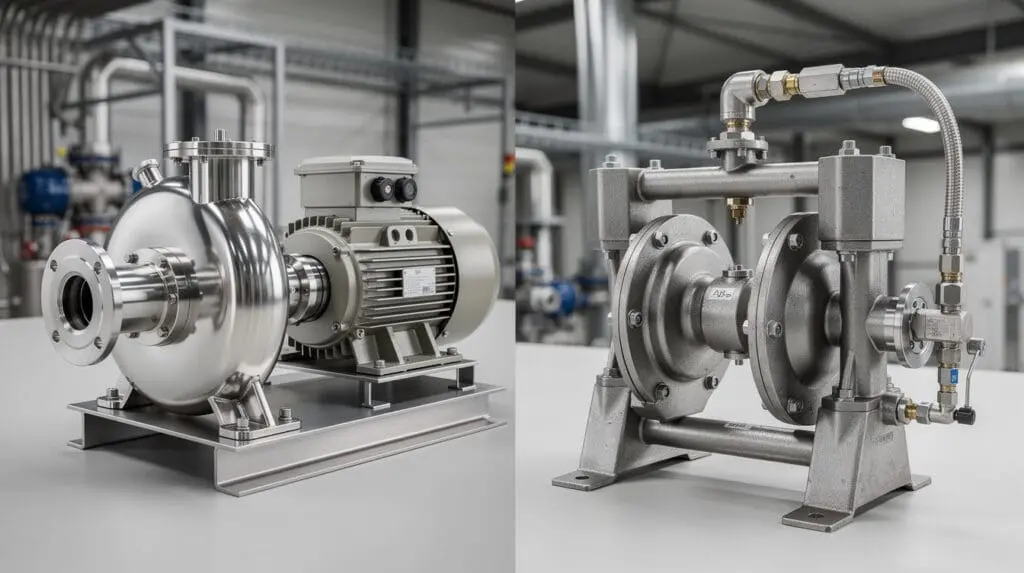
The fundamental difference between these industrial fluid transfer pumps lies in their prime movers.
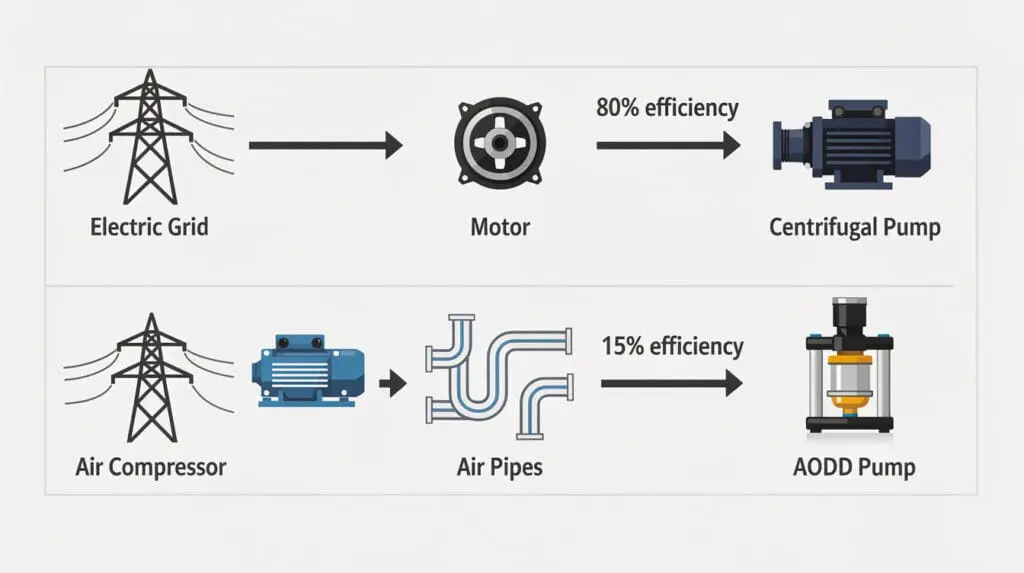
An SS centrifugal pump relies on a direct-coupled electric motor (typically 3-phase, 415V in India) turning an impeller—usually at 1440 or 2880 RPM. The efficiency from the electrical grid to the fluid kinetic energy is incredibly direct. A high-efficiency motor paired with a properly designed closed impeller will run at roughly 60% to 85% mechanical efficiency depending on the duty point.
An AODD pump, on the other hand, relies on compressed air. To get that air, an electric motor must drive an air compressor, which generates immense heat (energy loss). The air travels through pipes (friction loss), goes through a regulator (pressure drop), and finally enters the pump's air valve to push a diaphragm. The overall system efficiency of compressed air from grid to fluid transfer rarely exceeds 10% to 15%.
Pro Tip: I always tell junior engineers: Only use compressed air for fluid transfer when the fluid absolutely demands it, or the environment strictly dictates it. Never use it just because "we already have an airline nearby."
Decoding the Technologies
The SS Centrifugal Pump (The Workhorse)
For continuous duty, high-volume transfer of fluids up to 1500 centipoise (cP), the stainless steel centrifugal pump is unmatched. I've personally seen our CE Series units run non-stop for three years with nothing but standard seal flushes.
Here are the actual operating specs of a correctly sized SS centrifugal unit:
- Capacity: Up to 120 M³/hr
- Head: Up to 60 Meters
- Material of Construction (M.O.C.): SS-304, SS-316 (rolled stainless steel)
- Power Rating: 1.0 HP to 20 HP (Three Phase, 380-415V)
- Speed: Up to 2880 RPM
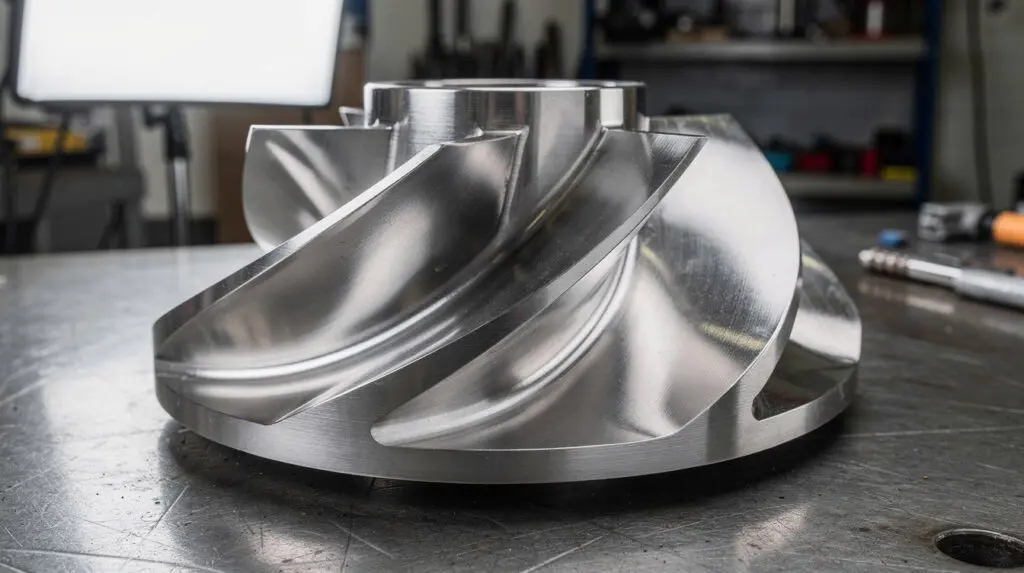
The rolled stainless steel construction provides a pore-free, non-pitting surface. This is critical for hygienic applications in dairies or pharmaceutical plants where bacterial ingress in cast metal pitting is a severe compliance violation. The back pull-out design allows our technicians to withdraw the rotating assembly without disturbing the suction and delivery piping—a massive advantage for minimizing downtime during preventive maintenance.
Need continuous, high-efficiency fluid transfer?
Our CE Series SS Centrifugal Pumps handle up to 120 M³/hr with rolled SS-316 construction for zero pitting. Perfect for dairy, chemical, and pharma applications.
The AODD Pump (The Problem Solver)
AODD pumps have two flexible diaphragms that reciprocate back and forth. They are seal-less, self-priming from dry, and can handle massive solids and highly viscous sludges. If you need to pump heavy chemical slurries, paints, or abrasive resins, an AODD is brilliant.
They also safely stall under pressure. If a discharge valve closes, the pump just stops without blowing a line or burning a motor. Plus, they are inherently explosion-proof because they lack electrical components, making them ideal for Zone 1 hazardous solvent transfers.
But for standard chemical transfer, RO water, milk, or edible oils? They are an operational nightmare disguised as a cheap capex purchase.
Direct Comparison: SS Centrifugal vs. AODD
When evaluating SS 316 pump manufacturers versus AODD suppliers, you must look past the spec sheet. Based on thousands of field calibrations across Gujarat and Maharashtra, here is how they actually compare:
| Engineering Parameter | SS Centrifugal Pump (Chintan CE Series) | AODD Pump |
| :— | :— | :— |
| Energy Efficiency | High (60-85%) | Extremely Low (10-15%) |
| Flow Rate Stability | Continuous, pulse-free flow | Pulsating flow (requires dampeners) |
| Max Capacity | Up to 120 M³/hr | Typically limited to 50-60 M³/hr |
| Max Viscosity Limit | ~1500 centipoise | 20,000+ centipoise |
| Dry Running | Will damage mechanical seals | Can run dry indefinitely |
| Solids Handling | Limited (requires semi-open impeller) | Excellent (handles large abrasive solids) |
| Control | Requires VFD for flow variation | Simple air valve regulation |
Warning: If you are pushing fluid through an industrial flow meter, do not use an AODD pump without a heavily engineered pulsation dampener. The pulsing flow causes severe inaccuracies in positive displacement and turbine meters. A centrifugal pump provides the smooth, laminar flow necessary for compliance with BIS & OIML Standards for Fuel Flow Meters in India.
TCO Analysis: A 5-Year Financial Breakdown
Let's run the actual math. Just as we calculate the Diesel Dispenser Total Cost of Ownership in India, we must look at a pump's 5-year Opex to get the real story.
The Scenario: A plant needs to transfer 20 M³/hr of clean chemical fluid at a 20-meter head. The pump runs 8 hours a day, 300 days a year. Power costs ₹8 per kWh.
Option A: 3 HP SS Centrifugal Pump
- Power required: ~2.2 kW
- Annual Energy: 2.2 kW × 8 hrs × 300 days = 5,280 kWh
- Annual Energy Cost: ₹42,240
Option B: 2-inch AODD Pump
- Requires ~40 CFM of compressed air at 80 PSI.
- Compressor power required to generate 40 CFM: ~10 HP (7.5 kW)
- Annual Energy: 7.5 kW × 8 hrs × 300 days = 18,000 kWh
- Annual Energy Cost: ₹1,44,000
The AODD pump costs you ₹1,01,760 more per year just in electricity. Over five years, that is ₹5,08,800 washed down the drain per pump. You could have bought three premium SS-316 centrifugal pumps for the cost of that wasted compressed air.
Indian Industrial Context: Where Does Each Excel?
Working across diverse Indian topographies, from the humid coastal zones of Dahej to the dusty GIDC estates in Sanand, environmental factors heavily influence pump selection. Gujarat's coastal humidity, for instance, is an absolute pump killer if you don't plan for it.
When to specify an SS Centrifugal Pump:
- Dairy and Food Processing: Milk, juices, and edible oils require high sanitary standards. The pore-free rolled SS-304/316 construction of our CE Series guarantees no bacterial growth pockets. The continuous flow prevents product foaming.
- Bulk Chemical Transfer: Moving solvents, acids, or alkalis from underground tanks to day tanks. The continuous duty cycle demands the electrical efficiency of a monoblock centrifugal.
- RO Water Systems: High pressure and high flow requirements make centrifugal multi-stage or high-RPM single-stage pumps the only viable engineering choice.
When to specify an AODD Pump:
- High Viscosity/Shear Sensitive: Transferring thick resins, adhesives, or shampoos where a centrifugal impeller spinning at 2880 RPM would shear and destroy the product.
- Slurries and Effluent: Pumping ETP sludge with high solid content. A centrifugal pump would clog or suffer severe impeller wear.
- Hazardous Environments without Flameproof Budgets: While you can equip an SS centrifugal pump with an Ex-d (flameproof) motor, AODDs are naturally safe for highly volatile solvent transfers.
Did You Know: The Humidity Factor: In high-humidity coastal areas of Gujarat and Maharashtra, AODD pumps often suffer from "icing." Expanding compressed air drops in temperature rapidly, freezing the moisture in the air and clogging the pump exhaust. Electric centrifugal pumps completely avoid this issue.
Installation & Maintenance Field Notes
Upgrading your fluid handling from primitive methods to engineered pump systems requires proper installation logic. Just as we advise clients moving from manual operations in our guide on Diesel Dispenser vs. Barrel Pump: An Engineer's Guide, proper piping geometry is critical.
For SS Centrifugal Pumps:
- Suction is Sacred: Ensure the suction pipe is at least one size larger than the pump's suction flange to minimize friction loss. Maintain a straight run of at least 5 to 10 pipe diameters before the pump inlet to ensure laminar flow.
- NPSH Calculations: In hot Indian summers, chemical vapor pressures rise. Ensure your Net Positive Suction Head Available (NPSHa) strictly exceeds the pump's NPSH Required (NPSHr) by at least 1 meter to prevent cavitation. Cavitation sounds like pumping gravel, and it will pit even the best SS-316 impeller over time.
- Shaft Sealing: We utilize flexible shaft sealing arrangements—either standard gland packing or mechanical seals. For aggressive chemicals, always opt for a high-quality mechanical seal (Silicon Carbide/Carbon) to ensure zero leakage.
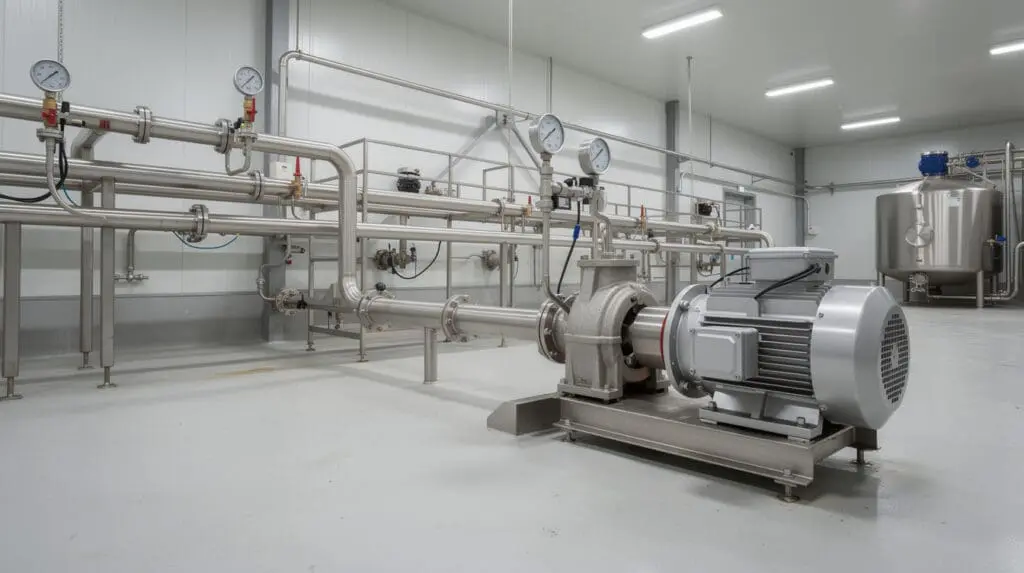
Is your current pump causing cavitation or seal failures?
Stop replacing seals every month. Let our engineers size the correct SS Centrifugal Pump for your specific fluid viscosity and vapor pressure.
Frequently Asked Questions
What is the stainless steel pump price in India?
Prices vary dramatically based on capacity, M.O.C., and motor HP. A standard 1 HP SS-304 monoblock pump can start around ₹15,000 to ₹25,000, while a heavy-duty 20 HP SS-316 process pump can exceed ₹1.5 Lakhs. Remember, the purchase price is only ~10% of the pump's lifetime cost; energy consumption is the other 90%.
Can an SS centrifugal pump handle viscous fluids?
Yes, up to a limit. Our Chintan CE Series handles viscosities up to 1500 centipoise. However, as viscosity increases, pump efficiency drops, and the required power (HP) increases. Beyond 1500 cP, a positive displacement pump (like a lobe or gear pump) is a better choice.
Why do AODD pumps cause flow meter inaccuracies?
AODD pumps create a pulsating flow due to the reciprocating diaphragms. This pulsing creates hydraulic shocks that confuse the measuring elements in most flow meters, causing erratic readings. Centrifugal pumps provide the smooth, continuous flow required for precise volumetric measurement.
How does the Chintan Back Pull-out design save maintenance time?
Our CE Backpullout BPO Series allows the entire rotating assembly (impeller, shaft, and seal) to be removed from the rear without disconnecting the main suction and discharge piping or moving the motor. This cuts maintenance downtime from a 4-hour pipefitting job to a 45-minute mechanical swap.
Are SS 316 pump manufacturers better than SS 304 for chemicals?
Yes. SS-316 contains molybdenum, which dramatically increases its resistance to chlorides and acidic corrosion compared to SS-304. If you are pumping industrial chemicals, brackish water, or CIP (Clean-in-Place) acids, SS-316 is the mandatory engineering standard.
The Final Verdict
In my 22 years of commissioning plants, I've learned that while there is no single "perfect" pump, there is absolutely a correct engineering choice for your specific application.
If you are pumping slurries, handling highly abrasive solids, or dealing with fluids exceeding 2,000 centipoise, buy the AODD pump and accept the energy penalty.
However, if your plant requires continuous, high-volume transfer of water, milk, pharmaceutical fluids, or light chemicals, an SS Centrifugal Pump is the only logical choice. Relying on compressed air for these applications is an engineering failure that drains your operational budget month after month.
Do the math on your compressed air usage. If you are using AODDs for bulk liquid transfer, swapping to a direct-drive SS centrifugal pump will pay for itself in less than eight months.
Ready to optimize your fluid transfer systems?
Chintan Engineers manufactures robust, high-efficiency SS Centrifugal, Monoblock, and Lobe pumps customized for Indian industrial conditions.
