
















For industrial engineers and plant managers across India, migrating from manual fluid transfer to an automated Liquid Batching System is a critical milestone in process optimization. Whether you are filling 200-litre drums with high-viscosity lubricants, dosing specialty chemicals into reactor vessels, or dispensing diesel for depot operations, the cost of product giveaway (overshoot) and manual logging errors directly impacts your bottom line. However, when procurement and engineering teams sit down to specify the automation layer, a persistent dilemma arises: PLC based liquid batching system vs preset counter architecture.
Understanding the fundamental differences in control logic, input/output (I/O) handling, communication protocols, and scalability between these two options is vital. Over-specifying a full Programmable Logic Controller (PLC) with a Supervisory Control and Data Acquisition (SCADA) interface for a standalone diesel dispensing skid inflates capital expenditure unnecessarily. Conversely, under-specifying a basic preset counter for a multi-fluid lube blending facility will cripple your ability to manage recipes, integrate with ERP systems, and maintain digital traceability. This highly detailed guide compares these two control architectures to help you navigate your next procurement cycle without over- or under-specifying your process instrumentation.
1. Overview of Liquid Batching System Family
At its core, a Liquid Batching System is a turnkey skid designed to meter, mix, and dispense industrial fluids with high volumetric accuracy, typically ranging from ±0.5% with standard Positive Displacement (PD) meters to ±0.2% on CE-113-based custody transfer skids. While the mechanical components—rotary vane or gear pumps, inline strainers, air eliminators, and the metering element—remain largely consistent across applications, the "brain" of the system dictates its capability.
The control architecture is responsible for reading the high-speed pulse outputs from the flow meter (such as the CE-110/111 PD meters or CE-210 turbine sensors) and translating that data into precise valve actuation commands. To prevent fluid hammer and volume overshoot, the controller must execute a multi-stage (fast/slow or dual-stage) shut-off sequence via pneumatically actuated valves.
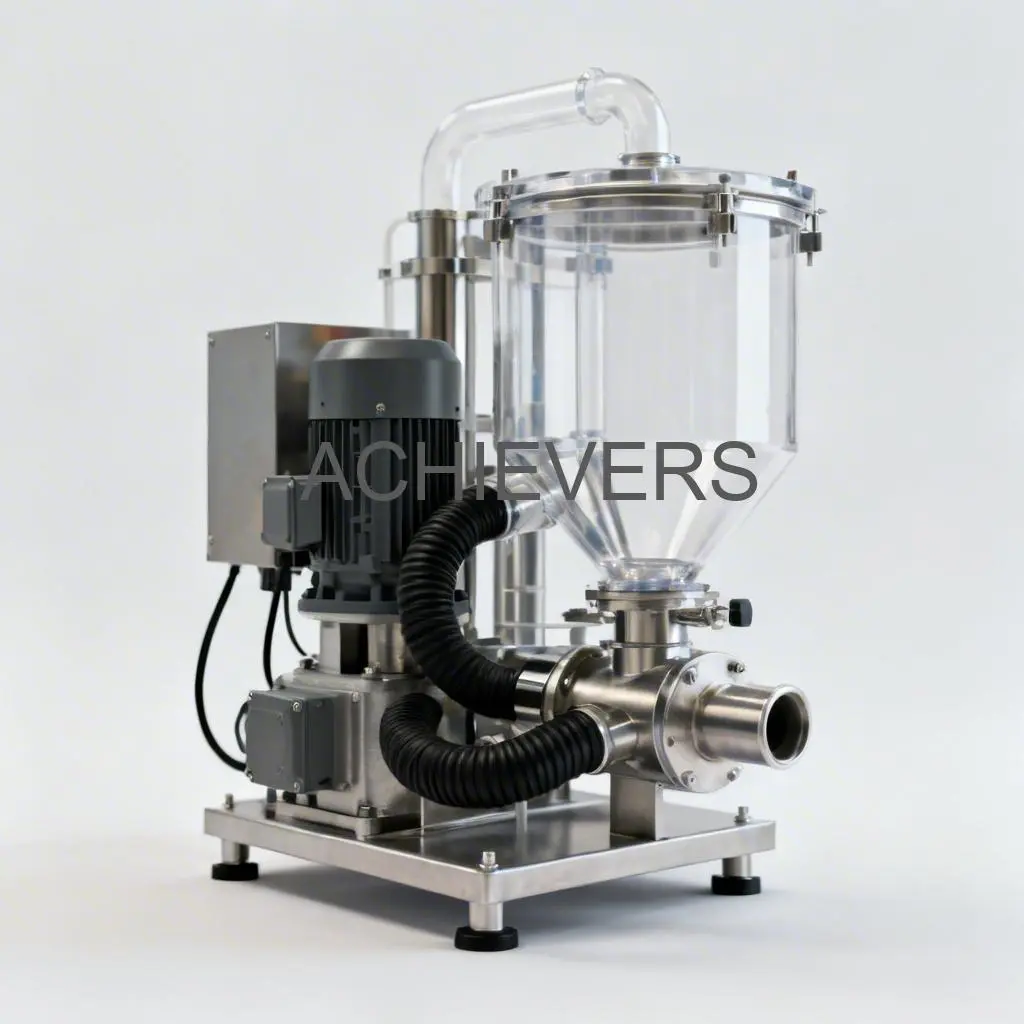
The CE-Setstop Preset Counter Architecture
A preset counter is a dedicated, purpose-built microprocessor controller. It features a tactile keypad and a simple digital display. The operator manually punches in the target volume (e.g., 500 litres) and presses start. The counter reads the pulse train from the flow meter, energizes the pump motor starter, and opens the solenoid valves. As the batch nears completion (e.g., at 480 litres), the counter automatically de-energizes the main fast-fill valve, allowing the final 20 litres to trickle in through a smaller bypass valve. Once the exact volume is hit, the system shuts down. It is robust, straightforward, and highly effective for repetitive, single-fluid operations.
The PLC/HMI Architecture
A PLC-based Liquid Batching System replaces the dedicated preset counter with a modular industrial computer (such as Siemens, Allen-Bradley, or Delta) paired with a Human Machine Interface (HMI) touchscreen. The PLC utilizes a High-Speed Counter (HSC) module to read flow meter pulses. The inherent advantage here is programmable logic: the PLC can handle infinite recipes, flush sequences, multiple fluid headers, temperature compensation algorithms, and complex interlocking with site-wide emergency shutdown (ESD) systems. For plant managers looking for a liquid batching system with recipe control and batch report capabilities mapped directly to SAP or an MES database, the PLC route is the only viable engineering standard.
2. Head-to-Head Specification Comparison
When evaluating a Liquid Batching System for your plant, the technical specifications of the control panel dictate the mechanical layout of the skid. Below is a rigorous technical comparison of the two primary architectures based on standard configurations available in the Indian market.
| Feature / Specification | CE-Setstop Preset Counter | PLC / HMI Control Architecture |
| :— | :— | :— |
| Primary Controller Hardware | Dedicated embedded microprocessor unit | Modular PLC rack with HMI touch panel |
| Volumetric Accuracy | ±0.5% (standard multi-stage valve logic) | ±0.5% to ±0.2% (supports complex PID valve trimming) |
| High-Speed Pulse Handling | Direct hardware pulse input (up to 10 kHz typically) | Requires dedicated HSC (High-Speed Counter) expansion card |
| Recipe Management | Limited (usually 1 to 5 hardcoded batch presets) | Unlimited (database-driven via HMI memory) |
| Multi-Fluid Manifolding | Complex to wire; typically 1 counter per fluid line | Native support; logic dictates automated flushing & valve matrix |
| Data Connectivity | Pulse out, 4-20 mA, basic serial (RS485) | Ethernet/IP, Modbus TCP/IP, Profinet, direct SQL/ERP push |
| Batch Traceability | Local ticket printing via serial port | Digital logging, timestamping, user ID tracking, digital twin integration |
| Viscosity Handling Limits | Handles up to 5,000 mPa·s (relies on meter physics) | Handles up to 5,000 mPa·s (can integrate temperature/viscosity compensation algorithms) |
| Hazardous Area Suitability | Readily available in flameproof (FLP) enclosures | Requires Ex-d panel enclosures or intrinsically safe barriers (often bulkier) |
| I/O Scalability | Fixed I/O (hardwired limits on relays and inputs) | Fully expandable (add I/O cards for additional sensors, levels, or drives) |
The table above illustrates that while the mechanical accuracy of the Liquid Batching System is largely governed by the CE-110/111 positive displacement meters, the process accuracy—how the system handles varying operational parameters—is dictated by the controller.
For instance, if fluid viscosity changes drastically due to ambient temperature shifts in a non-climate-controlled Indian warehouse, a PLC can take a 4-20mA input from an inline RTD temperature sensor and dynamically adjust the "slow-fill" trigger point to compensate for the fluid's altered kinetic energy. A preset counter operates on a fixed mechanical volume logic, which might result in a slight overshoot if a highly viscous fluid suddenly thins out during a summer heatwave and flows faster past the closing valve.
3. Application Comparison Table
Selecting the right control level is rarely a question of which technology is "better," but rather which is fundamentally appropriate for the site's process narrative. A liquid batching system for drum filling India often faces unique localized challenges, including voltage sags, unskilled contract labour, and dusty environments.
| Application Scenario | Recommended Option | Engineering Reason |
| :— | :— | :— |
| High-Viscosity Lube Blending (up to 5000 mPa·s) | PLC / HMI | Viscous blending requires multi-stage ingredient dosing, strict recipe control, and complex pump torque monitoring. |
| Corrosive Chemical Dosing into Reactors | PLC / HMI | Requires advanced interlocking with reactor level sensors, agitator status, and automated manifold flushing to prevent crystallization. |
| Stand-alone 200L Drum Filling (Single Lube/Oil) | Preset Counter | Repetitive, identical batches do not require recipe management. Operators simply press a button for rapid, repeatable ±0.5% fills. |
| Outdoor Diesel Depot Operation | Preset Counter | Extreme robustness needed. FLP (Flameproof) enclosures are smaller and more cost-effective for dedicated counter hardware than for full PLC racks. |
| Custody Transfer / High-Accuracy Loading (±0.2%) | PLC / HMI | Legal metrology demands extensive data logging, temperature compensation, and encrypted batch tickets for invoicing. |
| Centralized SCADA Monitored Plant | PLC / HMI | Ethernet/Modbus TCP allows seamless polling of flow rates, totalizers, and alarms to the central control room without data translation lags. |
| Mobile / Skid-Mounted Dispensing Unit | Preset Counter | Compact footprint, lower power draw (220V AC single-phase easily run off a small inverter), and high vibration tolerance. |
| Automotive Assembly Line Fluid Topping | PLC / HMI | Needs tight integration with conveyor logic, part-presence sensors, and variable target volumes based on the specific gearbox or engine model on the line. |
When designing a system for specialty chemicals or aggressive fluids, pairing your control architecture with the correct fluid handling metallurgy is critical. For instance, integrating Stainless Steel Pumps within the skid ensures that the high precision of the PLC is not compromised by premature mechanical wear or cavitation caused by incompatible pump casing materials.
4. Total Cost Comparison
Procurement heads constantly ask about the industrial liquid batching skid price India, but upfront capital expenditure (CAPEX) is only one facet of the total cost of ownership (TCO). A system's lifecycle includes installation, SCADA integration, annual maintenance contracts (AMC), legal metrology calibration, and potential downtime.
| Option | Purchase Range CAPEX (INR) | Annual Maintenance Focus | Expected Lifecycle | Best For |
| :— | :— | :— | :— | :— |
| Preset Counter Skid | ₹1,50,000 – ₹4,00,000 | Low. Focus is strictly on mechanical wear (strainer cleaning, meter calibration, valve seal replacement). | 10–15 Years | Budget-conscious plants needing rapid ROI on simple drum/tote filling. |
| PLC / HMI Standard Skid | ₹4,50,000 – ₹8,00,000 | Medium. Requires instrumentation techs to verify I/O, backup HMI logic, and standard mechanical upkeep. | 12–15 Years (Requires occasional software updates) | Plants requiring multi-fluid handling, recipe changes, and ERP batch data logging. |
| Custody Transfer / ATEX PLC Skid | ₹8,00,000 – ₹15,00,000+ | High. Rigorous CCOE/PESO compliance checks, strict ±0.2% legal calibration schedules, digital twin maintenance. | 15+ Years | Refineries, major fuel depots, and high-value chemical manufacturers. |
Note: The above ranges are illustrative estimates for standard skids flowing between 5 – 120 L/min per stream. Custom higher-capacity manifolds, exotic materials (Hastelloy, Duplex steel), or complex pneumatic logic will shift these brackets.
The hidden cost of choosing a preset counter when a plant actually intends to digitize its operations in the next two years is the complete replacement of the control panel. If you plan to implement an SAP or MES system to track raw material consumption, the lack of an Ethernet port on a basic counter means you cannot easily extract data without relying on crude pulse-to-Modbus converters, which introduce latency and potential pulse-drop errors. Conversely, if you buy liquid batching system India models with high-end PLCs for a simple manual diesel dispensing application, you are paying for processing power that will literally never be utilized.
5. Decision Guide: Which One for Your Plant?
To prevent engineering misalignments, plant managers should evaluate their specific site conditions against these 8 critical decision scenarios:
- You are filling identical 200L drums with the exact same base oil all day.
- Recommendation: Preset Counter.
- Reasoning: Operator intervention is minimal. The workflow is purely repetitive. A rugged keypad to hit "Start" is faster and less prone to screen-glare issues or touchscreen failure from oily operator gloves. If you are handling various grades of thick base oils, ensure you pair the mechanical side with highly accurate Oil Flow Meters that utilize helical or positive displacement technology to ignore viscosity shifts.
- Your plant manufactures 30 different grades of industrial coolants, each requiring a specific blend of water, glycol, and additives.
- Recommendation: PLC / HMI.
- Reasoning: Operator error is the highest risk here. A PLC allows you to store "Recipe A," "Recipe B," etc. The operator selects the recipe, and the PLC automatically adjusts the target volumes, sequence of addition, and flushing cycles without manual parameter entry.
- The skid will be installed in a remote, dusty mining site in Rajasthan with unstable grid power.
- Recommendation: Preset Counter with robust SMPS and UPS.
- Reasoning: Industrial PCs and HMIs are sensitive to extreme heat (50°C+ ambient inside a panel) and fine particulate dust. A dedicated solid-state preset counter with a segmented LED display is virtually indestructible in these environments and boots up instantly after a power failure without risking OS corruption.
- Your clients demand a printed "Batch Certificate" showing exact timestamp, volume, and material for ISO 9001 compliance.
- Recommendation: PLC / HMI.
- Reasoning: While some advanced preset counters can trigger a serial ticket printer, a PLC logs the data permanently into a secure database. It can generate comprehensive batch reports, track operator IDs, and instantly flag out-of-tolerance batches to quality control before the drum leaves the loading bay.
- You need to integrate the batching skid into an existing plant-wide Allen-Bradley or Siemens SCADA network.
- Recommendation: PLC / HMI.
- Reasoning: Native communication protocols (EtherNet/IP, Profibus, Profinet) make integration seamless. The plant PLC can treat the batching skid PLC as a remote node, sending permissive signals and receiving live totalizer data without hardwiring dozens of relay contacts.
- The application involves hazardous Zone 1 / Zone 2 environments (e.g., Ethanol or Toluene filling).
- Recommendation: Preset Counter (for simple tasks) or specially engineered Ex-d PLC.
- Reasoning: Certifying a large HMI touchscreen for Zone 1 is exceedingly expensive. If the task is simple, placing a small, flameproof preset counter locally at the filling station is highly cost-effective. If complex PLC logic is mandatory, the main PLC rack must be placed in a safe zone (control room), with intrinsically safe I/O barriers running to the hazardous area sensors and valves.
- You require extreme accuracy (±0.2%) for custody transfer of high-value specialty chemicals.
- Recommendation: PLC / HMI.
- Reasoning: Custody transfer accuracy relies heavily on precise dual-stage valve timing and temperature compensation (since fluids expand with heat). A PLC can process complex PID loops to trim the valve closure down to the millisecond, ensuring zero product giveaway.
- Capital budget is strictly capped, but you must move away from manual dip-stick or weigh-scale filling.
- Recommendation: Preset Counter.
- Reasoning: Upgrading from manual filling to a preset counter skid instantly improves accuracy to ±0.5% and stops operator overfilling. It delivers the core mechanical benefits of automated batching at the lowest possible entry price.
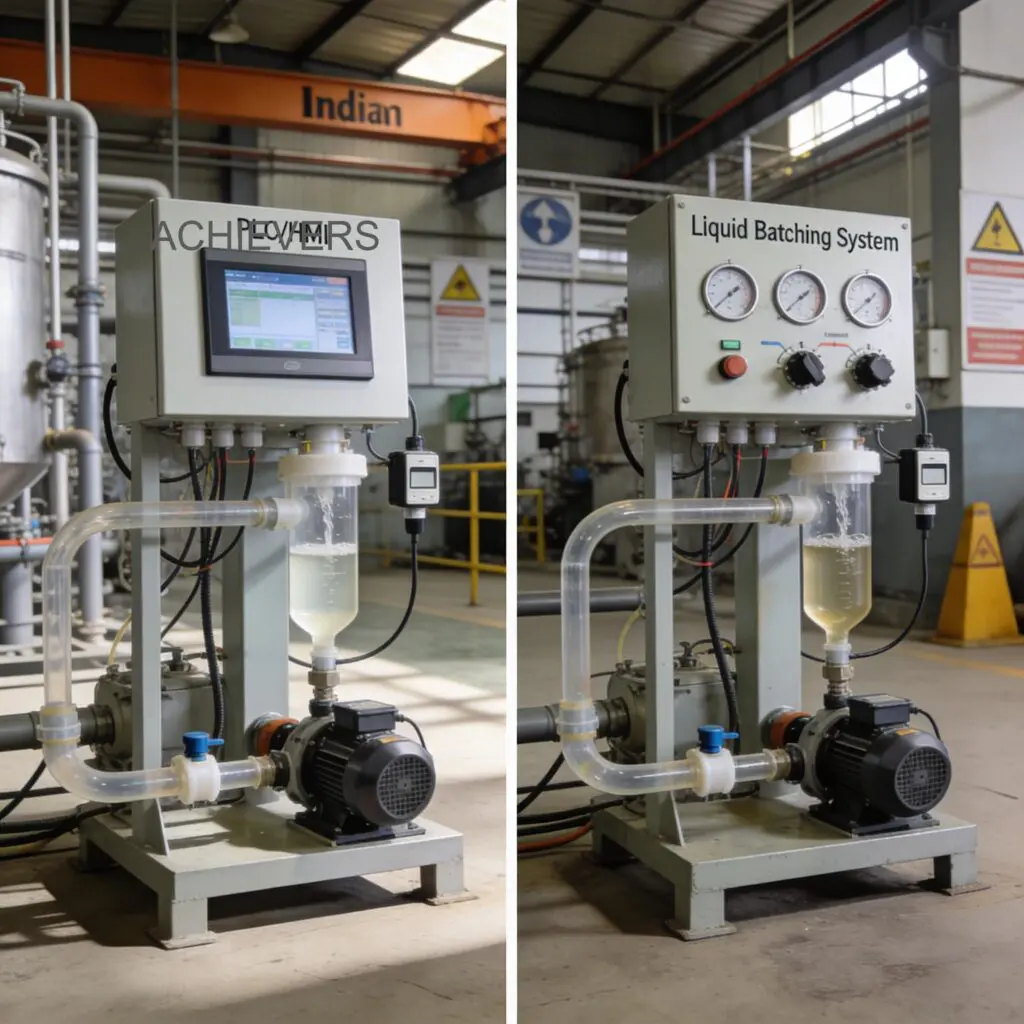
6-Step Implementation Process for Indian Plants
Regardless of whether you select a PLC or a preset counter, successfully commissioning a Liquid Batching System requires a structured engineering approach. Chintan Engineers follows a rigorous lifecycle implementation process to ensure the skid performs perfectly within your existing infrastructure:
- Process Assessment & Data Gathering: The engineering team captures exact media properties (kinematic viscosity, specific gravity, corrosivity), target batch volumes, available line pressures, pump suction conditions, and the required automation hierarchy (stand-alone vs. SCADA).
- Engineering & Fabrication Formulation: Based on the assessment, a detailed Piping and Instrumentation Diagram (P&ID) is generated. The skid—including the matched pump, inline filtration, air eliminator, meter, and valve manifold—is fabricated. All piping is sized to minimize pressure drop while keeping flow velocities within the meter’s linear range.
- Control Panel Assembly & Logic Programming: If a preset counter is chosen, I/O relays are hardwired. If a PLC is selected, the ladder logic is coded, HMI screens (including recipe management and alarm logs) are designed, and the Modbus/Ethernet communication maps are established.
- Factory Acceptance Test (FAT): The fully assembled skid undergoes wet testing at the factory. Batches are simulated using water or test oils. Crucially, the fast/slow pneumatic valve timing is mechanically and electronically tuned to verify that repeatability remains strict and overshoot is eliminated.
- Site Installation & SCADA Commissioning: The turnkey skid is dropped into the plant's process line requiring minimal onsite pipe fitting. Power is connected, pneumatic air lines are supplied to the valve actuators, and (if applicable) the PLC is networked to the plant’s master control room for ERP data handshaking.
- On-Site Calibration & Lifecycle Handover: Final volumetric calibration is performed using certified proving cans or master meters to account for actual site fluid dynamics. Operators are trained on recipe selection, strainer maintenance, and emergency bypass procedures. Scheduled AMC support is initiated to maintain long-term ±0.5% or ±0.2% accuracy.
FAQ
Q: What is the primary cause of volume overshoot in a liquid batching system?
A: Overshoot is typically caused by valve closure latency. If the system uses a single-stage, slow-closing valve, the fluid continues to flow past the meter while the valve mechanically shuts. Utilizing dual-stage (fast-fill/trim) pneumatically actuated valves controlled by either a PLC or preset counter eliminates this by trickling the final 5-10% of the batch.
Q: Can a preset counter system be upgraded to a PLC system later?
A: Mechanically, yes. The pumps, meters, and valves on the skid remain the same. However, electrically, it requires a complete replacement of the control panel, rewiring of the sensor I/O, and new programming. If you anticipate needing digital batch reports or ERP integration within 2-3 years, it is far more cost-effective to specify a PLC system from day one.
Q: Does viscosity affect the accuracy of the batching system?
A: It depends on the meter technology. Positive Displacement (PD) meters (like the CE-110/111) rely on mechanical cavities to measure volume, so they remain highly accurate (±0.5%) regardless of viscosity changes. Turbine meters, however, can lose accuracy if fluid viscosity shifts drastically. The control system (PLC) can sometimes apply correction factors if temperature sensors are integrated.
Q: What power supply is required for the control panel?
A: The control architecture—whether PLC or preset counter—typically operates on standard 220 V AC single-phase power. However, the mechanical drives (rotary vane or gear pumps) and the pneumatic air compressors required for valve actuation must be sized according to the fluid's specific gravity and the required flow rate.
Q: How often does the system require calibration in an Indian industrial environment?
A: For internal process control, bi-annual calibration checks against a master flow meter or certified proving vessel are recommended. If the system is used for custody transfer or commercial invoicing, legal metrology laws in India typically mandate re-calibration and stamping every 12 months. Regular cleaning of inline strainers will drastically extend the time between required calibrations.
Q: Can the system handle multiple fluids without cross-contamination?
A: Yes, provided it is engineered correctly. A PLC-based system is highly recommended for multi-fluid applications. The PLC can control a complex manifold of automated isolation valves and initiate compressed air or solvent flushing sequences between batches to ensure zero cross-contamination.
Q: Why do I need an air eliminator on the batching skid?
A: Flow meters measure volumetric displacement. If your pump sucks in air due to a low tank level or pipe cavitation, the meter will count the air bubbles as fluid volume. An air eliminator vents this trapped air before it reaches the meter, ensuring you are batching pure product and not paying for or logging empty air.
Ready to eliminate product giveaway and automate your fluid transfer? Contact Chintan Engineers today to request a comprehensive consultation for your Liquid Batching System—simply share your fluid specifications, target batch volumes, line pressure, and preferred automation goals, and our technical team will engineer a skid perfectly matched to your Indian plant conditions.
