
















In the fast-paced industrial landscape of India, precision is not just a metric—it is the difference between profitability and waste. For plant managers and process engineers handling bulk fluids, the transition from manual weighing or timing-based filling to automated volumetric batching is a critical upgrade. Manual methods often lead to spillage, inconsistent fill levels, and safety hazards, particularly when handling hazardous chemicals or expensive petroleum products. This is where a robust Liquid Batching System becomes the backbone of efficient production lines.
Achieving operational efficiency in drum and tote filling requires more than just installing a flow meter; it demands a fully integrated control logic that communicates with pumps, valves, and plant networks. Whether you are dispensing solvents, diesel, or high-viscosity additives, the specification process determines the long-term reliability of your filling station. By leveraging advanced PLC-based controls and precision instrumentation, Indian manufacturers can ensure that every drop is accounted for, reducing giveaway costs and ensuring compliance with legal metrology standards.
1. What this product does
The Liquid Batching System by Chintan Engineers is an engineered solution designed to automate the dispensing of liquids with high repeatability and accuracy. Unlike simple flow indicators that merely display volume, this system acts as the central brain of a fluid handling circuit. It actively manages the flow by interfacing with pumps and control valves to deliver a pre-set volume of liquid into drums, IBC totes, or process reactors.
At its core, the system integrates a high-precision flow meter (such as a Positive Displacement, Turbine, or Mass Flow Meter) with a batch controller or PLC. The user inputs the desired quantity via a keypad or remote HMI. The system then energizes the pump and opens the solenoid or pneumatic valves to begin flow. As the target volume approaches, the system executes intelligent cutoff logic to stop the flow exactly at the set point.
Key Technical Capabilities:
- Automated Cutoff: Eliminates manual intervention, preventing overflows and underfills.
- Pump and Valve Control: Direct relay outputs to control motor starters and actuation valves (solenoid or pneumatic).
- Precision Metering: Compatible with various flow measurement technologies suited for low to high viscosity fluids.
- Rugged Construction: Designed for harsh industrial environments, with enclosures available for standard or hazardous (flameproof) zones.
- Data Retention: Keeps a log of cumulative totals and batch history, which is essential for inventory reconciliation.
This solution serves as a standalone industrial drum and tote filling batching skid or can be integrated into larger pipeline networks. It transforms a manual, error-prone task into a streamlined, push-button operation.
2. Specifying a PLC-Based Liquid Batching System for Drum Filling
When upgrading a facility or designing a new filling line, specifying the correct components is crucial. A generic specification often leads to systems that hunt for the setpoint, struggle with viscosity changes, or fail to integrate with plant ERPs. To specify a PLC based liquid batching system for drum filling that performs consistently in Indian plant conditions, engineers must define several critical parameters regarding flow logic and control architecture.
Defining Flow Range and Fill Logic
The most common error in specifying batching systems is ignoring the "turndown ratio" and the dynamics of valve closure. If fluid flows too fast into a small container, it causes foaming and static buildup. If it flows too slow, production targets are missed.
To achieve repeatable volumes with minimal overfill, the system must employ Two-Stage Batching Logic (Coarse and Fine Fill):
- Fast Fill (Coarse): The system opens the valve fully to deliver 80-90% of the batch volume quickly.
- Slow Fill (Fine): As the target approaches, the PLC signals the valve to throttle down or switch to a smaller bypass stream. This slow flow rate allows for a precise "dribble" finish, compensating for valve reaction time and hydraulic shock (water hammer).
Meter Type and Valve Actuation
The choice of meter dictates accuracy. For conductive liquids like water or weak acids, electromagnetic meters work well. However, for a liquid batching system for high viscosity lubricants or oils, a Positive Displacement (PD) or Coriolis Mass Flow meter is required to maintain accuracy despite pressure and temperature fluctuations.
Similarly, valve actuation must match the logic. Pneumatic actuated ball valves or two-stage solenoid valves are preferred over simple gate valves because they offer the rapid response times necessary for the PLC's cutoff signals.
SCADA and ERP Connectivity
Modern manufacturing demands data visibility. A standalone batch controller is good, but a liquid batching system with Modbus SCADA integration is better. This feature allows the batching skid to communicate with the central control room, sending real-time data on batch completion, totalized volume, and alarm states directly to the plant's SCADA or ERP system. This eliminates manual data entry errors and provides real-time inventory deduction.
Practical Specification Checklist
To ensure you receive a quote for a system that meets your operational needs, use this checklist when consulting liquid batching system manufacturers in India:
- Fluid Characteristics:
- Name of Liquid and Chemical Compatibility.
- Viscosity (cSt) at operating temperature.
- Specific Gravity/Density.
- Operating Temperature and Pressure.
- Batching Requirements:
- Minimum and Maximum Batch Size (e.g., 20L to 200L).
- Desired Flow Rate (LPM) and Fill Time per drum.
- Accuracy Required (e.g., ±0.5% or ±0.1%).
- Control Logic & Hardware:
- Two-Stage Cutoff: Mandatory for accuracy? (Yes/No).
- Valve Type: Pneumatic, Solenoid, or Motorized.
- Safety Interlocks: Grounding clamp verification, Emergency Stop, Pump dry run protection.
- Environment & Connectivity:
- Area Classification: Safe Area or Hazardous (Zone 1/2, Flameproof Ex-d).
- Communication: 4-20mA, Pulse output, RS485 Modbus, or Ethernet/IP.
- Material of Construction (MOC):
- Wetted Parts: SS304, SS316, Aluminum, or PP/PTFE.
3. Selection and Configuration Guide
Selecting the right Liquid Batching System involves balancing performance requirements with budget and site infrastructure. Here is a guide to configuring the optimal system for your facility.
Power Supply and Mounting
In India, industrial power stability can vary. Ensure the batch controller power supply matches your site availability—typically 230V AC or 24V DC.
- Panel Mount: Ideal if you have an existing control cabinet.
- Field Mount: Requires a robust, IP65/IP67 rated enclosure to protect the electronics from dust, moisture, and chemical splashes.
- Flameproof (Ex-proof): If the liquid is flammable (solvents, fuels), the controller and all electrical peripherals (solenoids, sensors) must be certified flameproof (Ex-d) to prevent ignition sources.
Filtration Strategy
Even the best batching system will fail if the meter gets clogged. Always configure the system with an upstream strainer or filter.
- Mesh Size: Select based on the meter’s clearance. For PD meters, a fine mesh (40-80 mesh) is often required to protect the gears.
- Maintenance: Ensure the strainer is accessible for regular cleaning to prevent pressure drop spikes that could affect pump performance.
System Sizing
Do not oversize the meter. A 2-inch meter might seem robust, but if your flow rate is at the bottom 5% of its range, accuracy will suffer. Select the line size based on the flow rate, not just the existing pipe diameter. Use reducers if necessary to ensure the fluid velocity is within the linear range of the flow meter.
Summary of Selection Priorities:
- For High Accuracy: Prioritize Coriolis or high-grade PD meters and two-stage valves.
- For Viscous Fluids: Ensure pumps and meters are rated for the pressure drop; avoid turbine meters.
- For Corrosive Chemicals: Verify MOC of O-rings and seals (Viton, PTFE, Kalrez).
- For Inventory Control: insist on Modbus/RS485 output for digital logging.
4. Typical Applications
The versatility of the Liquid Batching System makes it indispensable across various sectors in the Indian manufacturing ecosystem. While initially popular for fuel dispensing, modern PLC-based iterations are used wherever precise liquid handling is required.
Chemical and Solvents
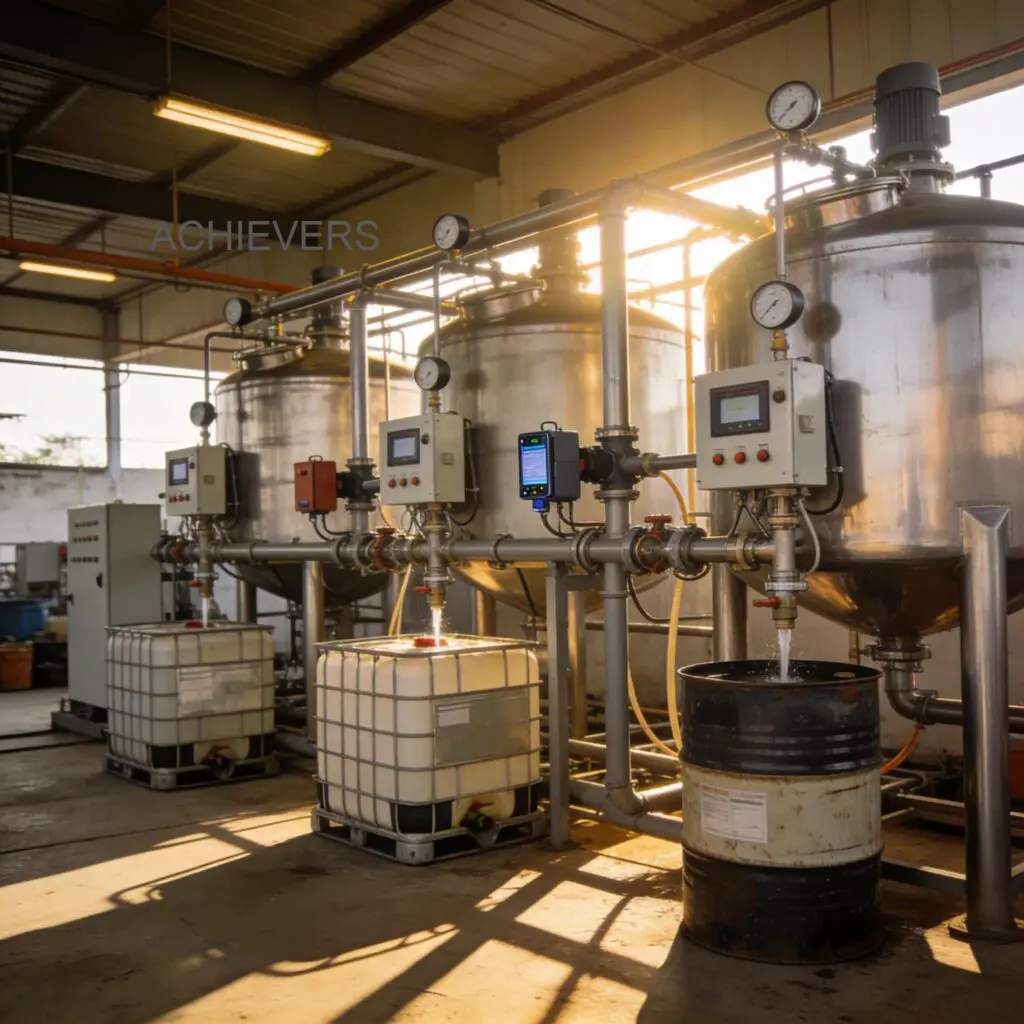
Batching systems are extensively used for filling 200L drums and IBC totes with solvents like Acetone, Toluene, or IPA. Safety is paramount here; the system usually integrates grounding relays to ensure the drum is earthed before the fill cycle can begin, preventing static discharge.
Lubricants and Oils
Lube blending plants utilize these systems for filling engine oils, hydraulic fluids, and greases. The system must handle high viscosity fluids that change flow characteristics with temperature. A liquid batching system for high viscosity lubricants often employs heating jackets on the flow meter or temperature compensation logic in the PLC to report volume standardized to 15°C or 29.5°C.
Food and Pharmaceutical
In these hygienic industries, the batching system dispenses ingredients like glucose, syrups, or purified water into mixing tanks. The focus here shifts to sanitary connections (Tri-Clover), food-grade MOC (SS316L), and Clean-in-Place (CIP) compatibility.
Construction Chemicals
Admixture plants use batching systems to dose precise amounts of hardeners and plasticizers into concrete trucks or blending vessels. The rugged nature of the Chintan Engineers system ensures durability despite the dusty and aggressive environment typical of construction material plants.
5. Service, Installation, and Support
The lifecycle value of a batching system is defined not just by its purchase price, but by its uptime. Installation requires adherence to best practices to ensure accuracy.
Installation Best Practices:
- Straight Run: Most flow meters require a specific length of straight pipe before and after the meter (e.g., 10D upstream, 5D downstream) to condition the flow profile. Turbulence causes measurement errors.
- Air Elimination: Air is the enemy of accuracy. If air pockets pass through the meter, they are counted as liquid, leading to "over-reading" (short deliveries). Installing an air eliminator upstream is critical for truck unloading or empty-tank situations.
- Vibration Isolation: Ensure the skid is bolted down securely and isolated from pump vibrations, which can interfere with sensitive electronic sensors.
Calibration and AMC
Over time, mechanical wear or fluid buildup can cause meter drift. Regular calibration using a master proving tank is essential. Chintan Engineers provides end-to-end support, from commissioning to Annual Maintenance Contracts (AMC).
- On-Site Calibration: Verification against a known standard volume.
- Spares Availability: Using a domestic manufacturer ensures that critical spares like sensor coils, PCBs, and seal kits are readily available, minimizing downtime compared to imported units.
By choosing a partner that offers comprehensive engineering support, Indian plants can ensure their batching operations remain accurate, compliant, and efficient for years to come.
Ready to Upgrade Your Filling Line?
Don't let manual errors drain your profits. Contact Chintan Engineers to configure the right solution for your plant. When enquiring, please share your:
- Fluid name and viscosity.
- Required flow rate and batch sizes.
- Application type (Drum filling, Tank loading, or Process dosing).
- Site conditions (Flameproof or Safe area).
