
















In the diverse landscape of Indian manufacturing—ranging from the high-precision pharmaceutical hubs of Gujarat to the bustling textile mills and large-scale water treatment facilities across the nation—fluid handling is a critical operational backbone. For facility managers and process engineers, the challenge isn't just moving liquid; it is moving it reliably without contamination, corrosion, or downtime. This is where the selection of the correct pumping equipment becomes paramount.
Industrial environments are often harsh. Corrosive acids, hygienic food products, and high-purity water systems all demand materials that can withstand chemical attack while maintaining structural integrity. Standard cast iron pumps simply cannot survive these conditions. Consequently, SS Pumps have become the industry standard for durability and hygiene. However, selecting the "right" stainless steel pump is not a one-size-fits-all process. It requires a nuanced understanding of metallurgy, hydraulic performance, and seal technology to ensure operational efficiency and long-term value.
1. What Are SS Pumps and How Do They Function?
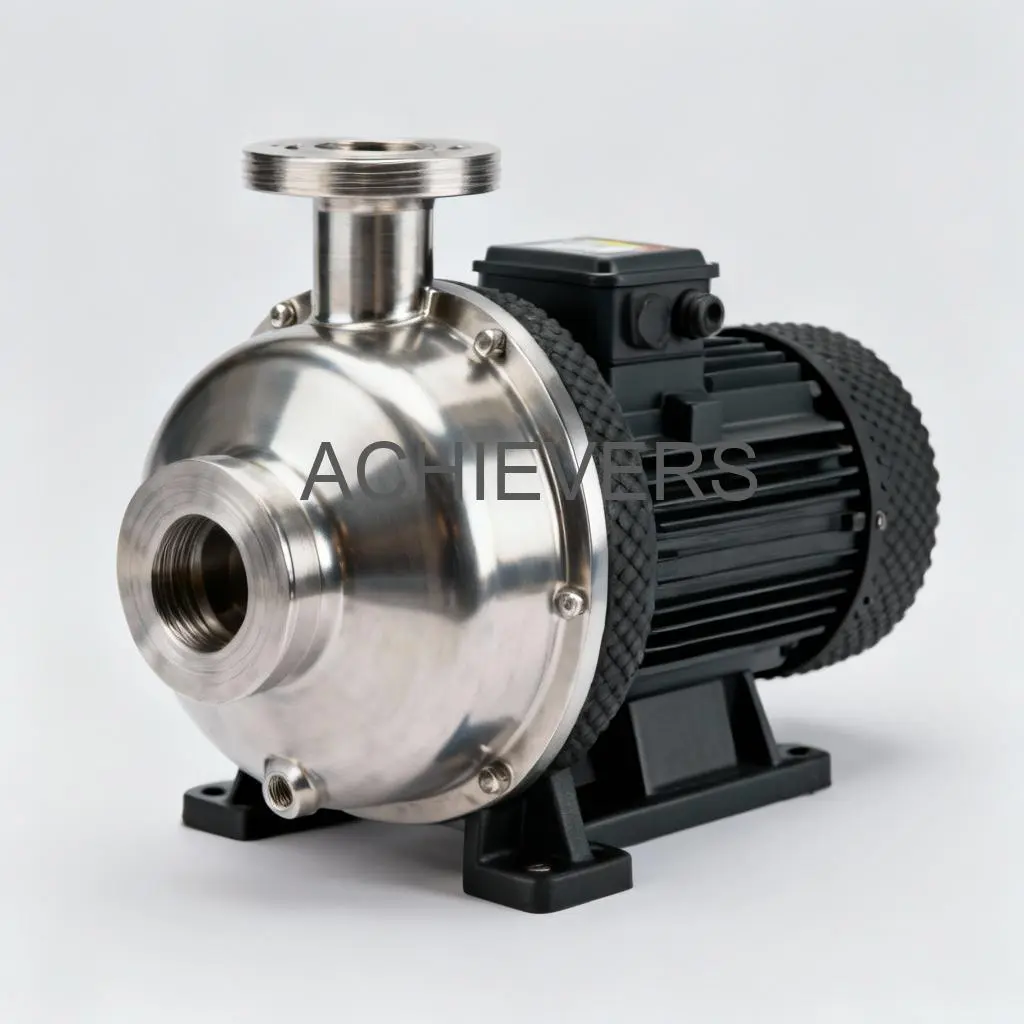
At their core, SS Pumps designed by Chintan Engineers are high-performance centrifugal process pumps constructed primarily from stainless steel alloys. Unlike standard mild steel or cast iron alternatives, these pumps are engineered to resist oxidation and chemical degradation, making them indispensable for handling aggressive fluids or liquids requiring strict hygiene standards.
The fundamental operation relies on centrifugal force. An impeller, housed within a stainless steel casing (volute), rotates at high speeds, imparting kinetic energy to the fluid. This energy is converted into pressure, driving the fluid through the discharge outlet. The critical differentiator for this product line is the material of construction (MOC).
Key Technical Specifications & Features:
- Material Construction: The primary contact parts—casing, impeller, backplate, and shaft—are manufactured from high-grade Stainless Steel. The most common grades used are SS 304 (CF8) and SS 316 (CF8M).
- Design Type: These are typically horizontal, end-suction centrifugal pumps or monoblock designs where the pump is directly coupled to the motor for compact installation.
- Corrosion Resistance: The chromium oxide layer inherent in stainless steel provides a passive shield against rust and chemical attack, crucial for SS pumps for chemical process plants.
- Hygienic Surface: The internal surfaces are often finished to be smooth and crevice-free, preventing bacterial growth—a non-negotiable feature for stainless steel pumps for dairy applications.
- Seal Options: To prevent leakage of hazardous or expensive fluids, these pumps utilize specialized mechanical seals (Carbon/Ceramic, Silicon/Carbide, etc.) rather than basic gland packing.
For industries seeking SS pump manufacturers in India, the focus is often on the balance between hydraulic efficiency and the grade of steel used. A higher-grade alloy ensures longer life but requires precise casting and machining, an area where Chintan Engineers specializes.
2. Choosing the Right SS Pump for Chemical, Dairy, and Water Applications
Selecting the correct pump requires more than just matching flow rate and head. This section helps industrial buyers evaluate and select the most suitable SS Pumps model based on fluid type, site conditions, and specific industrial requirements seen in sectors like chemicals, food processing, and water supply.
Material Selection: SS 304 vs. SS 316
The first decision point in industrial stainless steel pumps selection is the metallurgy.
- SS 304 (CF8): This is the "workhorse" grade. It offers excellent resistance to atmospheric corrosion and is suitable for a wide range of organic chemicals, dyes, and foodstuffs. It is the standard choice for water treatment plants, RO systems, and general industrial water transfer where extreme acidity is not present.
- SS 316 (CF8M): This grade contains Molybdenum, which significantly increases resistance to chloride pitting and crevice corrosion. For SS pumps for chemical process plants handling sulfuric acid, phosphoric acid, pharmaceutical solvents, or saline water, SS 316 is the mandatory choice. It is also preferred in dairy applications where harsh Clean-In-Place (CIP) chemicals are used for sterilization.
Sealing Systems: Preventing Leaks
In chemical and pharmaceutical applications, leakage is a safety hazard, not just a maintenance nuisance.
- Gland Packing: Rarely used in modern high-purity SS applications due to leakage requirements for lubrication.
- Mechanical Seals: This is the standard for SS Pumps. Buyers must select the seal face material based on the fluid.
- Carbon/Ceramic: Good for clear water and non-abrasive fluids.
- Silicon Carbide/Tungsten Carbide: Essential for fluids containing abrasive particles or slurries to prevent premature seal failure.
- Double Mechanical Seals: Required for toxic, volatile, or polymerizing fluids where a barrier fluid is needed to ensure zero emissions.
Impeller Design and Efficiency
The nature of the fluid dictates the impeller type:
- Closed Impeller: Offers the highest efficiency. Best suited for clear liquids like water, solvents, and milk.
- Semi-Open/Open Impeller: If the fluid contains suspended solids, crystals, or fibrous material (common in effluent treatment or paper pulp), an open impeller prevents clogging, though at a slight cost to efficiency.
Motor and Shaft Considerations
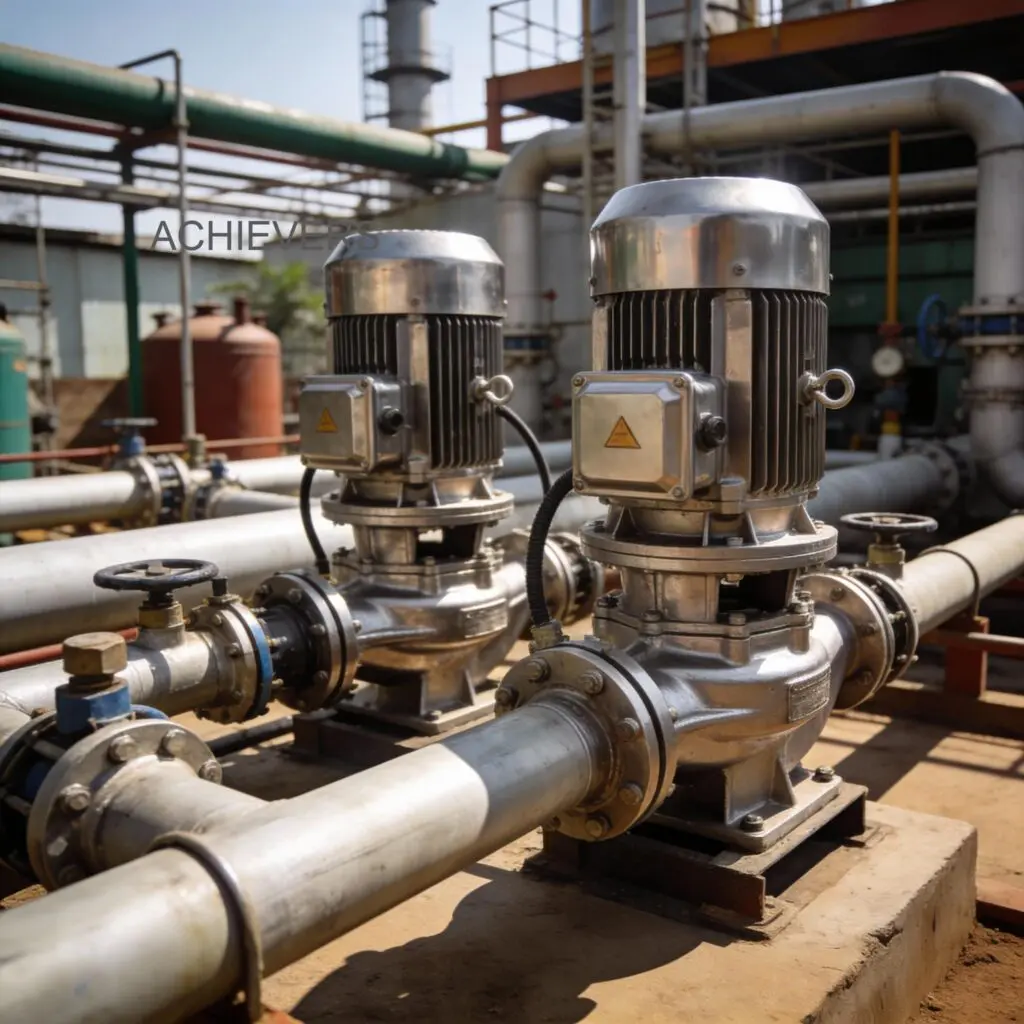
For best SS pumps Ahmedabad sourcing, consider the drive unit. The pump shaft must be robust enough to handle the torque without deflection, which can damage seals. Furthermore, in chemical plants with flammable atmospheres, the pump must be coupled with a Flame Proof (FLP) motor to meet safety compliance.
3. Selection and Configuration Guide
When approaching a manufacturer to procure SS pumps, providing incomplete data often leads to undersized or incompatible equipment. To ensure you receive a system that offers corrosion-resistant industrial pumps performance, follow this configuration guide.
Step 1: Define the Fluid Properties
You must communicate the exact nature of the medium.
- Chemical Composition: specific acids, alkalis, or solvents and their concentrations.
- Specific Gravity (SG): Water has an SG of 1.0. Heavy chemicals (like Sulfuric Acid) have a higher SG, requiring more motor power (HP/kW).
- Viscosity: Thicker fluids reduce pump performance and may require lower RPM motors.
- Temperature: High temperatures affect the choice of elastomers (O-rings and gaskets) inside the pump (e.g., Viton vs. Teflon).
Step 2: Calculate Hydraulic Requirements
- Flow Rate: How many liters per minute (LPM) or cubic meters per hour (m³/hr) do you need?
- Total Head: This is not just the vertical height. It includes friction losses in pipes, bends, and valves. Undersizing head results in zero flow; oversizing causes cavitation and vibration.
- Suction Conditions: Is the pump lifting fluid (negative suction) or is the fluid flowing into it (flooded suction)? SS pumps generally function best with flooded suction; for lifting, self-priming variants or foot valves are necessary.
Step 3: Operational Environment
- Duty Cycle: Is this for continuous 24/7 operation or intermittent batch transfer?
- Power Supply: Standard industrial supply is 415V/3-phase, but remote sites might need single-phase options for smaller pumps.
Checklist for Enquiry
When sending an enquiry to Chintan Engineers, include:
- Liquid Name & Concentration
- Operating Temperature
- Required Flow & Discharge Head
- Presence of Solids (Yes/No)
- Motor Preference (Standard or Flame Proof)
4. Typical Applications in Indian Industries
The versatility of the SS Pump product line makes it a staple across various sectors. Based on the product capabilities, here are the primary use cases:
Chemical and Pharmaceutical Industry
This is the largest consumer of SS pumps for chemical process plants. The pumps are used for transferring solvents, reactor feed, filtration systems, and bulk chemical unloading. The inert nature of stainless steel ensures that the pump does not react with the product, maintaining the purity of pharmaceutical compounds.
Food, Beverage, and Dairy
In the food sector, hygiene is the law. Stainless steel pumps for dairy applications are used for milk reception, pasteurization loops, and transferring fruit pulps or syrups. The pumps withstand daily caustic soda and nitric acid washes (CIP cycles) without corroding, ensuring food safety compliance.
Water Treatment and RO Plants
Desalination, Reverse Osmosis (RO), and Demineralization (DM) plants handle water that is "hungry" (ultra-pure water strips ions from metals) or saline. SS 316 pumps are critical here to prevent iron contamination in the treated water and to resist the corrosive nature of brine reject streams.
Textile and Dyeing
The textile industry in India relies heavily on SS pumps for circulating bleaching agents, dyes, and mordants. The pumps must handle high temperatures and fluctuating pH levels typical in dye bath circulation systems.
5. Service, Installation, and Support
Even the highest quality engineering product requires proper installation to function correctly. As a provider of SS pump manufacturers in India, Chintan Engineers emphasizes not just the sale, but the lifecycle support of the equipment.
Installation Best Practices
- Foundation: The pump must be mounted on a rigid, flat foundation to absorb vibration. Misalignment is the #1 cause of bearing and seal failure.
- Piping Support: Piping should not rest on the pump. The pump casing is designed to hold pressure, not the weight of heavy steel pipes. Independent pipe supports are mandatory.
- Priming: Centrifugal SS pumps must be primed (filled with liquid) before starting. Running dry, even for a few seconds, can destroy the mechanical seal faces due to friction heat.
Maintenance and AMC
Routine maintenance ensures longevity. This includes checking the mechanical seal for drips, monitoring motor amperage, and listening for abnormal noise (cavitation).
- Spares Availability: Using genuine spares (impellers, shafts, seals) ensures the pump retains its original efficiency.
- AMC Services: For critical plants, Annual Maintenance Contracts (AMC) provide peace of mind. Regular calibration checks and preventive maintenance by technical experts can prevent unexpected shutdowns.
Why Factory Calibration Matters
While pumps are mechanical devices, verifying their performance curve (Head vs. Flow) at the factory ensures that the pump delivers exactly what was promised. Every unit leaving the facility is tested to ensure it meets the efficiency standards required by modern Indian industries.
Summary
Choosing the right SS pump is a balance of science and engineering. It involves matching the chemical compatibility of SS 304 or 316 with the hydraulic demands of your specific process. Whether you are managing a chemical reactor, a milk processing line, or a water treatment plant, the reliability of your operation hinges on the quality of your pump.
For industrial buyers, the goal is to select a solution that offers corrosion resistance, leak-free sealing, and energy efficiency. By focusing on the specific fluid properties and site conditions, you can ensure a long service life and reduced operational costs.
Contact Chintan Engineers Today
To ensure you select the exact SS pump configuration for your facility, connect with our technical team. Please have your flow rate, head pressure, and fluid details ready so we can engineer the perfect solution for your needs.
