
















A 0.5% calibration drift on a 10,000-liter-per-day diesel throughput costs your operation ₹1.35 lakh per month in untracked fuel. Over five years, that "minor" measurement error bleeds ₹81 lakhs directly from your bottom line.
I am Vikram Desai, Senior Flow Measurement Engineer at Chintan Engineers. Over the last 22 years, I have calibrated and commissioned over 5,000 flow measurement systems—from high-volume ONGC loading bays to dusty fleet depots in remote Kutch. When procurement managers ask me for the lowest fuel dispenser price in India, they are usually looking at the wrong numbers. You don't pay for a fuel dispenser once; you pay for it every single day through maintenance downtime, calibration drift, and parts replacement.
Below, I will walk you through a practical fuel dispenser TCO analysis (Total Cost of Ownership) over a standard five-year operational lifespan. I want to show you exactly how initial CapEx, AMC costs, and metering accuracy dictate the true financial impact of your dispensing infrastructure under brutal Indian industrial conditions.
In This Article
- Beyond the Sticker Price: The Anatomy of Dispenser TCO
- The Cost of Inaccuracy: Your Silent Budget Killer
- 5-Year TCO Breakdown: Cheap Alternatives vs. Industrial Grade
- Dispenser Sizing and Selection Guide
- Real-World Application and Indian Industrial Context
- Installation & Maintenance Protocols for Longevity
- Frequently Asked Questions (FAQs)
- Final Engineering Recommendation
Beyond the Sticker Price: The Anatomy of Dispenser TCO
When calculating the industrial fuel dispenser cost, procurement naturally defaults to the initial invoice. But a dispenser isn't office furniture—it is a high-cycle electromechanical asset handling a volatile, abrasive, and temperature-sensitive fluid.
True TCO boils down to three distinct pillars:
- Capital Expenditure (CapEx): The initial hardware, installation, and commissioning.
- Operating Expenditure (OpEx): The fuel dispenser maintenance cost, annual maintenance contracts (AMCs), spare parts, filter replacements, and power consumption.
- Cost of Inaccuracy (CoI): The financial loss incurred due to metering drift beyond Legal Metrology Act allowances.
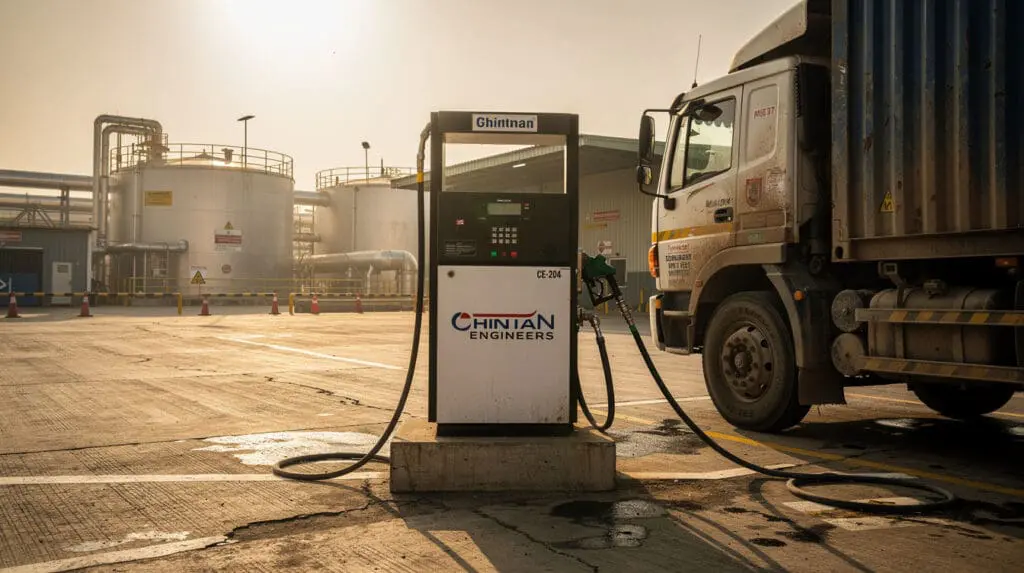
Ever wonder why that "bargain" meter needs recalibrating every three months? I've opened up enough cheap, imported dispensers in GIDC industrial estates to know exactly how they fail. The aluminum housing pits under monsoon humidity, the digital displays burn out from local voltage fluctuations, and the low-grade turbine rotors wear down, shifting accuracy from ±1% on day one to a disastrous ±3% by month six.
The Cost of Inaccuracy: Your Silent Budget Killer
Do you actually know how much fluid you're losing? Let's run the math.
Diesel density fluctuates with temperature. A volumetric meter without proper calibration and thermal stability will constantly over-deliver or under-deliver. In India, fuel dispensers are governed by IS 14883 and must comply with OIML R117 standards for dynamic measuring systems—though in my experience, very few budget options actually hold these tolerances in the field.
Compare two scenarios for a plant dispensing 5,000 liters of diesel daily (approx. ₹4,50,000 daily spend at ₹90/liter):
Scenario A: Budget Dispenser (±2.0% Accuracy Drift)
If the meter drifts to a +2% over-delivery rate, you are giving away 100 liters of diesel every single day.
- Daily Loss: ₹9,000
- Monthly Loss: ₹2,70,000
- Annual Loss: ₹32.4 Lakhs
Scenario B: High-Accuracy Positive Displacement Dispenser (CE-204 with ±0.2% Accuracy)
Using a digital preset controller with a highly machined positive displacement (PD) meter, the variance is tightly controlled to just 0.2%.
- Max Daily Variance: 10 liters
- Monthly Variance: ₹27,000 (a 90% reduction in unbilled loss)
Pro Tip: I've calibrated enough turbine meters to know they don't belong anywhere near industrial fleet refueling. For high-volume diesel transfer, always specify a positive displacement or oval gear meter. The initial 30% premium in CapEx is almost always recovered in fuel savings within the first 45 days of operation.
5-Year TCO Breakdown: Cheap Alternatives vs. Industrial Grade
I recently audited a plant using generic unbranded dispensers. Here is how their 5-year financial outlook compared to standardizing on the Chintan CE-204 High Accuracy Dispenser (Starting ₹95,000 Ex-GST).
| Cost Component (5-Year Projection) | Unbranded Local Dispenser | Chintan CE-204 (±0.2% Accuracy) |
| :— | :— | :— |
| Initial CapEx | ₹45,000 | ₹95,000 |
| Installation & Grounding | ₹10,000 | ₹10,000 |
| Routine Spares & Consumables | ₹40,000 (Frequent rotor/seal failure) | ₹18,000 (Standard filter/hose wear) |
| AMC & Calibration Visits | ₹60,000 (Requires constant re-cal) | ₹35,000 (Stable PD meter) |
| Downtime Costs (Est. ₹5k/day) | ₹75,000 (15 days over 5 years) | ₹10,000 (2 days over 5 years) |
| Fuel Loss (Cost of Inaccuracy) | ₹45,00,000+ (Assuming 1% avg drift) | ₹4,50,000 (Tightly held to 0.2%) |
| Total 5-Year TCO | ₹47,30,000 | ₹6,18,000 |
The numbers speak for themselves. The "cheaper" dispenser actually costs your plant nearly 8 times more over a five-year cycle due to catastrophic metering drift and higher fuel dispenser maintenance cost.
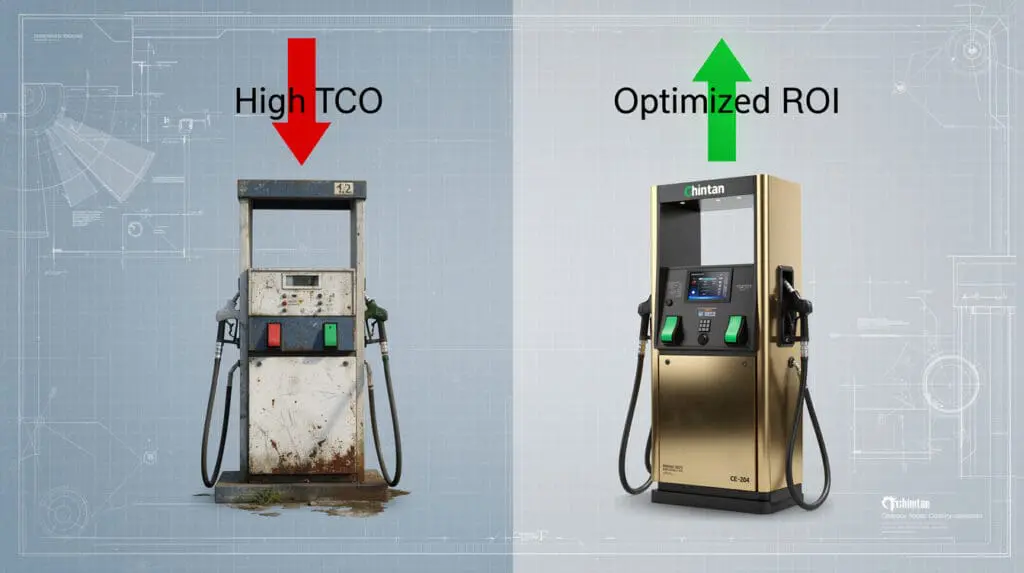
Losing diesel to uncalibrated dispensers?
Upgrade to the CE-204 for Legal Metrology approved ±0.2% accuracy, preset batching, and 365-day data logging.
Dispenser Sizing and Selection Guide
How do you avoid these TCO traps? You size the dispenser to the environment, not just the budget. Selecting the right unit requires matching the flow rate, fluid viscosity, and power availability to your specific operational constraints. Here is how I size systems for our clients based on the Chintan Engineers product matrix.
1. For High-Accountability Fleet Depots
Recommendation: CE-204 High Accuracy Dispenser
If you need audit-ready records and Legal Metrology compliance, this is the benchmark.
- Accuracy: ±0.2%
- Flow Range: 20 – 80 L/min
- Features: Volume/amount preset controller, integrated receipt printer, and storage of daily data for the last 365 days.
- Power: Available in 12/24V DC or 220V AC.
- Price: Starting at ₹95,000 (Ex-GST)
2. For General Factory & Mid-Sized Workyards
Recommendation: CE-202 Digital Dispenser
This is the mid-range workhorse. It lacks the printer of the 204 but provides rock-solid electronic flow calculation and robust build quality.
- Accuracy: ±0.5%
- Flow Range: 20 – 60 L/min
- Features: Digital LCD display, ambient noise automatic shutoff nozzle, 360-degree nozzle swivel.
- Connection Size: 25mm
- Price: Starting at ₹55,000 (Ex-GST)
3. For Remote Construction and Mining (Mobile)
Recommendation: CE-117 Entry-Level Digital
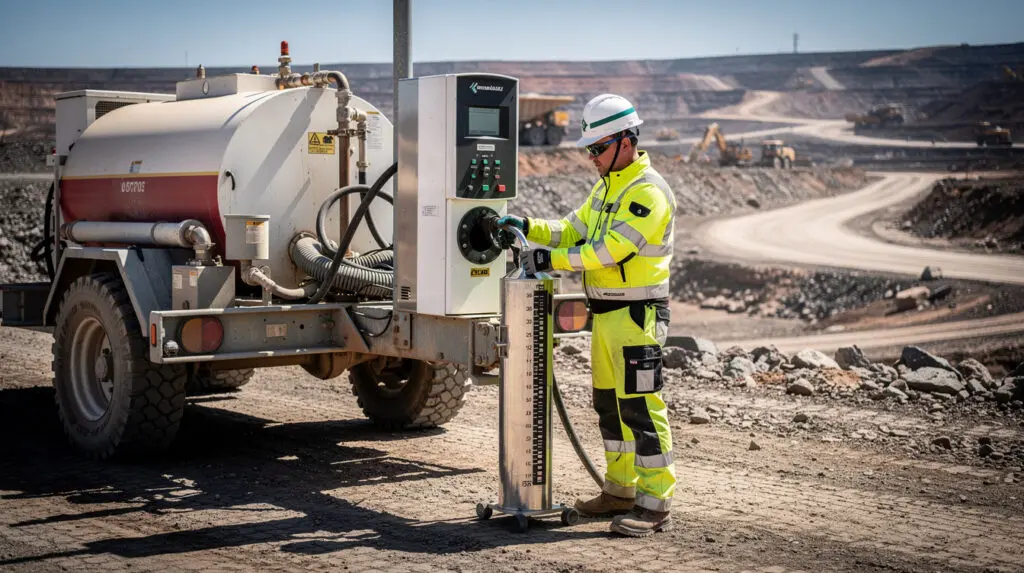
When you are mounting a bowser on a skid to fuel earthmovers in an open-cast mine, you need simplicity and vibration resistance above all else.
- Accuracy: ±0.5% (High-precision positive displacement)
- Flow Range: 40 – 60 L/min
- Max Pressure: 3 BAR / 0.3 MPA
- Materials: Brass internals for corrosion resistance.
- Price: Starting at ₹44,000 (Ex-GST)
For engineers designing mobile setups, I highly recommend reviewing our detailed Engineering Guide to Mobile Fuel Dispensers to understand skid-mounting dynamics and structural considerations.
Did You Know: Why Brass Internals Matter: Diesel in India often contains higher moisture and sulfur traces. Brass internals in units like the CE-117 prevent internal oxidation, which is the leading cause of rotor jamming in cheap aluminum-cast meters.
Real-World Application and Indian Industrial Context
European models are beautiful pieces of engineering—until you put them in a dusty Indian industrial park with 95% humidity and wildly fluctuating voltage.
Power Quality Challenges:
In industrial zones like Ankleshwar or Sanand, voltage spikes and sags are a daily reality. A standard dispensing controller will fry its motherboard during a 220V to 280V spike. Chintan digital control boards (found in the CE-206 and CE-204) are engineered with widened voltage tolerances and robust isolation transformers to handle grid instability without losing your calibration data.
Monsoon and Dust Ingress:
During the Gujarat monsoons, relative humidity hits 95%. This wreaks havoc on unsealed electronics. Our enclosures are weather-sealed to strict IP ratings, protecting the digital PDP meters and pulse output relays. If you are operating mobile bowsers on dusty construction sites, protecting the fluid path is just as critical. Read more on how we secure these setups in our guide to Stop Fleet Fuel Losses: Mobile Dispensers.
Installation & Maintenance Protocols for Longevity
To keep your fuel dispenser maintenance cost at an absolute minimum and maintain your ROI, strict installation protocols per BIS IS 5765 must be followed.
1. Mandatory Grounding (Earthing)
Static electricity buildup during diesel transfer can exceed 10,000 volts. I will literally halt a commissioning job if the grounding pit measures more than 1 ohm resistance. Ensure the delivery hose has continuous continuity wire bonded from the nozzle to the dispenser chassis.
2. Pre-Filtration is Non-Negotiable
The tight tolerances inside a ±0.2% positive displacement meter will score and degrade if grit enters the system. Always install a Y-strainer (minimum 100 mesh) before the pump inlet, and a water-absorbing particulate filter (like a 10-micron spin-on element) between the pump and the flow meter.
3. Legal Calibration Cycles
Under the Legal Metrology Act, standard weights and measures require periodic stamping. A well-maintained CE-204 will typically pass annual calibration without any mechanical adjustment required, whereas budget models will need their K-factor electronically manipulated every few months just to hide the mechanical wear.
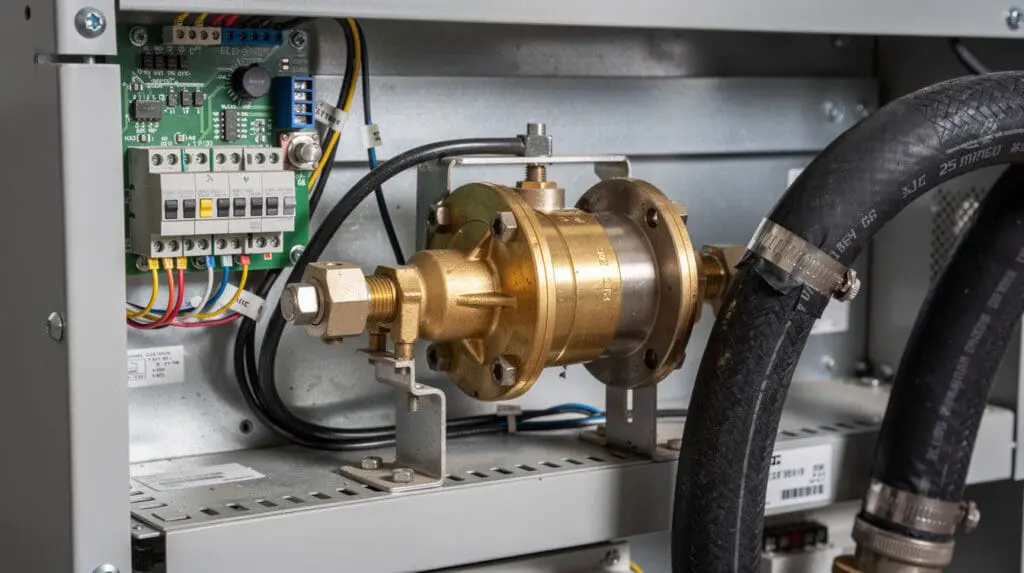
Warning: Never bypass the dispenser's internal bypass valve on the rotary vane pump. If a driver shuts the automatic nozzle while the pump is running, pressure spikes can blow the pump seals. Ensure the internal pressure relief is correctly set to 0.3 MPA (3 BAR) during installation.
Frequently Asked Questions (FAQs)
What is the average fuel dispenser price in India for industrial use?
For reliable industrial use, prices range from ₹44,000 for an entry-level digital unit (like the CE-117) to ₹95,000+ for high-accuracy, Legal Metrology compliant models with receipt printers (like the CE-204). Custom units for heavy fluids can cost more.
How much is the typical fuel dispenser maintenance cost per year?
A high-quality unit with a positive displacement meter typically costs ₹5,000 to ₹8,000 annually in preventative maintenance (filter changes, seal inspections). Cheap turbine models can cost over ₹25,000 annually due to frequent parts replacement and mandatory recalibrations.
Why does the CE-204 cost more than generic market dispensers?
The CE-204 features a highly engineered positive displacement (PD) meter achieving ±0.2% accuracy, a preset controller for exact batching, a receipt printer, and memory for 365 days of data logging. This prevents fuel theft and inaccurate billing, effectively returning its cost via fuel savings within months.
Can I run an industrial fuel dispenser on DC power for mobile units?
Absolutely. Models like the CE-202, CE-117, and even the high-accuracy CE-204 can be configured with 12V DC or 24V DC rotary vane pumps for mounting directly on trucks or battery-operated trolleys without sacrificing metering accuracy.
What is a fuel dispenser TCO analysis, and why does it matter?
A TCO (Total Cost of Ownership) analysis looks beyond the initial purchase price to calculate maintenance, downtime, and the cost of fuel lost to metering inaccuracy over 5 years. It proves that cheaper dispensers ultimately cost lakhs of rupees more due to hidden measurement drift.
Final Engineering Recommendation
If there is one thing 22 years in this industry has taught me, it's this: the most expensive dispenser you will ever buy is the one that lies to you about how much fluid it is moving.
If you are transferring more than 1,000 liters of diesel per day, do not compromise on CapEx to save ₹40,000 upfront. Specify the Chintan CE-204 High Accuracy Dispenser. The ±0.2% accuracy, combined with printed receipts and 365-day data retention, instantly removes human error and "shrinkage" from your fluid logistics.
Design your fluid transfer systems for the realities of Indian industry. Invest in positive displacement metering, mandate proper filtration, and watch your industrial fuel dispenser cost drop dramatically over the next five years.
Ready to audit-proof your fuel transfer operations?
Speak directly with our engineering team to spec a custom dispensing skid with precision metering for your exact application.
