
















A 0.5mm baseplate deflection on a 120 M³/hr stainless steel pump operating at 2880 RPM will destroy your mechanical seals in under 90 days. For a chemical plant transferring corrosive fluids or a dairy operation maintaining hygiene standards, that translates to approximately ₹2.4 Lakhs annually in wasted seals, lost product, and unplanned downtime.
I am Vikram Desai, Senior Flow Measurement and Pumping Systems Engineer at Chintan Engineers. Over the last 22 years, I have commissioned thousands of fluid transfer systems across India—from the humid, salt-heavy atmosphere of Dahej to the dusty, high-heat environments of industrial estates in Rajasthan.
I regularly see plant managers invest heavily in premium SS-316 or SS-304 pumps, only to mount them on uneven concrete pads with poorly engineered suction piping. The pump is not failing; the installation was flawed from day one.
Let me walk you through the standard-compliant commissioning protocol we use for Indian industrial conditions. We need to look at foundation integrity, piping geometry for viscous fluids, and motor protection against our notoriously volatile grid.
In This Article
- Foundation and Baseplate Leveling: Eliminating Structural Resonance
- Suction Piping Geometry: Winning the NPSH Battle
- Motor Protection for the Indian Electrical Grid
- Technical Specifications & Sizing Guide
- Defending Against Monsoon Humidity and Corrosion
- Frequently Asked Questions
- Final Engineering Recommendation
Foundation and Baseplate Leveling: Eliminating Structural Resonance
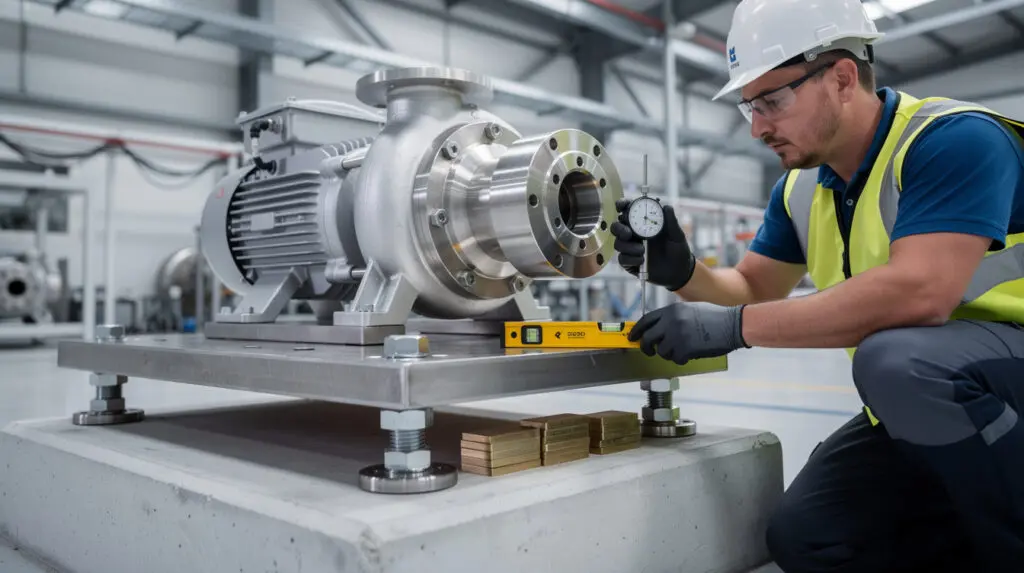
The foundation is where mechanical reliability begins. In industrial hubs like Vatva or Ankleshwar GIDC, ambient floor vibration from neighboring heavy machinery is a constant threat. I can't tell you how many times I've seen a beautifully machined SS-316 pump vibrating itself to death because it's sitting on a hollow skid.
When setting up your centrifugal pump, the concrete foundation block should be at least three times the mass of the pump and motor combined. This acts as a dampener, absorbing the dynamic forces generated at 2880 RPM.
Pro Tip: I never allow plant operators to bolt a pump directly to bare concrete. Always use non-shrink epoxy grout beneath the baseplate. Cementitious grouts shrink over time in high Indian ambient temperatures, leaving microscopic voids that amplify vibration.
Use a precision machinist level across the machined mounting pads. If your installation team shows up with a standard carpenter's bubble level, send them home. Your leveling tolerance should not exceed 0.25mm per meter. Shims used for leveling must be full-contact, U-shaped stainless steel—never stack mild steel washers, as they will corrode during the monsoon and collapse under torque.
Suction Piping Geometry: Winning the NPSH Battle
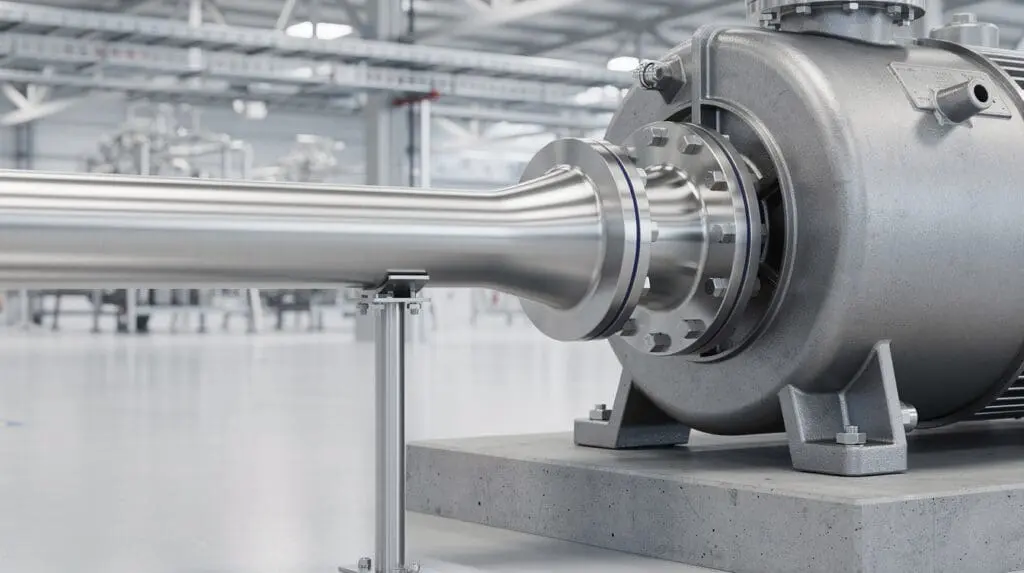
A centrifugal pump does not "suck" fluid; it creates a low-pressure zone at the impeller eye, allowing atmospheric pressure (or tank head) to push the fluid in. If your suction piping creates too much friction, the localized pressure drops below the fluid's vapor pressure, causing cavitation.
Our CE Series SS pumps are engineered to handle viscosities up to 1500 centipoise, making them ideal for milk, chemical transfer, and sugar syrups. However, pushing highly viscous fluid requires strict adherence to piping geometry rules:
- The Straight Run Rule: Provide a straight run of suction pipe at least 5 to 10 times the pipe diameter (5D-10D) directly upstream of the pump nozzle. No elbows, valves, or tees in this zone.
- Reducer Orientation: When reducing pipe size into the horizontal suction nozzle, always use an eccentric reducer with the flat side up. A concentric reducer traps air at the top of the pipe, which eventually collapses the impeller's hydraulic performance.
- Pipe Sizing: The suction pipe should generally be one or two sizes larger than the pump's suction nozzle.
Warning: Cavitation pitting on a rolled stainless steel impeller is often misdiagnosed as chemical corrosion. If you hear a noise resembling gravel passing through your pump, your NPSH available (NPSHa) has dropped below the NPSH required (NPSHr). Throttle the discharge valve to reduce flow until the noise stops, then re-engineer your suction line.
Transferring Viscous Liquids or Dairy Products?
Our CE Series SS pumps feature pore-free, non-pitting surfaces, designed specifically for hygienic applications and heavy chemical transfer.
Motor Protection for the Indian Electrical Grid
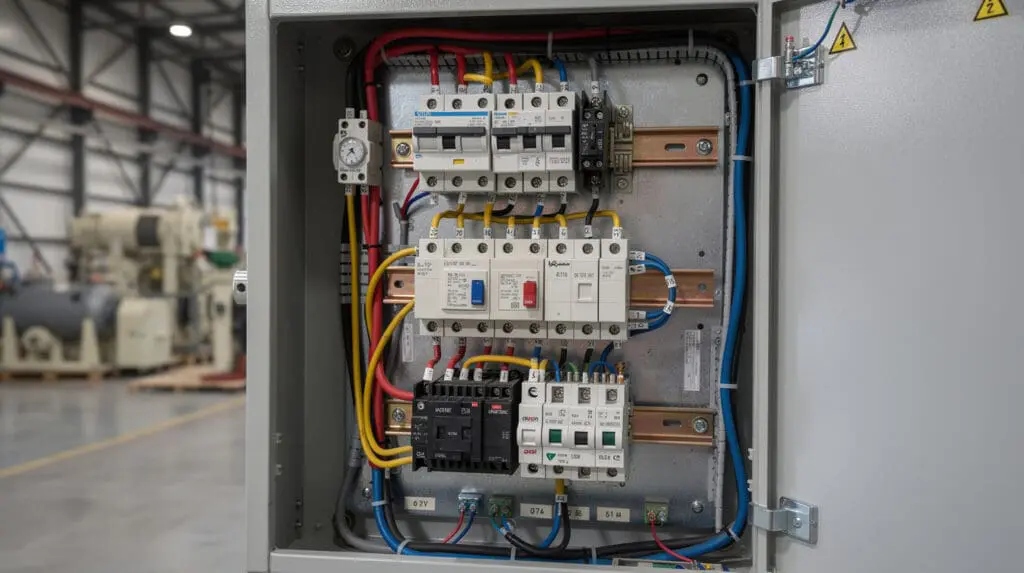
Hydraulics are only half the battle. Once your piping is dialed in, you have to protect the motor. Indian industrial grid voltages are theoretically 415V for three-phase systems, but in reality, plants often see dips down to 380V or spikes up to 440V, especially during summer peak loads.
When voltage drops, a motor drawing constant power must pull higher current to compensate. Heat generation in motor windings increases with the square of the current ($I^2R$). I've seen 20 HP motors bake their insulation during the first week of operation simply because a plant manager ignored a brownout.
Your SS monoblock pump electrical commissioning checklist must include:
- Phase Asymmetry Protection: Voltage unbalance exceeding 2% will cause a disproportionate current unbalance of 10-15%, leading to rapid overheating.
- Thermal Overload Relays (Bimetallic or Electronic): Set these to exactly 100% of the motor's Full Load Amperage (FLA) listed on the nameplate, not higher.
- Single Phasing Preventers: Essential for remote agricultural or peripheral GIDC locations where utility phase loss is common.
Just as we size components in our Mobile Fuel Dispenser Engineering & Sizing Guide, your motor protection circuit must be sized to handle the starting current (typically 6-7 times the running current) without nuisance tripping.
Technical Specifications & Sizing Guide
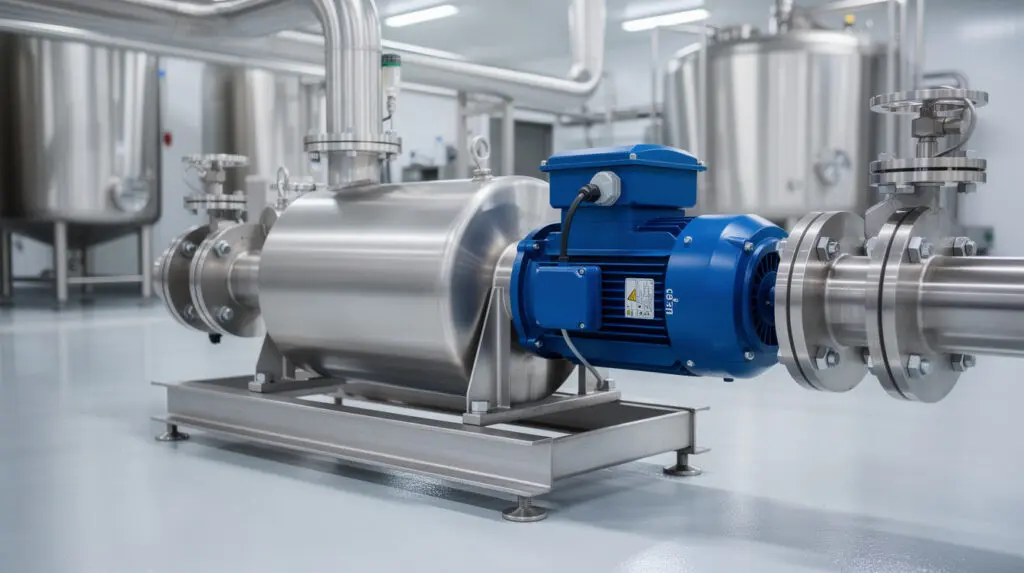
Choosing the right metallurgical composition and operational parameters is critical. Our CE Series and BPO (Back Pull Out) series offer distinct advantages based on your operational uptime requirements.
| Specification Parameter | CE Series Monoblock / Bare Pump Capability |
| :— | :— |
| Material of Construction (M.O.C) | SS-304, SS-316 (Rolled stainless steel, pore-free) |
| Maximum Head | Up to 60 Meters |
| Maximum Capacity | Up to 120 M³/hr |
| Discharge Size Options | 25 mm to 100 mm |
| Viscosity Handling | Up to 1500 centipoise |
| Speed | Up to 2880 RPM |
| Power Rating (3-Phase) | 1.0 HP to 20 HP (380 V to 415 V) |
| Power Rating (1-Phase) | 0.5 HP to 2.0 HP (200 V to 240 V) |
The back pull-out design (found in our BPO series) allows your maintenance team to remove the rotating assembly—including the impeller, shaft, and mechanical seal—without disturbing the suction and delivery pipeline connections. This reduces maintenance downtime by nearly 60% compared to standard pump designs.
Did You Know: Corrosion Allowances in Indian Plants: Our cast components feature a corrosion allowance of over 3mm, adhering to heavy-duty industrial requirements. This extends the operational life of the casing in highly corrosive chemical transfer applications before wall thickness drops below pressure-retaining thresholds.
Defending Against Monsoon Humidity and Corrosion
The Indian monsoon brings 90%+ relative humidity to coastal and central industrial zones. While the fluid-wetted parts of an SS-316 pump will resist process corrosion, the external environment attacks the motor and bearing housings.
- Terminal Box Sealing: Ensure the motor terminal box is fitted with a proper rubber gasket. Use IP55 rated motors as an absolute minimum; IP66 is preferred for dairy and wash-down environments where high-pressure hoses are used.
- Condensation Heaters: For pumps operating intermittently in high humidity, space heaters inside the motor stator prevent moisture condensation on the windings during off-cycles.
- Coupling Guards: Don't treat the coupling guard as an afterthought. Standard mild steel guards will rust within a single season in Gujarat's coastal belts. Specify aluminum or painted heavy-gauge steel, and ensure they are ventilated to prevent heat buildup around the mechanical seal.
Need assistance sizing a pump for a specific chemical?
Our engineering team can analyze your specific gravity, viscosity, and vapor pressure to select the perfect CE or BPO Series pump.
Frequently Asked Questions
Why is my newly installed SS pump drawing excessive current?
In my experience, excessive current draw usually indicates the pump is operating past its Best Efficiency Point (BEP) on the curve (delivering too much flow at a lower head than expected), high fluid viscosity, or severe mechanical friction due to baseplate misalignment.
Can I use a concentric reducer on the suction side if it's installed vertically?
Yes. A concentric reducer is acceptable on a vertical suction line flowing upwards into the pump. However, if the suction line is horizontal, you must strictly use an eccentric reducer with the flat side on top to prevent air pockets.
What is the maximum viscosity the Chintan CE Series SS Pump can handle?
Our CE series pumps can efficiently handle viscous fluids up to 1500 centipoise, making them highly suitable for pharmaceutical syrups, dairy products, and certain grades of oils. Always consult with us to verify motor horsepower sizing for high-viscosity applications.
How often should mechanical seals be inspected on an SS centrifugal pump?
In clean water or dairy applications, mechanical seals can last 2 to 3 years if properly flushed and aligned. For chemical processes with abrasive suspended solids, continuous seal flush plans (like API Plan 11 or 32) are required, and inspection should occur every 6 months.
Is the Back Pull-Out (BPO) feature necessary for my setup?
If your plant values uptime and reducing maintenance labor, yes. The BPO design allows the entire rotating element to be removed for bearing or seal replacement while leaving the heavy volute casing and piping firmly bolted in place.
Final Engineering Recommendation
Based on two decades of field data, the success of your fluid transfer system relies 30% on the quality of the pump and 70% on the strictness of your installation parameters.
Never compromise on grouting, strictly follow the 5D straight-run suction rule, and protect your motor from the harsh realities of the Indian power grid. For plant operations requiring hygiene, chemical resistance, and high efficiency, I recommend the Chintan CE Series Rolled Stainless Steel Pump. Its pore-free surface guarantees no pitting, ensuring long-term reliability even in the most demanding process applications.
Ready to upgrade your plant's fluid handling?
Deploy engineering-grade, vibration-free SS pumps built for Indian industrial realities.
