















In This Article:
- The Anatomy of Total Cost of Ownership (TCO)
- Energy Efficiency: The Hidden Rs. 4.8 Lakh Penalty
- Mechanical Seals and the True Centrifugal Pump Maintenance Cost
- Corrosion, Metallurgy, and Production Uptime
- System Sizing and Performance Specifications
- Integration with Dispensing and Skids
- Installation & Maintenance: Field Lessons from 22 Years
- Frequently Asked Questions
- Summary
- My Recommendation
A 5% drop in pump efficiency on a 20 HP continuous-duty transfer line costs your operation Rs. 4.8 lakhs in wasted electricity across five years. Let me be blunt: procurement managers who focus solely on the initial SS pump price in India are actively bleeding their maintenance budgets dry.
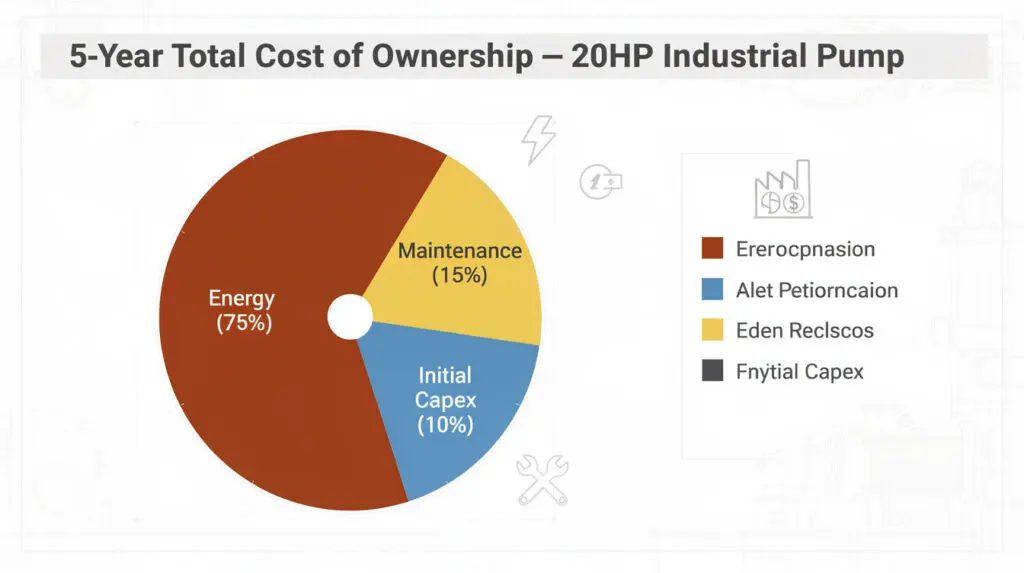
Over my 22 years at Chintan Engineers, designing fluid transfer and flow measurement systems from ONGC refineries to chemical plants in Vapi, I have seen hundreds of cheap pumps fail. When you evaluate the industrial stainless steel pump cost, the Capex on the purchase order represents less than 15% of what that equipment will actually cost your plant over its lifecycle.
I’ve calibrated enough metering systems to know that a pulsating, cavitating flow from a degraded cast-iron pump will destroy the accuracy of your downstream instrumentation. If you want to meet OIML R117 standards or comply with Legal Metrology Act requirements for batching, your fluid delivery must be flawless. That starts with the right pump.
Here is the unvarnished engineering truth about the real cost of owning and operating stainless steel centrifugal and monoblock pumps in the Indian industrial context, backed by actual field data and BIS standards.
In This Article
- The Anatomy of Total Cost of Ownership (TCO)
- Energy Efficiency: The Hidden Rs. 4.8 Lakh Penalty
- Mechanical Seals and the True Centrifugal Pump Maintenance Cost
- Corrosion, Metallurgy, and Production Uptime
- System Sizing and Performance Specifications
- Integration with Dispensing and Skids
- Installation & Maintenance: Field Lessons from 22 Years
- Frequently Asked Questions
- Summary
- My Recommendation
The Anatomy of Total Cost of Ownership (TCO)
To understand true costs, we must stop looking at vendor quotes and start looking at the lifetime utility of the equipment. A standard 5-year TCO calculation for an industrial pump consists of three main pillars:
- Initial Procurement (Capex): The base price, baseplate, coupling, and motor.
- Energy Consumption (Opex): The electricity required to overcome system head and internal hydraulic friction.
- Maintenance & Downtime (Opex): Mechanical seal replacements, bearing lubrication, corrosion mitigation, and the staggering cost of lost production during unexpected failures.
I want to show you exactly how specifying the right stainless steel pump fundamentally alters these numbers.
Need help selecting the right SS Pumps?
Our engineering team can match the exact configuration to your operational requirements.
Energy Efficiency: The Hidden Rs. 4.8 Lakh Penalty
The largest component of your pump’s lifecycle cost is energy. In India, industrial power tariffs hover around Rs. 8 per kWh.
Consider our standard Chintan CE Series 15 kW (20 HP) pump running 8,000 hours a year. It consumes 120,000 kWh annually. Over five years, that is Rs. 48,00,000 spent purely on electricity.
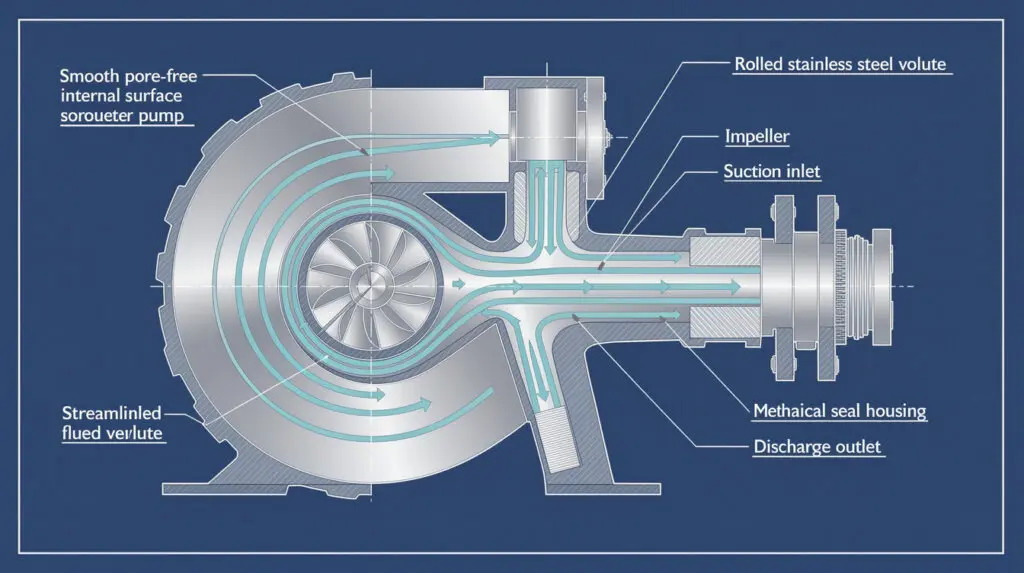
This is exactly where SS monoblock pump efficiency flips the financial math. Standard cast iron pumps rely on sand-cast volutes. No matter how well they are machined, sand casting leaves microscopic pitting and surface roughness. This roughness creates boundary layer turbulence, which increases hydraulic friction.
Our CE Series SS Pumps are manufactured using rolled stainless steel construction. This results in a pore-free, non-pitting surface with a dramatically lower coefficient of friction.
(I have personally audited fluid lines where swapping a pitted cast iron pump for a rolled SS-316 pump increased hydraulic efficiency by 4% to 6%. On a Rs. 48 lakh energy bill, a 5% savings puts Rs. 2.4 lakhs back in your pocket—often completely covering the initial purchase price of the SS pump.)
Impact on Downstream Flow Measurement
But energy efficiency isn’t just about lowering your power bill—it’s about hydraulic stability. A highly efficient, smooth-volute pump delivers laminar flow. If you are feeding a precision meter—and I explain this dynamic heavily in our Fuel Flow Meter Specification Guide: PD vs Turbine—laminar flow is non-negotiable. Cavitation or micro-pulsations from an inefficient pump will cause calibration drift, meaning you give away free product or short-change your process batching.
Mechanical Seals and the True Centrifugal Pump Maintenance Cost
If there is a weak link in any centrifugal pump, it is the shaft seal. In my experience, 70% of all pump failures in Gujarat’s GIDC industrial estates stem from mechanical seal failure, directly driven by our harsh operating environments: heavy monsoon humidity, 45°C+ summer ambient temperatures, and pervasive industrial dust.
When calculating centrifugal pump maintenance cost, you must factor in the labor and downtime required for seal replacement. (I’ve seen plants try to save a few thousand rupees on unbranded seals, only to lose lakhs in downtime later. It’s madness.)
I have watched maintenance crews spend six to eight hours dismantling heavily rusted pipe arrays just to access the wet end of a standard pump. During those eight hours, a dairy processing plant or chemical batching line is completely halted. The Rs. 3,500 seal replacement just cost the company Rs. 5 lakhs in lost production.
The Back Pull-Out (BPO) Advantage
This exact scenario is why we heavily advocate for the Chintan CE Backpullout Pump BPO Series.
- Capacity: Up to 990 m3/hr
- Head: Up to 120 meters
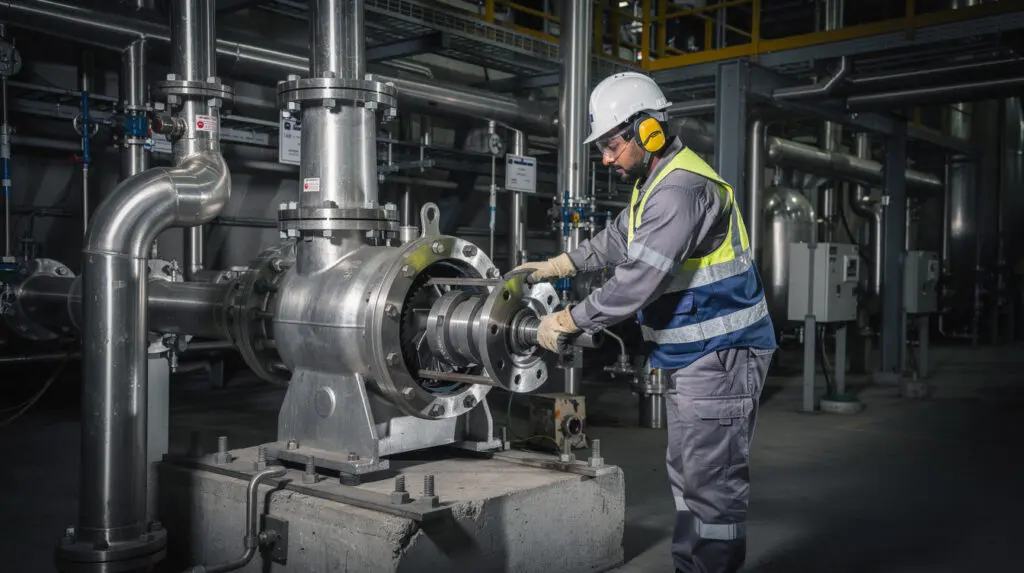
- Design: Back pull-out construction allows the entire rotating assembly (impeller, shaft, seal, and bearing housing) to be withdrawn without disturbing the suction and delivery piping or the pump casing.
With a BPO design, a two-man crew can swap a mechanical seal in under 45 minutes. When you project this over a 5-year lifecycle with scheduled maintenance intervals, the reduction in labor hours and production downtime drastically offsets the marginal premium on the initial procurement cost.
Need help selecting the right SS Pumps?
Our engineering team can match the exact configuration to your operational requirements.
Corrosion, Metallurgy, and Production Uptime
Many procurement managers ask me, “Vikram, why should we pay the premium for SS-316 when SS-304 is cheaper?”
The answer comes down to the Pitting Resistance Equivalent Number (PREN) and the specific chemical makeup of your process fluid. SS-304 contains 18% chromium and 8% nickel. It is excellent for RO water, dairy processing, and mild chemicals. However, if your fluid contains chlorides (saltwater, certain CIP chemicals, or brine solutions), SS-304 is susceptible to localized pitting and crevice corrosion.
SS-316 adds 2-3% molybdenum to the alloy matrix. This drastically increases its resistance to chloride attack.
If you are pumping pharmaceuticals, dairy chemicals, or handling cooling tower water supply, specifying the correct M.O.C. (Material of Construction) prevents catastrophic mid-batch failures. A single contamination event in a pharmaceutical batch due to a corroded pump casing can cost crores.
Our CE Series pumps offer modular construction with high interchangeability, available in SS-304, SS-316, and specialized bronze or cast steel options, ensuring compliance with strict hygiene and safety standards.
System Sizing and Performance Specifications
An oversized pump operates far from its Best Efficiency Point (BEP), wasting energy, inducing destructive vibration, and prematurely ruining bearings. An undersized pump will fail to deliver the necessary NPSHr (Net Positive Suction Head required), leading to cavitation.
When sizing an SS pump for your operation, compare your system curve against these true operating data points from our CE and BPO series:
CE Series SS Monoblock Pump Data:
- Head: Up to 60 Mtr.
- Capacity: Up to 120 M3/hr
- Discharge Size: 25 mm to 100 mm
- Power Rating: 1.0 HP to 20 HP (Three Phase) / 0.5 HP to 2.0 HP (Single Phase)
- Voltage Range: 380 V to 415 V (Three Phase) / 200 V to 240 V (Single Phase)
- Speed: Up to 2880 RPM
- Viscosity Handling: Up to 1500 centipoise
BPO Series Backpullout Pump Data:
- Delivery Size: Up to 250 mm
- Capacity: Up to 990 m3/hr
- Head: Up to 120 meters
- Speed: 500 to 3600 RPM
- Working Pressure: Designed for 16 bar (optional casing for up to 20 bar)
(Note on Indian Context: Notice our specified voltage range of 380 V to 415 V. Standard European pumps assume a clean 400V supply. We engineer for the harsh reality of grid fluctuations in Indian industrial zones. Motors wound strictly for 400V will overheat and degrade insulation during a 380V brownout. We design for the reality of the field, not just the laboratory.)
Integration with Dispensing and Skids
Pumps don’t operate in a vacuum. They are the beating heart of your fluid transfer skids and mobile bowsers. If you are constructing a mobile fuel delivery vehicle, the pump’s weight, vibration footprint, and power draw are critical.
For engineers outfitting fleet refueling operations, the compact nature of our SS monoblock pumps pairs flawlessly with mobile setups. You can see how tight the integration tolerances must be by reviewing our Mobile Fuel Dispenser Specs: Bowser Flow Meters & Pumps.
And if you’re transferring diesel from underground tanks to heavy machinery, your pump selection directly dictates your dispenser’s throughput. A mismatch here leads to slow fill times and long queues at the depot. I break down these exact throughput requirements in our Diesel Dispenser Specs: Flow Rates & Accuracy guide.
Installation & Maintenance: Field Lessons from 22 Years
Even a meticulously machined SS pump will destroy itself if installed poorly. Based on decades of commissioning flow systems, here are my non-negotiable rules for pump installation:
- Baseplate Rigidity: A monoblock pump naturally eliminates coupling alignment issues, which is a massive advantage. However, for bare-shaft BPO pumps, your baseplate must be grouted properly. Micro-vibrations from poor grouting will transmit through the volute and shatter mechanical seal faces within months.
- Suction Piping: The straight run of pipe entering the pump suction must be at least 5 to 10 times the pipe diameter. I see contractors put a 90-degree elbow right at the suction flange to save space. This guarantees turbulent, uneven flow into the impeller eye, causing localized cavitation and rapid wear.
- VFD Integration: To maximize SS monoblock pump efficiency, pair the pump with a Variable Frequency Drive (VFD). However, ensure the motor is VFD-rated (inverter duty). Running a standard motor at 30 Hz will reduce its cooling fan speed, causing thermal breakdown of the windings during hot Indian summers.
Frequently Asked Questions
What is the average SS pump price in India for industrial applications?
The price varies heavily based on capacity and material (SS-304 vs SS-316). A standard 5 HP SS-304 monoblock pump may range from Rs. 25,000 to Rs. 45,000, while larger 20 HP BPO series pumps in SS-316 can exceed Rs. 1.5 lakhs. However, always calculate the TCO; a cheaper pump often costs 5x its price in energy waste over 5 years.
Why is the centrifugal pump maintenance cost lower for a BPO (Back Pull-Out) design?
A BPO design allows maintenance teams to remove the impeller, shaft, and mechanical seal without disconnecting the heavy suction and discharge piping or removing the pump casing from its foundation. This reduces maintenance labor time by up to 80% and drastically cuts production downtime.
Does SS monoblock pump efficiency really impact my electricity bill?
It certainly does. Rolled stainless steel provides a pore-free, hyper-smooth internal surface unlike rough cast iron. This directly reduces hydraulic friction. A 5% efficiency gain on a pump running 24/7 can save hundreds of thousands of rupees in electricity costs annually.
Can a Chintan SS pump handle viscous fluids like syrups or pharmaceutical gels?
Yes, our CE Series SS pumps are engineered to handle viscosities up to 1500 centipoise. They are widely used in the sugar, confectionery, and pharmaceutical industries where positive displacement isn’t strictly required but robust viscosity handling is.
What causes mechanical seals to fail prematurely in SS pumps?
The primary culprits are dry running (loss of prime), severe vibration due to poor baseplate grouting, and thermal shock. Additionally, choosing the wrong seal face material (e.g., carbon vs silicon carbide) for abrasive fluids will cause rapid degradation.
Are these pumps suitable for Legal Metrology batching systems?
Yes. Because of their stable, pulsation-free delivery, our SS pumps provide the laminar flow required by high-precision flow meters to maintain accuracies of ±0.1%, ensuring compliance with OIML R117 and Indian Legal Metrology standards.
Summary
The modern industrial sector has zero margin for operational inefficiencies. If you are evaluating the industrial stainless steel pump cost, you must elevate your perspective from Capex to TCO.
By specifying rolled stainless steel construction, you eliminate the hydraulic drag of cast iron, directly cutting your energy bills. By utilizing Back Pull-Out (BPO) architectures, you slash maintenance downtime from hours to minutes. And by matching the pump’s voltage ratings to the reality of the Indian power grid (380V-415V), you prevent catastrophic motor burnouts.
My Recommendation
Based on 22 years of field data, here is what I recommend for your operation:
If you are pumping clear water, chemicals, or pharmaceutical fluids up to 1500 centipoise, and require heads up to 60 meters, specify the Chintan CE Series SS Monoblock Pump. The pore-free rolled SS construction will pay for itself in energy savings within 18 months.
If you are running continuous-duty process lines, fire fighting systems, or heavy chemical transfer handling up to 990 m3/hr, you must deploy the Chintan CE Backpullout Pump BPO Series. The maintenance labor savings of the back pull-out design makes it the only mathematically sound choice for high-uptime environments.
Stop buying pumps based on quotes. Start buying them based on math. Contact our engineering team at Chintan Engineers to run a custom sizing and TCO calculation for your specific process line today.
Products Mentioned in This Article:
- SS Pumps — View full specifications and request a quote
Ready to discuss your requirements?
Contact our engineering team with your specifications. We’ll provide a detailed configuration recommendation.
