
















In This Article:
- The Metrology Mandate: Standards and True Accuracy
- Deconstructing Flow Meter Technologies
- Interpreting Core Specifications for Industrial Liquids
- Environmental Reality Checks for Indian Plants
- Installation and Maintenance Imperatives
- Smart Data Integration and Custody Transfer
- Frequently Asked Questions
- The Bottom Line
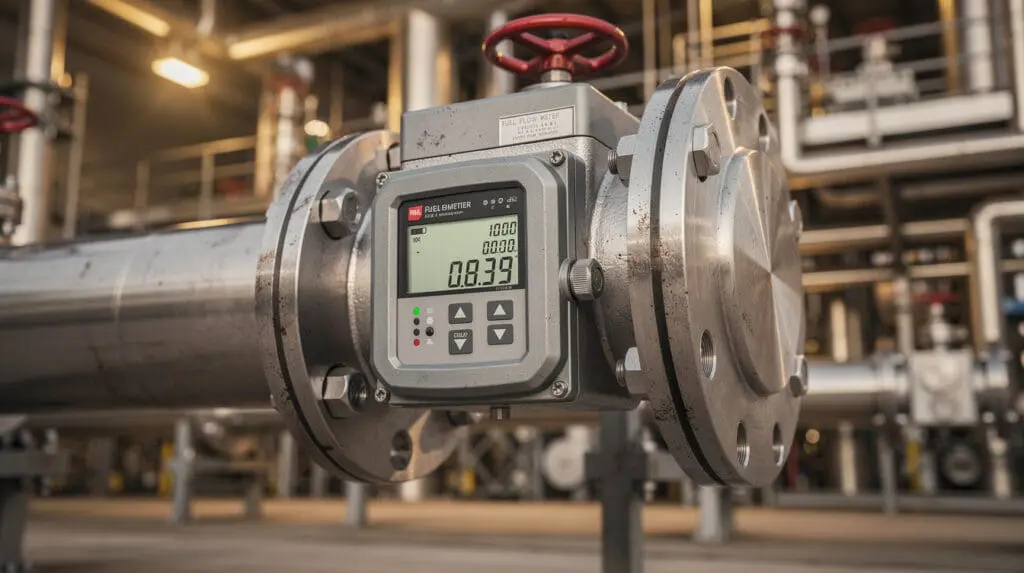
A 0.5% calibration drift on an 8,000-liter-per-day industrial fuel throughput doesn’t just look sloppy on a monthly audit—it quietly siphons ₹1.08 lakh per month from your operating budget in untracked diesel. Over a year, that is nearly ₹13 lakh of raw fuel cost vanishing into the atmosphere.
I am Vikram Desai, Senior Flow Measurement Engineer at Chintan Engineers. Over the past 22 years, I have designed, installed, and calibrated over 5,000 flow measurement systems—from high-pressure ONGC refinery nodes to gravity-fed fleet depots in rural Gujarat. When procurement managers ask me why they should invest in a ±0.2% positive displacement meter over a standard ±0.5% commercial unit, I show them that exact calculation.
In industrial flow measurement, “good enough” is an expensive illusion. To achieve true fluid accountability, plant engineers must look past basic flow rates and understand the intricate physics of viscosity tolerances, pressure drops, and metrological compliance. Are you relying on generic spec sheets to secure your plant’s fuel? If so, it’s time to dig deeper.
In This Article
- The Metrology Mandate: Standards and True Accuracy
- Deconstructing Flow Meter Technologies
- Interpreting Core Specifications for Industrial Liquids
- Environmental Reality Checks for Indian Plants
- Installation and Maintenance Imperatives
- Smart Data Integration and Custody Transfer
- Frequently Asked Questions
- The Bottom Line
The Metrology Mandate: Standards and True Accuracy
Before we even look at a flow meter catalog, I always start with the legal and standard frameworks governing liquid measurement. In India, bulk fuel transfer and dispensing fall under the purview of the Legal Metrology Act, adhering to standards like IS 14883 for measuring systems for liquids other than water, which harmonizes with OIML R117 globally.
Accuracy is not a static number; it is a curve influenced by flow rate and fluid viscosity.
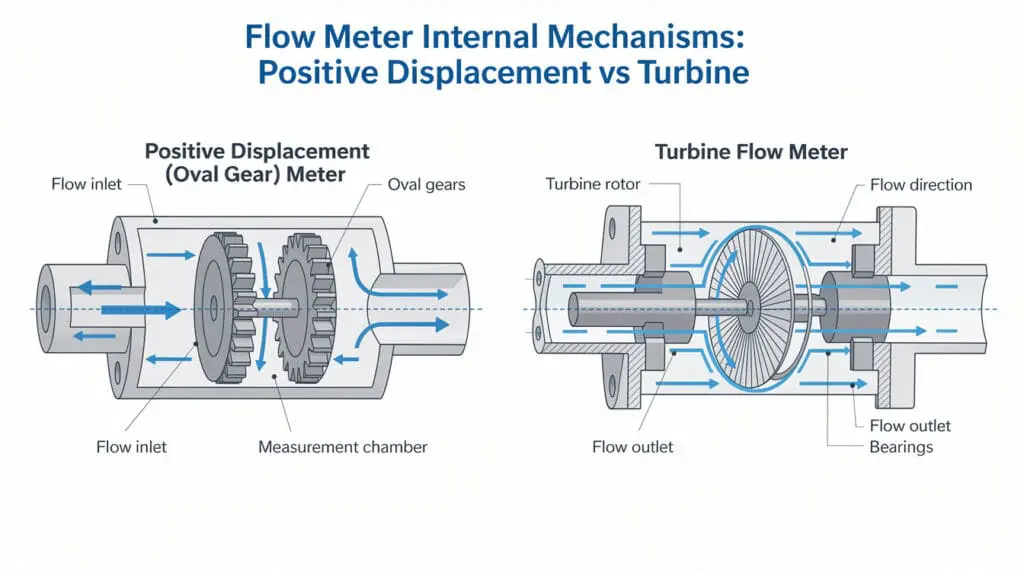
When you see a meter rated for ±0.5% standard accuracy, this implies that across its optimal turndown ratio (often 10:1), the maximum permissible error will not exceed 0.5% of the measured volume. For high-volume transfer, ±0.5% is often inadequate. This is exactly why my team frequently specifies systems with a micro-machined positive displacement (PD) metering block and external calibrator adjustments—such as the CE-113 High Accuracy Transfer Meter or the CE-106 High Accuracy Digital Flow Meter. These specialized units tighten the error margin to a highly reliable ±0.2%.
To put that in perspective: On a 20,000-liter tanker decantation, a ±0.5% meter allows a 100-liter discrepancy. A ±0.2% custody-transfer build reduces that uncertainty to just 40 liters. At current diesel prices, the tighter tolerance pays for the meter upgrade in fewer than 15 decantations.
Need help selecting the right Fuel Flow Meter?
Our engineering team can match the exact configuration to your operational requirements.
Deconstructing Flow Meter Technologies
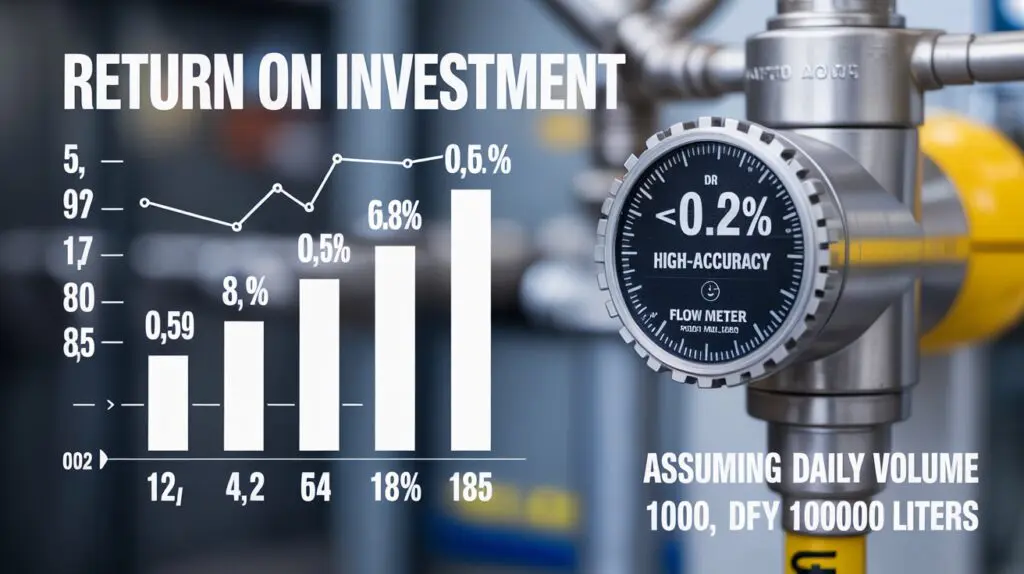
Plant engineers frequently ask me to simplify the positive displacement vs turbine liquid batching system debate. I usually tell them: don’t chase the cheapest option, chase the correct physics. The reality is that the core technology dictates the specification limits.
Turbine Measurement (Kinetic Energy)
Turbine meters, like the CE-210 Turbine/Helical Sensor, calculate flow by measuring the rotational speed of a bladed rotor positioned in the fluid stream. The flowing liquid imparts kinetic energy to the rotor, and a magnetic pickup counts the blade passes, converting them into a pulse output (K-factor).
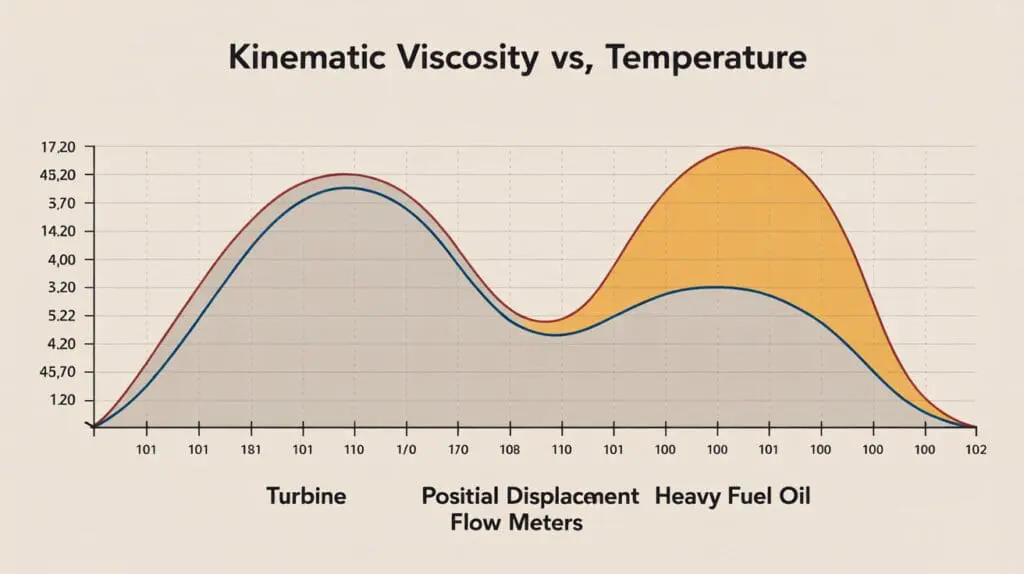
I have recalibrated enough turbine meters in Vapi chemical plants to know they do not belong anywhere near high-viscosity furnace oils. And I’ll tell you exactly why: As viscosity increases, fluid drag slows the rotor, causing severe under-registration. Turbine meters are exclusively for low-viscosity fuels like diesel, kerosene, and light solvents where kinematic viscosity remains under 10 mm²/s.
Positive Displacement (Volumetric)
Positive displacement meters measure volumetric flow directly by dividing the liquid into distinct, measurable packets. Whether using oval gears, helical rotors, or reciprocating pistons (like the CE-212 Piston PD Meter), the fluid physically forces the internal components to rotate.
Because PD meters rely on tight mechanical clearances rather than fluid velocity, they offer distinct advantages for industrial plant operations:
- Viscosity Independence: They handle fluid changes gracefully. A PD meter calibrated on light diesel remains highly accurate even if tasked with measuring a thicker lubricant.
- Zero Straight-Run Requirements: Unlike turbines that require flow conditioning (typically 10x pipe diameters upstream and 5x downstream), PD meters can be bolted directly after a 90-degree elbow without losing accuracy. This is a massive spatial advantage in cramped pump rooms.
Interpreting Core Specifications for Industrial Liquids
When evaluating diesel dispenser specifications, procurement teams must cross-reference several interdependent variables. I never just look at the top-line numbers; here is exactly how I read a flow meter catalog:
1. Flow Coverage and Turndown Ratio
A meter’s flow range is critical. Operating a meter below its minimum flow rate allows fluid to slip past the measuring elements uncounted (slippage). Operating above the maximum rate destroys the bearings through excessive rotational speed and causes an unacceptable pressure drop (ΔP).
Take a standard unit like the CE-110 Mechanical Flow Meter, which is rated for 20 to 300 L/min. If you install it on a gravity-fed 1/2-inch line producing only 8 L/min, the gears will barely turn, and the accuracy will plummet from ±0.5% to worse than ±3.0%. For ultra-low flow rates, a specialized model like the CE-210 Turbine (handling as low as 5 L/h) or the CE-212 Piston PD is mandatory.
2. Viscosity Window and Pressure Drop
Kinematic viscosity (measured in centistokes, cSt, or mm²/s) drastically impacts pressure drop. The CE-series positive displacement meters can handle viscosities ranging from 1 mm²/s (petrol) up to 10⁶ mm²/s (heavy lubricants), depending on the specific model and gear clearance.
However, forcing 300 cSt gear oil through a 1-inch PD meter at maximum flow rate will generate a massive pressure drop, potentially starving the downstream pump and causing cavitation. Always check the ΔP curves in the technical documentation before specifying the meter size.
3. Construction Materials and Seals
Fuel chemistry dictates metallurgy. A robust meter like the CE-106 utilizes an aluminum body with Viton seals, rated for a maximum pressure of 10 BAR and temperatures up to 80°C. For standard diesel and biodiesel blends, aluminum and Viton or Buna-N are standard. If you are measuring corrosive additives or high-temperature fluids, stainless steel bodies (available in our Smart Flow Meter range) and specialized elastomeric seals are non-negotiable.
Multi-Factor Technology Comparison
Based on 22 years of field installations, here is the performance matrix I use for sizing:
| Model Series | Core Technology | Optimal Flow Range | Maximum Accuracy | Viscosity Tolerance | Output/Display | Primary Industrial Application |
|---|---|---|---|---|---|---|
| CE-110 | Mechanical PD | 20 – 300 L/min | ±0.5% | Medium to High | Mechanical Register | Rugged truck depots, no-power zones |
| CE-106 | Digital PD | Model Dependent | ±0.2% | Medium | LCD + Pulse | High-accuracy engine consumption monitoring |
| CE-113 | Transfer PD | 25 – 1300 L/min | ±0.2% | Low to High | Printer / Pulser | Custody transfer, bulk loading gantries |
| CE-210 | Turbine Sensor | 5 – 10,000 L/h | ±0.5% | Low (< 10 cSt) | 4–20 mA, Pulse | PLC integration, chemical dosing |
| CE-212 | 4-Piston PD | 5 – 60 L/min | ±0.2% | Low to Medium | Pulse / Mechanical | Dispensers, tight-tolerance batching |
Need help selecting the right Fuel Flow Meter?
Our engineering team can match the exact configuration to your operational requirements.
Environmental Reality Checks for Indian Plants
Specifying a positive displacement flow meter accuracy rating on paper is easy. Maintaining that accuracy during an Indian monsoon inside a dusty GIDC industrial estate? That is where real engineering matters.
Humidity and Condensation
In coastal areas like Dahej or high-humidity zones during the monsoon, temperature swings cause severe condensation inside standard mechanical registers. This fogs the display and rusts internal totalizer springs. For these environments, I strongly specify IP65-rated digital models like the CE-111 Digital Flow Meter or hermetically sealed mechanical counters with silica gel breathers.
Voltage Fluctuations and Data Loss
Industrial grid power is rarely clean. Voltage sags and spikes will reset poorly designed electronics, wiping out batch totals mid-transfer. Professional digital models utilize battery-backed non-volatile memory (EEPROM) to ensure cumulative totals and current batch data survive hard power failures. Our Smart Flow Meter setups can even log up to 500 records directly to a USB pen drive in text format, completely bypassing SCADA downtime.
Particulate Ingress (Dust and Rust)
Indian supply chains involve multiple transfer points, meaning the diesel arriving at your plant is often loaded with pipe scale, rust, and particulate matter. Because PD meters operate on micro-clearances, a 50-micron piece of weld slag can jam an oval gear instantly.
Installation and Maintenance Imperatives
A premium digital fuel flow meter will perform like a cheap water meter if installed incorrectly. Over the years, I’ve seen countless expensive meters ruined by bad piping. My team mandates the following protocol for every deployment:
- Mandatory Upstream Protection: You must install a Y-strainer or basket strainer immediately upstream of any PD meter. We specify a 100-mesh (150-micron) screen for diesel and a 40-mesh for heavier oils.
- Air Elimination: A flow meter cannot distinguish between a liter of fluid and a liter of air. If your system draws from an underground tank or pumps frequently run dry, an air eliminator vessel must be installed before the meter to vent entrained gases. Custody-transfer builds like the CE-113 integrate this by default.
- Proving and K-Factor Calibration: Never trust factory calibration as an absolute constant once installed. Fluid density, local piping geometry, and pump vibration shift the curve. Commission the meter using a calibrated prover can (volumetric standard), run three separate batches, and calculate the average error. Adjust the mechanical calibration wheel or update the K-factor in the digital preset until the unit falls within the required ±0.2% or ±0.5% window.
For ongoing reliability, establish a rigorous fuel dispenser preventive maintenance schedule that includes quarterly strainer cleaning and bi-annual volumetric proving.
Smart Data Integration and Custody Transfer
The era of manually recording flow totals on a clipboard is over—or at least, it should be. Today’s procurement demands verifiable accountability.
If you require basic PLC integration, look for meters offering a dual-channel Hall Effect pulse output or a standard 4–20 mA analog signal (like the CE-210 Turbine). This allows remote monitoring systems to log flow rates into an ERP system in real-time.
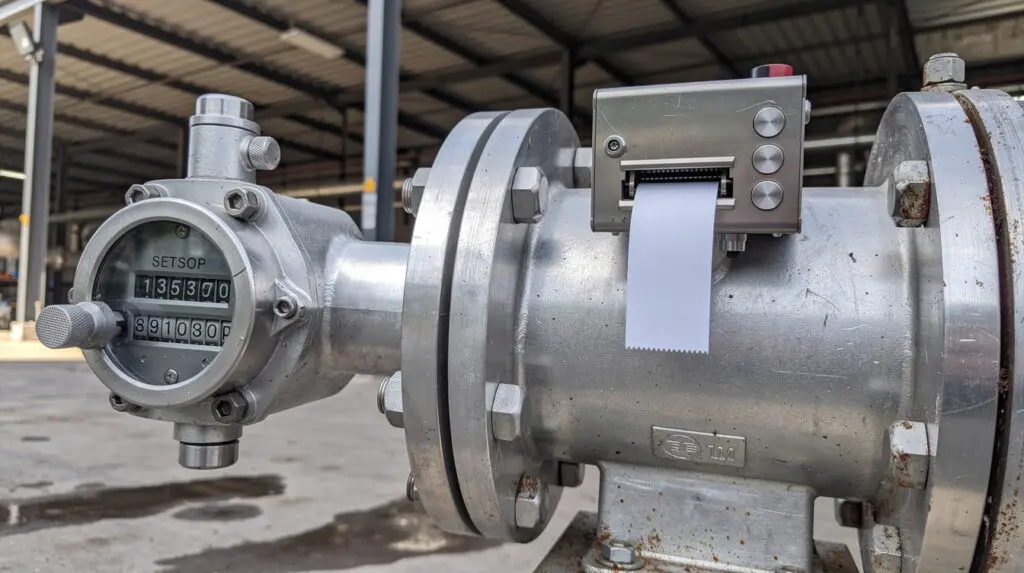
For true custody transfer, localized proof is required. A localized Smart Flow Meter allows users to configure the fuel rate and print a hardcopy receipt on a button press, while the CE-113 combined with a Setstop counter and mechanical printer creates a robust, tamper-evident ticketing system right at the loading gantry. When you hand a truck driver a time-stamped, mechanically printed volume ticket, disputes regarding short-loading vanish instantly.
Frequently Asked Questions
Can positive displacement meters handle blended fuels or biodiesel?
Yes, absolutely. However, you must specify the correct elastomer seals. Biodiesel (B20 to B100) will aggressively degrade standard Buna-N (Nitrile) rubber over time. I always engineer our CE-106 and CE-115 meters with Viton (FKM) seals specifically to withstand biodiesel, ethanol blends, and harsh chemical additives.
What causes a flow meter’s accuracy to drift over time?
I get this question constantly. In PD meters, accuracy drift is almost entirely caused by mechanical wear on the gear lobes or piston seals, usually accelerated by abrasive particles in unfiltered fuel. In turbine meters, bearing wear or residue buildup on the rotor blades changes the K-factor. Regular proving and strict filtration prevent premature drift.
Why does my meter read accurately at 100 L/min but under-register at 10 L/min?
This is classic fluid slippage. At lower flow rates, the fluid pressure drops, and the internal friction of the meter causes a small amount of fluid to bypass the gears without turning them. If your process requires high accuracy at 10 L/min, your meter is oversized. You should transition to a smaller volumetric displacement model like the CE-212 Piston PD.
What is the maximum operating pressure and temperature for standard industrial flow meters?
Our heavy-duty aluminum units like the CE-106 handle up to 10 BAR (145 PSI) of pressure and operating temperatures up to 80°C safely. If your process exceeds these parameters, we custom-specify cast iron or stainless steel metering blocks.
Do you require a straight pipe run for oval gear PD meters?
No. This is the greatest structural advantage of positive displacement technology. Because they divide fluid volumetrically rather than measuring velocity profiles, they are immune to flow turbulence. You can mount a valve or an elbow immediately before the meter inlet without degrading accuracy.
The Bottom Line
Choosing an industrial fuel flow meter is an exercise in risk management, not just pipe-fitting. When you buy a cheaper meter, you aren’t saving money; you are simply shifting the cost from the capital expenditure budget to a permanent, monthly operating loss disguised as “unaccounted fuel.”
Based on 22 years of field data, here is what I recommend for your operation: If you are measuring standard diesel at steady flow rates for basic accountability, deploy the rugged CE-110 or CE-111 series. However, if you are performing custody transfer, decanting tankers, or feeding critical engine test beds where every drop translates to rupees, specify the CE-113 High Accuracy Transfer Meter or the CE-106 with its ±0.2% micro-accuracy.
Protect it with a 100-mesh strainer, install an air eliminator, and prove it volumetrically twice a year. That is how you turn a plumbing fitting into a financial instrument.
Require a site-specific flow study for your depot or processing plant? Reach out to the technical team at Chintan Engineers to discuss your exact viscosity, pressure, and integration parameters.
Products Mentioned in This Article:
- Fuel Flow Meter — View full specifications and request a quote
Ready to discuss your requirements?
Contact our engineering team with your specifications. We’ll provide a detailed configuration recommendation.
